
Feeds:
Posts
Comments

tumblr_n9z91ls6xO1r7gbhio1_500When I saw this graphic — posted on an Internet atheism community — the first thing I did was look up the definition of cult. Here’s part of what Dictionary.com says:

1. A system of religious worship, especially with reference to its rites and ceremonies.
2. An instance of veneration of a person, ideal, or thing.
3. A group or sect bound together by veneration of the same thing, person, ideal, etc.
4. A religion or sect considered to be false, unorthodox, or extremist, with members often living outside of conventional society under the direction of a charismatic leader.

Does Christianity fit all that? I’m sure some folks would shout YES! Let me beg to differ. As far as I’m concerned “religion” is a set of behavioral rules designed to fit people into little slots and let others pass judgement on them. I would not be a follower of Jesus Of Nazareth (who many people believe is the Son of God) if that’s what Christianity is about.

It’s hardly a surprise to write that serious Jesus followers venerate Jesus. Nor is it a shock to write that serious Jesus followers are a group bound together by veneration of Jesus.

But by those definitions, “Beliebers” (fans of pop star Justin Bieber) and “Swifties” (Taylor Swift fans) could be labelled cults, complete with all the onerous attributes that most of us associate with that term.

So what happens when anyone leaves any group? Most of the time, it would be questioned, dissected and judged. Indeed, if it weren’t, then the members of the group clearly don’t care about the person leaving.

Serious believers understand that following Jesus means:

  • Having a lighthouse to guide us through life’s nastiest emotional, financial and physical storms.
  • Knowing that we are loved — loved so much that God offers all humanity the gift of His Son, whose sacrificial death makes up for all the wrong things we’ve done and all the right things we’ve failed to do.
  • Having the assurance we will spend all of eternity in the intimate presence of our Creator.
  • When someone leaves all that, should we do nothing but shrug? That’s not respectful; that’s telling them they don’t matter to us or to Jesus. And that would be very wrong.

Does that mean we would stage “interventions” or prevent them from leaving like the inmates of Jonestown, the horrific cult that Jim Jones established in South America in the 1970s? That cult ended in 1978 when, on Jones’ orders, more than 900 people drank cyanide-laced punch and died.

I think even the angriest opponents of Christianity would admit that’s not what following Jesus is all about.

What wise Jesus followers do when someone decides to leave is to remain friends with them, pray for them and welcome spiritual conversations.

Not all Jesus followers are that wise, of course. But I think it’s safe to write that following Jesus has nothing to do with any credible definition of “cult”. It has to do with Jesus’s explanation for why He came to this earth: “I came to give life—life that is full and good.”

Do you want this life? Yes or no, post your thoughts below and let’s have a conversation.
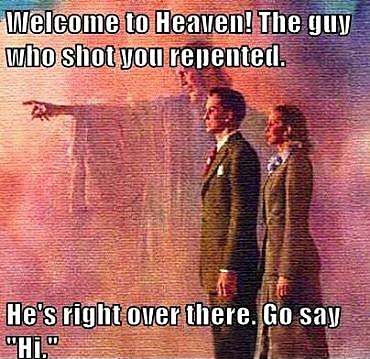
repentedIs this offensive to you? The entire notion was certainly offensive to the person who posted the graphic on an atheist Internet community.

And I get it. We grow up learning concepts like “An eye for an eye, and a tooth for a tooth”. As kids we often hotly tell our parents “that’s not fair!!”. And as parents, we endlessly, sometimes obsessively, strive to treat our children with fairness.

So when people hear about others who seem to get away with murder, they rightfully scream and holler in protest. Like I said, I get that.

But consider the approach of Jesus of Nazareth, who many people believe is the Son of God. In one of the four original-source accounts of His life on earth, He says this to anyone willing to listen:

You have heard that it was said, ‘An eye for an eye, and a tooth for a tooth.’ But I tell you, don’t fight back against someone who wants to do harm to you. If they hit you on the right cheek, let them hit the other cheek, too.

This is radical. This is upside down to how our culture thinks. In fact, for some people (such as the person who posted the graphic above), this is downright ludicrous.

Is it really?

If you believe there is a Heaven, don’t you want it to be far, FAR better than this world? Don’t you want it to be free of anger, resentment, jealousy, rage, greed, violence and ignorance?

If you do, then what about forgiveness? Don’t you want Heaven to be saturated — heck, OVERFLOWING — with forgiveness?

If you’re still with me, then a Heaven that is free of our human weaknesses and welcoming to all will absolutely include killers and their victims. In both cases, these people will have repented of their sins (however big or small we might consider them to be) and been utterly, utterly transformed through faith in what Jesus did for them.

What did He do? For those who have sincerely accepted the gift of Jesus, He allowed Himself to be sacrificed on a cross to make up for all (and I mean ALL) the bad things we’ve done and the good things we’ve failed to do.

For those who seriously accepted the gift of Jesus, God looks at us and DOESN’T see murder or greed or theft or fraud or lying or betrayal or self-centredness. He sees only the perfection of His Son.

So when the murder victims depicted in the graphic above get to Heaven and are directed to the person who shot them, they will ABSOLUTELY go over and do more than say “Hi”. They’ll hug that person with overflowing love.

And that person, utterly transformed by following Jesus, will absolutely hug those people right back. It will be a time of joy, of tears, of praise for their creator who wiped away every moment of fear, anguish, pain and sadness and replaced them with praise and gratefulness.

That’s a place I want to go. That’s a place I want YOU to go, so we can hug, high-five each other and spend eternity with our creator. Are you in? Yes or no, post your thoughts below and let’s have a conversation.

mysteriousHave you ever encountered people of faith who think this way? Sadly, I have. I wouldn’t be surprised if they turned you off of considering a life of faith.

The frustrating thing is, many people of faith have not bothered to ask honest questions. Instead, if there are things they don’t understand, those things are just buried deep inside of them. And in turn, they want others to bury their questions, too.

And yet, the history is rife with people of faith asking God hard questions. Here are just a few from ancient writers:

  • My God, why did you dump me miles from nowhere?
  • Sometimes I ask God, ‘why did you let me down?’
  • I counted on you, God. Why did you walk out on me?

Probably the most amazing and poignant hard question for God came from the lips of Jesus of Nazareth, who many people believe is God’s son. When Jesus’s enemies succeeded in having Him put to death on trumped-up charges, one of His last statements (as He hung on a Roman cross) was this anguished cry: “My God, my God, why have you abandoned me?”

Call me crazy, but I think if Jesus can ask a question like that, then so can His followers — or any other person, for that matter.

I showed the meme that inspired this essay to a pastor friend. Here is Ross Carkner’s thoughtful response:

God is not afraid of our hard questions, but I can’t say that we feel the same way about His answers. I believe we are very afraid of His answers.

The mystery is not so much that God cannot be understood, but why we expect who He is to fit within our own understanding. When we have hard questions, we seem to expect easy and simplified answers.

Part of the deep mystery of God is that His ways are not our ways. If we want to know God, we need courage to set our own understanding aside and trade what has previously been a mystery, for faith in Him.

Since I became a Jesus follower in my 40s, I’ve had hard questions. And they’ve never gone away. But I know enough about God — about what He’s done for me and everyone else willing to accept the gift of His Son — to set those questions aside.

Ross was a big help in this. A few years ago, he had the wisdom to tell me that when I’m through with this life, all those hard questions simply won’t matter. They’ll be utterly irrelevant in the light of eternity in the presence of Jesus.

Do you have hard questions? Are they the reason — or the convenient excuse — you have not truly checked out what a life of faith in Jesus is all about? Yes or no, post your thoughts below and let’s have a conversation.

HSBCWhenever I fly, I always enjoy seeing the unusual HSBC (Hong Kong and Shanghai Banking Corporation) advertisements posted along the walls of the walkway into the plane.

This one struck a nerve. Why? On one hand, the statement is, in the broadest sense, true. Just think about all the changes that have happened in the last 30 years: iPods, internet commerce and media, iPads, “apps” on a “smartphone”, rear view cameras on vehicles, flat-screen TVs, Twitter and Facebook.

Together, these changes have created entirely new business models and changed the way many of us live. I can’t imagine what will happen in the next 30 years, but there are already entire teams of smarter people than me working on technologies and inventions that could make tomorrow “nothing like today”.

On the other hand, I feel quite safe in writing that in even more important ways, tomorrow will be exactly the same as today.

  • Human beings will still want and need love and sometimes do horrible things to get it
  • We will still be insecure and behave quite sadly to get others approval
  • People will still judge others on many ridiculous “criteria”, often without even knowing it.
  • Greed will still haunt us
  • We will still look to other people to bring us happiness and fulfillment — and still be let down many, many times.
  • Our egos will continue to rule over us, often convincing us to do and say ridiculous things.
  • Most human beings will still to be their own worst critics, driving us into depression and stunting our emotional growth.

All the technological, medical, scientific and psychiatric breakthroughs that humanity can ever hope to achieve will not alter those bullet points.

So what will? Let me be quite controversial and absolutely radical when I suggest this: a living, breathing relationship with your creator.

If you’re still with me, consider this: Loving God and having a daily connection to Him through Jesus of Nazareth (who many people believe is God’s son) has the potential to take all these bullet points off the table.

With God, you don’t have to do horrible things to be loved. You already are loved, beyond all measure. And the evidence is this: God offers Jesus  as a gift to you and every other person on this planet. No exceptions. All you have to do is accept the gift.

With God, you don’t have to feel better by judging others or looking to others for happiness. God has already done the judging. And every one of us has fallen short. That means the intrinsic value of a terrorist is exactly the same as that of a Nobel Peace Prize winner.

Furthermore, He spoke these words through an ancient prophet: “I am the Lord, and I don’t change.” That means the things I’ve just written about don’t change. God’s love is the same  yesterday, today and tomorrow. The gift of Jesus is the same yesterday, today and tomorrow. And our falling short of God’s standard is the same for everyone, yesterday, today and tomorrow.

But when you accept the gift of Jesus, declare Him (in complete, sincere seriousness) to be your Saviour, leader and best friend, all the judgement disappears. God sees you as he sees His Son: Perfect in every way and ready to spend eternity in Heaven.

Does this sound attractive? Post your thoughts below and let’s have a conversation.

Religion+is+Slavery+-Robert+G.+Ingersoll-1I’m a person of faith, so what I’m going to write probably won’t make a lick of sense to you. But I’m gonna write it anyway.

1. “Religion” can never reform humanity. Ever.

2. Without a doubt, “religion” is slavery.

Religion is dogma, rules to follow, appearance to keep up, judgements to hand out. It all too often translates into numbing negativity that gives people of faith a bad reputation.

A quick example? You would be amazed at how many religious people spend their Halloweens telling followers of Jesus of Nazareth (who many people believe is the Son of God) how deluded and misguided they are to be “celebrating” what one called a “pagan holiday about death”.

I feel quite safe in writing if I line up 100 North American parents who are taking their six-year-olds out to collect candy and tell them what these religious people said, they would look at me like I’m out of my mind.

Sadly, there are people who become addicted to this kind of thinking. In other words, they become slaves to religion. Some even go so far as to pass judgement on people’s clothes and hairstyles, declaring that today’s men and women look too much alike and it’s “one of the reasons we have this is the epidemic of homosexuality”. Yes, I’m actually quoting from a religious person who wrote this on the Internet.

Frankly, I’m embarrassed by it. And I wouldn’t be surprised if Jesus is embarrassed, too. The original-source documents about His physical life on earth don’t have a single quote from Him about Halloween or about people’s clothing and hairstyles. Not. One. Word.

But in one of those documents, Jesus does have this to say about people in love with religion: “They pile heavy burdens on people’s shoulders and won’t lift a finger to help. Everything they do is just to show off in front of others.”

I’m sure you’re as turned off by all of this as I am. Indeed, if people tried to attract me to Jesus with this kind of thinking, I would have run the other way.

So what attracted me? The prospect of a relationship with the Son of God that starts in this life and extends into eternity. The idea that God loves — yes, LOVES me so much that He offered me an extraordinary gift: Jesus — His life and incredible teachings, His sacrificial death to make up for all the bad things I’ve done and all the good things I’ve failed to do, and His game-changing resurrection.

I wanted this relationship. I wanted to be reformed in a way “religion” never can. And I wanted to be free of the slavery of our culture — the meaningless drive for money, power and prestige, the irrelevant obsession with looking good and earning the praise of judgmental people.

And I have it. By no means am I anywhere within shouting distance of “perfect”. But because I follow Jesus, I’m a better person than before. And I have the assurance of life with Him for all eternity.

Do you find this at all attractive? Yes or no, post your thoughts below and let’s have a conversation.

A MIND UNHIJACKED

Hijacks mindIt’s such a common stereotype that many people accept it without a moment’s thought or investigation: people of faith just don’t think “critically”. For many years, I bought this sales pitch, too.

Only after becoming a follower of Jesus of Nazareth (who many people believe is the Son of God) did I check out the facts. And they left me astounded.

1. Between 1901 and 2000, more than 65 per cent of Nobel prize winners have identified Christianity as their religious preference. That’s according to the book 100 Years of Nobel Prizes.

The Christian Nobel list includes J.J. Thomson in physics, former Liberian president Helen Johnson Sirleaf for the peace prize, Ivan Pavlov in physiology or medicine and Gabriel Garcia Marquez in literature. A little bit of research will reveal that none of these people are brain-dead dolts.

2. In the entertainment world, how about actress Mira Sorvino (who won an Academy Award for Woody Allen’s 1995 move Mighty Aphrodite), Tyler Perry (who, besides his TV and movie acting/directing/screenwriting credits, owns a 200,000-square-foot movie studio) and two-time Oscar-winner Denzel Washington? Can anyone credibly state these people are idiots?

3. Scientists? I’ve already written an entire blog on just a few of the Jesus followers who are doing amazing work in the science world. You can read it here: http://wp.me/p2wzRb-e9

So does “religion” hijack the mind? More often than not, yes. Religion is about following rules, keeping up appearances and judging others. That’s not what serious Jesus followers are all about. We are about having a life-long relationship with Jesus.

In my case, I did all kinds of critical thinking before deciding to follow Jesus at age 41. I read books from a wide variety of perspectives. I debated the basics of Christianity with Jesus followers. I thought long and hard about I’d read, what I’d heard, and how this world has always worked.

That’s not all it took for me to become a man of faith. It took an understanding that God is not the evil ogre that some people make Him out to be. And finally, it took a leap of faith.

A mix of reason, understanding and faith is what it takes to become a Jesus follower.

Maybe that sounds like a lot of work. Maybe you’re shrugging your shoulders and thinking “Meh, I don’t need this. What’s on TV?”

Fine. But if you were satisfied by what our culture insists are the keys to success — money, power, fame, toys, sex, the newest iPad and cruise-ship vacations — would you be reading this blog?

You know there has to be more to life than that. And maybe you’ve even wondered what happens when this life ends. Do you simply become rancid worm food or do you have a soul that lives on? These are important questions. And Jesus has the answers.

Want to know more? Click the ‘links to other sites’ tab at the top of this page or email me at fdking@hotmail.com. I’ll do my best to answer your questions.

plan 10.14It’s something most serious followers of Jesus of Nazareth believe, that God has a plan for each human being who decides to follow Jesus  (who many people believe is God’s son).

For people who have accepted the gift of Jesus, that means seeking God’s will for their lives through carefully reading the original source documents about Jesus’s life, praying (alone and with others) and attending worship services.

Does this mean we’ve got it all figured out — that’s learning God’s plan is simply a matter of following an equation? Not even a little.

One of the things thoughtful Jesus followers take very seriously is the truth that God is God. And we are NOT. God is, in many ways, a mystery. Indeed, God described Himself through one of the ancient prophets, who wrote “I [God] don’t think the way you think. The way you work isn’t the way I work.”

With that in mind, it’s no surprise that figuring out God’s plan is sometimes as easy as decyphering string theory. Frustrating? Sometimes, but careful reading, praying, attending church and consulting knowledgeable, experienced people of faith can make the process easier.

So what about the graphic (found in an atheist internet community) that inspired this essay? Is God’s plan for so many a life of starvation and early death? Absolutely NOT.

Let me go out on a limb and write that in many ways, starvation is humanity’s plan. What am I talking about? Consider this:

  • Corrupt governments in developing nations are often far more interested in spending money on guns than on growing food.
  • Stingy governments — and the citizens they represent — in well-off nations just don’t care about people far away (who should just suck it up and feed themselves, darn it!).
  • Big business, which is beholden to shareholders, usually concentrates on sponsoring local charity runs and local community projects. In other words, helping people in well-off nations who are potential customers and/or shareholders.

All these things are certainly NOT part of God’s plan. Indeed, a case can be made that on a larger scale, the God that Jesus followers believe in makes His plan crystal clear. In one of the original source documents of His life, Jesus tells anyone willing to listen that “Anything you refused to do for any of my people here, you refused to do for me.”

And because God so loved THE WORLD that He gave His only Son (that fact is found in one of the four original source documents of Jesus’ life), that includes everyone who is starving.

You can be part of God’s plan, by welcoming Him into your life so you can learn what He has planned for YOU. Just accept the gift of His Son. And if you’re serious about it, watch as things start to change. For the better.

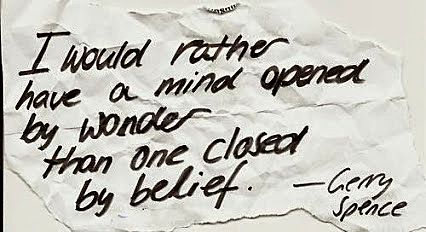
Mind open to belief 10.14The message in this graphic, kindly offered up by an atheist internet community, makes me smile. It’s a common notion in our culture, that people of faith are close-minded.

So stick with me as I advance some notions that might leave you wondering….

I asked questions about the universe; how it began, where did the planets (especially Earth) come from. My mind was open to all kinds of ideas.

After checking them out, reading about them, debating them with other open-minded people, I came to (what is for me and for many others), the logical conclusion: God began the universe. God created the planets.

I asked questions about how Earth seemed so perfect for life to form and thrive. Once again, I read up on the theories and talked to people.

After that, I came to the conclusion, as so many others have, that it was the work of God. No other explanation seems as logical.

My mind pondered the mysteries of human behaviour (and misbehaviour). Why do we act as we do? When and why do we fail to act? How did “right” and “wrong” come about?

I travelled back down the familiar road of reading the various viewpoints, talking to various people and thinking, thinking, thinking. My conclusion? God created right and wrong. God created freewill. And we humans have done many horrifying things with that gift.

What about life after death? My mind, opened by wonder, read all kinds of things about this. Some said it doesn’t exist. Other said it does and explored a myriad of possibilities.

I pondered those possibilities, discussed them and then came to the conclusion that’s shared by millions upon millions of others: after we die, there’s more to come. And what that “more” is depends on us (and how we’ve used the gift of freewill).

I wondered about this dude called Jesus. Did He exist? Was He who he claimed to be? Did He die on a cross as a sacrifice for all the bad things we’ve done and the good things we’ve failed to do? Did He come back to life after three days? Is He still active in our world?

I pondered these questions. Boy, did I ponder. I read articles and books, watched videos and heard church sermons. I had long discussions with people. In other words, I worked  like a miner through this mountain of questions.

In the end, I understood that not all my questions could be answered about Jesus. But enough of them could so that I could easily make the leap of faith and become a follower of Jesus.

When I did that, my life changed for the better. I saw the wonder of God’s creation in a new and glorious light. I saw the wonder of His gift to me (Jesus, offered to every person on this earth, regardless of race/creed/gender/behaviour). I gasped at the wonder of what is to come when this life ends — and how it will be amazing and more, because I accepted the gift of Jesus.

What do you think of this gift? Post your thoughts below and let’s have a conversation.

(P.S. A mind open to wonder means a mind open to belief.)

stupidYears ago, I would have blindly accepted this graphic, which was kindly supplied by an internet atheist community. It’s simple, right? “Religious” people hate science and scientists have no use for “religion”. End of story.

Well, not so fast. First of all, I follow Jesus of Nazareth (who many people believe is the Son of God) but I’m absolutely not “religious” (here’s why:  http://wp.me/p2wzRb-cP). That said, is faith really just for people who are too dumb to figure out science?

Let’s examine the evidence. I went to Wikipedia and found an entry called ‘List of Christian thinkers in science’. The list from the past is looooong, but I skipped that because people opposed to Jesus could claim science simply hadn’t advanced enough for these thinkers to toss God on the trash heap.

I jumped down to the bottom and found more than 60 (that’s correct; sixty) living thinkers in the fields of engineering, physics and astronomy, chemistry and biomedical sciences.

There are likely more, since Wikipedia notes “This list is non-exhaustive and is limited to those scientists whose Christian beliefs or thoughts, in writing or speaking, are relevant to their notability.”

Want a few names? How about:

  • Rosalind Picard, a Professor of Media Arts and Sciences at the renowned Massachusetts Institute of Technology and founder of the Affective Computing Research Group at MIT.
  • Don Page, a Canadian theoretical physicist who focuses on quantum cosmology.
  • Karl Giberson, a Canadian physicist who has published several books on the relationship between science and religion, such as The Language of Science and Faith: Straight Answers to Genuine Questions.
  • Joseph Taylor, an American astrophysicist and Nobel Prize in Physics laureate for his discovery (with Russell Alan Hulse) of a new type of pulsar, a discovery that has opened up new possibilities for the study of gravitation.
  • Ben Carson, an American neurosurgeon. He is credited with being the first surgeon to successfully separate conjoined twins joined at the head.

Is Wikipedia just a patsy for Jesus followers? Just in case someone out there is wondering, I investigated other sources.

The MIT site includes Rosalind Picard and her list of accomplishments is simply astonishing.  Don Page, Ph.D, is part of the physics faculty at the University of Alberta. Karl Giberson has a Ph.D from Rice University. The Nobel Prize website has an entry for 1993 winner Joseph Taylor. And the Academy of Achievement website inducted Dr. Ben Carson along with the likes of conservationist Jane Goodall, economist Milton Friedman and architect Frank Gehry.

All this leads to what I think is an obvious point: You absolutely do not have to be “stupid” to be a person of faith. In fact, I feel quite within my rights to leave you with this question: since following Jesus makes perfect sense to these brilliant people, shouldn’t it be worth your serious consideration? Yes or no, post your thoughts below and let’s have a conversation.
WhenLoveLeadsToLoveHmmm…before my wanderings into atheist internet communities, I’d never heard the notion that loving God means I have less love to give others.

Maybe that’s true for some unfortunate people, who are into “religion” and believe they should sit in judgement of others. But for most of the God-loving people I know, the reality goes something like this:

  • I love God, so I need to be more loving to homosexual people. That means speaking up whenever they are mocked, denigrated or unjustly criticized.
  • I love God, so I need to be more loving to homeless people.
  • I love God, so I need to be more loving to people who’ve been through the pain of abortion. (Ever met anyone who liked having an abortion? Me neither.)
  • I love God, so I need to be more loving to people who don’t care about the environment. (It’s God’s world, not mine, so I need to care about what we humans do to His planet.)
  • I love God, so I need to be more loving to people who are arrogant and pretentious.
  • I love God, so I need to be more loving toward people whose political views are diametrically opposite to mine. That means respecting and defending the values of democracy.
  • I love God, so I need to be more loving to Jewish people, Muslim people, Buddhist people and Hindu people. That means defending their right to worship without fear.
  • I love God, so I need to be more loving to atheist people. That means protecting their right to be atheists.
  • I love God, so I need to be more loving to people who oppose and mock or denigrate my faith.

People like me understand that we’ve been offered a great gift — Jesus of Nazareth, who many people believe is God’s son. Because we’ve accepted that gift, a perfect and holy God has hit the ‘delete’ key on all the wrong things we’ve done and the right things we’ve failed to do (like not loving others enough, for example).

Serious Jesus followers understand that the gift of Jesus is given out of unfathomable love. And that gift is offered to every person on this planet, no matter who they are, what they’ve done (or not done) and whatever faith they have (or don’t have).

How do I know this? Consider this excerpt from one of the four original source accounts of Jesus’s life: “God loved the world so much that he gave his only Son, so that everyone who believes in him would not be lost but have eternal life. God did not send him to judge the world guilty, but to save the world through him.”

That’s why I have more love to give. You can have more love to give, too. Interested? Yes or no, post your thoughts below and let’s have a conversation.