
Feeds:
Posts
Comments

Trustworthy 1.14Darn it, I guess I’m untrustworthy.

That was my reaction when I saw this graphic posted on the Internet.

Time and time again, I’ve “cleared my conscience” of my immoral acts by asking for forgiveness from my “imaginary friend”.

And it’s worked, too. I’ve been forgiven and had my conscience cleared. But then again, I follow Jesus of Nazareth (who many people believe is the Son of God), so I’m certainly not operating under the cynical world view of whoever created this graphic.

For example, I don’t treat the act of asking for forgiveness as a ticket to do whatever I like and then effortlessly get off the hook later on.

Because I follow Jesus, I know that He gave up his life to make up for all the wrong things I’ve done and all the right things I’ve failed to do. That’s serious business. And that’s why I don’t take forgiveness lightly.

Every time I do something wrong or ignore opportunities to do something right, I’m showing contempt for Jesus’ enormous sacrifice. And every time I come to God with a humble and sad heart, asking for forgiveness, I’m saying what Jesus did matters. What Jesus did really does give me an opportunity to do things differently.

Compared to the cynicism of whoever created this graphic, that’s the key difference in how Jesus followers view forgiveness. In our better moments, we don’t see it as ending there. In fact, asking for and receiving forgiveness is only the start of the process.

If we’re serious about it, then we open our hearts and minds to becoming the kind of person God knows we can be. We ask for His help in becoming that person and we read the original-source Jesus biographies to learn more about who a follower of Jesus should be and how we can get there.

We also go to church services to be surrounded by others who, for the most part, are on the same journey. In this way, we become the prime people God works through, in His mysterious way – to make each of us more like Jesus.

Being more like Jesus means:

  • 
Being kinder to everyone.
  • Being honest about our shortcomings and honestly seeking forgiveness from God and from each other when we fall short.
  • Seeing everyone – and I mean EVERYONE – as being loved equally by God.
  • Understanding that our world is damaged and God wants to work through us to repair it.
  • Standing up for the oppressed, for the weak, for the poor, just as Jesus did (and continues to do).
  • Being trustworthy, to prove, over and over, that the creator of this graphic is simply wrong.

You can join me on this journey. You can open your heart to God, to His gift of Jesus, and then watch in amazement as God begins to change your life.

What do you think? Post your reaction below and let’s have a conversation.
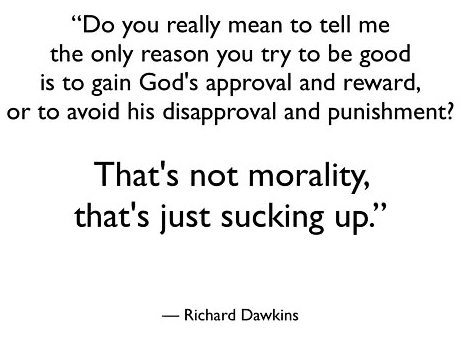
Missing The PointIs ‘sucking up’ really the only reason followers of Jesus of Nazareth (who many people believe is the Son of God) try to be good? I’m sure there are lots of people out there who believe that. And, sadly, I’m sure there are Jesus followers who do, in fact, live with this sentiment in mind.

I’m not one of them. And neither are most other people who know the truth of their faith. That’s why this graphic, found on an internet atheism community, so hugely misses the point — and that’s disappointing because the author is a shining star in the atheism world and probably knows the Bible inside and out. All that said….

I try to be good because I want to be the person God knows I can be. In fact, when I decided to follow Jesus (at age 42), I welcomed God’s holy spirit into my heart and mind to help me be a better person – because I simply couldn’t do it on my own.

I try to be good because, in one of the original source biographies of Jesus’ physical time on earth, He tells His followers “Anything you did for one of the least important of these brothers and sisters of mine, you did for me”.

I try to be good because, in a letter written by one of Jesus’s brothers, we’re told “Isn’t it obvious that God-talk without God-acts is outrageous nonsense?” In other words, I wouldn’t be much of a Jesus follower if my faith didn’t result in me at least attempting to do good.

I try to be good because one of Jesus’s earliest followers puts it this plain and simple: “God’s people should be bighearted and courteous”.

Finally, I try to be good because I believe Jesus was crucified to make up for the bad things I’ve done and the good things I’ve failed to do. Given His incredible sacrifice to wipe my slate clean with God, the least I can do to show my gratitude is try my best to get my act together.

Anyone who knows me also knows that I often fall short of being “good”. (Just ask my very patient wife.) But that’s why I follow Jesus. That’s why I attend church regularly, so God can use the pastor and other Jesus followers to encourage me and instruct me on being good.

What do you think of this? Post your thoughts below and let’s have a conversation.

Fear 12.13I’m still trying to work up some fear. If you see logic with this graphic posted on an Internet atheism community, then apparently that’s the basis of my faith (not “religion” – that’s a nasty word).

If I am to believe this graphic, then I came to a place of fear at age 42 – after reading many books from a variety of perspectives, debating several brave people and thinking long and hard about how this planet works.

After all that, I decided to follow Jesus of Nazareth — who many people believe is the Son of God — because I simply became more and more fearful.

NOT.

There’s no doubt that ‘fear of the lord’ is mentioned in ancient texts. Often, in fact. Here are just a few examples:

  • Wisdom begins with fear and respect for the Lord.
  • The fear of the Lord is the beginning of wisdom.
  • A simple life in the Fear-of-God is better than a rich life with a ton of headaches.
  • Happy is the one who always fears the Lord, but the person who hardens his heart to God falls into misfortune.

As I scanned these and so many other passages written by ancient prophets, it became plain that there are good reasons to fear the Lord:

1. Fear the possibility of disappointing Him. God knows my potential. He knows yours, too. In fact, He put that potential into you and me. So I fear not living up to that potential, of not truly letting Him into my life so He can make me all that I can be.

2. Fear mixing up who is in charge. I don’t know about you, but in North American culture, I need constant reminders that God is God. And I am NOT, no matter how many channels I can get on TV, no matter how many pills I can take to try and extend my life & health, no matter how often I’m told that I have control over everything.

3. Fear makes at least some sense when approaching the creator of space, time and the air you and I breathe. I heard one pastor liken it to approaching a massive, stunning waterfall like Niagara. We want to come close, but we also know that if we get too close, the water could drown us. And yet we still cautiously approach because it’s just so amazing, so glorious, so spectacular. We want to be in its presence.

Does this make sense? Yes or no, post your thoughts and let’s have a conversation.

PlaceholderGod 11.13I wonder: do I lack courage or intellectual honesty?

It’s a question I asked myself after seeing this meme on an internet atheism community.

I can say for certain that there are all kinds of important questions that I can’t answer and, I suspect, no one else can, either. Questions about stuff in the Bible, for example. Or questions about why our world is shot through with disease, violence and inequality.

But if you remember where I found this piece of internet art, you can probably guess – as I did – that whoever created it doesn’t think “God” is an explanation for anything.

If your whole being is trusting in science, then maybe you hope it will eventually figure out everything. And we’ll be left with no creator.

I follow Jesus of Nazareth (who many people believe is the Son of God) and so that’s not my hope. In fact, I know it will never happen.

Let’s get one thing straight, however. I like science. I like it a lot, primarily because it’s one of the ways God shows us how He works. I have lots of moments where I’ll read about discovery in physics or astronomy and think “Ah, that’s how God did it. Cool!”.

That said, science will never answer the most basic of all questions: Why are we here? What happens to us when we die? And I’m fine with that.

These unanswered questions are important because they remind me that even after all I can find out about God from ancient texts and writers, I still know that He is a mystery. To put it another way, God is God. And I am NOT.

“Trust God from the bottom of your heart; don’t try to figure out everything on your own.
Listen for God’s voice in everything you do, everywhere you go; he’s the one who will keep you on track.”

That’s from an ancient, God-inspired writer and it makes sense to me.

So how do you hear God’s voice? One way is to read original-source documents about the life of Jesus  and, when you encounter something you don’t understand (and trust me, you will), ask a knowledgeable Jesus follower. Or ask me (I’m no expert, but I can give it my best shot or direct you to where you can get a credible answer). Or visit a website like the Christian Apologetics & Research Ministry (http://carm.org/) and ask your question(s).

You can also start attending church. That’s where you’ll meet pastors and Jesus followers who will help you hear God’s voice.

Finally, you can pray. Prayer is a mystery (I wrote about that mystery here: http://wp.me/p2wzRb-9a), but it’s definitely worth doing, if for no other reason than Jesus, during his physical time on earth, prayed all the time.

Does all this make sense? Post your thoughts below and let’s have a conversation.

WHO’S TO BLAME?

Who's to blame?What I find so fascinating about hanging out with atheist folks is many of them love to blame God for pretty much everything they don’t like.

I suppose there’s an irony here, since atheism is defined as believing there is no God. But I suspect that most atheist people make charges like what you see in this graphic because they’re angry with people who DO believe in God.

All that said, you may be sitting back and asking me, a serious follower of Jesus of Nazareth, “OK, what about all the starving children and your prayers of thanks for food?”

Consider this: According to Oxfam Canada, there is enough food to feed everyone. In fact, the organization says the world produces 17 per cent more food per person today than 30 years ago.

So what’s the problem? It’s certainly not God. It’s corrupt governments, greedy big business, rich people who don’t care enough about the world’s problem to do anything and poor people who accept their lot in life without any fight. In other words, the problem is humanity.

Ok, you think. But why hasn’t God done an end-run around people and fixed the problem on His own? First, He IS doing something about it, through organizations like Oxfam, Samaritan’s Purse, World Vision, Feed The Children and dozens more.

This leads directly to my second point: thousands of years of evidence makes it clear that God prefers to work through people than on His own. Given our very, VERY imperfect nature, many folks may question this approach (count me among them), but it’s still God’s way and I respect it.

And that leads to my third point: since God is working through us to tackle the problem of hunger, what are YOU doing to make yourself available to Him? What organizations are you supporting? How are you thinking about the ways you spend your income? The vacations you go on?

The graphic is making another point – rejecting the power of prayer. I’ve tackled that issue elsewhere on Frank’s Cottage (http://wp.me/p2wzRb-9a), so all I’ll write about that here is this: I’m going to continue to be thankful to God for all He’s given me, including the gift of Jesus (who many people believe is His Son). And I’m going to continue to ask Him to use me in the work He’s doing to change the hearts and minds of people.

Now what are YOU going to do? Post your thoughts below and let’s have a conversation.

From faith to blessings 11.13Striking, angry, bitter words, aren’t they?

This graphic, posted on an internet Atheism community, certainly states an opinion very strongly. But exactly what is the creator of this meme raving about?

Wikipedia defines faith as “confidence or trust in a person, thing, deity or in the doctrines or teachings of a religion or view (e.g. having strong political faith). The word faith is often used as a synonym for hope, trust or belief.”

Does this sound like something worth throwing your time and energy into opposing? It certainly doesn’t to me.

But what about being gullible, having an absence of reason, etc.? Well consider this: I decided to follow Jesus of Nazareth — who many people believe is the divine son of God — at age 42, after reading many books from variety of perspectives, thinking long and hard about what I believed in and why, and having challenging conversations with several Jesus followers.

But if you are to believe everything in this graphic, then after all my deliberation, I made a choice to become gullible. I decided to throw away reason. Become dishonest and blind myself (to what, I’m not sure).

Are you really buying this?

I can imagine some opponents of faith saying it’s what people of faith do that’s so wrong, especially when they use their faith to back up their actions.

On this point, we absolutely agree. There’s nothing more wrong than blowing up a skyscraper, denying rights to women or bombing abortion clinics in the name of faith. Wrong, wrong, wrong.

That said, here’s a question for you: should all faith be detested because of the crazed actions of a fanatical few? I know how many atheist people would answer, but what about YOU?

Like it or not, it seems to me, faith is mixed into the fabric of our lives.

  • We place our faith in doctors without knowing if (or how often) they’ve been sued for malpractice.
  • We go on airplane trips, trusting in mechanics and safety inspectors (who are every bit as imperfect as you and me) to ensure the plane is safe.
  • We drive our vehicles over bridges every day, placing our faith in nothing more than steel, concrete and rebar, plus annual government inspections.

So, if you really want to detest faith, then you better not leave the house again. In fact, maybe you shouldn’t even live in a house. Despite all the building codes designed to ensure it was built to last, who knows when it could fall in on you?

My faith in Jesus means that without seeing Him, I know that He lived, died and came back to life – all for the benefit of people who believe in Him and trust Him with their lives.

Does this sound crazy? Jesus addresses that very question when, after his resurrection, he permitted a follower named Thomas to touch the wounds of his crucifixion.

“So, you believe because you’ve seen with your own eyes,” Jesus told ‘doubting’ Thomas. “Even better blessings are in store for those who believe without seeing.”

Do you want those blessings? Post your thoughts below and let’s have a conversation.

Oxford UniversityHere’s something I’ll bet you didn’t know: some of the world’s most renowned universities have their origins in Christianity.

Huh? Aren’t followers of Jesus of Nazareth kinda dumb – you know, shut off from reality and opposed to non-religious “higher learning”? That’s certainly the inference I’ve read in blogs by many atheists.

To make the point further, the website About.com states “It is true that studies have repeatedly shown a correlation between atheism and education levels. The more education a person receives — especially in the sciences — the less religious they become and the less likely they are to remain theists (believers in God).”

But get this: the motto at the University of Oxford in England, quite possibly the most prestigious university on the planet, is “The Lord is my Light”.

As an aside, consider this: Among Oxford’s Jesus-following graduates are famed authors C.S. Lewis (The Chronicles of Narnia) and J. R. R. Tolkien (The Lord of the Rings). Both were university professors, too. That’s right, serious followers of Jesus were – and are – teaching in the planet’s highest institutions of learning.

The motto of another famed institution, Princeton University in the United States, is “Under God’s Power She Flourishes”.

Another aside: Among Princeton’s famed Jesus-following professors (and presidents) is American president Woodrow Wilson, who helped form the League of Nations, which led to the United Nations. “He was a frequent church-goer and read the Bible regularly,” says the website Adherents.com.

Want some more examples of universities that wouldn’t be around today without Jesus followers? Then add the University of Paris and the University of Bologna (Italy) to the list.

In fact, Wikipedia states that “The university is generally regarded as an institution that has its origin in the Medieval Christian setting. Prior to the establishment of universities, European higher education took place for hundreds of years in Christian cathedral schools or monastic schools , in which monks and nuns taught classes; evidence of these immediate forerunners of the later university at many places dates back to the 6th century AD.”

As for the assertion that scientific education, in particular, causes atheism, I’ve tackled that on this website (see “Naïve children, frightened seniors?” – http://bit.ly/Tgrt9p)

So, what do you think of all this? Does this make you more willing to check out Jesus? Type your thoughts below and let’s have a conversation.
paintingMy mother can paint a decent picture. Me? I understand things like perspective and lighting, but only through a camera lens.

Still, I’ve been painting a metaphorical picture for many years now. And often, I didn’t even know it.

My “paint and brushes” are selfishness, willful ignorance, irrational anger, ignoring the needs of others, and self-centred greed.

Each is just a smudge of color on a canvas. But after all these years, those smudges have created a large and unappealing picture of someone who, time and time again, falls short of who I’m meant to be and misses the mark of what I should be aiming at.

How can I fix this painting? Especially when I keep adding to it like a drunken shopaholic with a fistful of credit cards?

The answer is simple: no matter how hard I try, no matter how many self-help books I read and no matter how many reruns of Oprah “fix up your life” episodes I watch, I can’t.

But there is a solution, once I figured out who can help me. It’s God who created me (and you), who put all sorts of gifts inside me (and you), who knows the kind of person you and I can be and the sorts of things we can accomplish.

God also knows every smudge I’ve put on that painting and every smudge you’ve put on yours. And He’s the one who offers the simple, life-changing solution: a guy named Jesus. He turned the ancient world on its head with offensive ideas like loving your enemies, forgiving someone who hurts you or your loved ones, and having a real, day-to-day relationship with God.

When the Roman authorities of his day put Jesus to death, they didn’t know they were also making a way for everyone who believes in Jesus to have their lives turned around. His death was the payment I didn’t have to make to have my ugly painting turned into white, clean canvas.

Want some evidence? I found it the words passed along to us through an ancient prophet: “Though your sins are like scarlet, I [God] will make them as white as snow. Though they are red like crimson, I will make them as white as wool.

Just as important as making payment, Jesus’s death—and His resurrection, described by several ancient Jesus biographies—opened the door to eternal life with God for all who believe in Jesus. When my days on this earth are finished, it’s just the end of the opening credits; the glorious 3-D Imax movie hasn’t even begun yet.

Anyone can have this. No matter how big and ugly your painting is, by accepting and believing in what Jesus did, you can have a brand-new canvas that God can use to create a picture of love, grace and new life. So, why not put your paint brushes aside and join me?

A POWERLESS GOD?

Where is God's power?Is the graphic here – kindly provided by an Internet atheism community – true? Has the power of God (if you believe in Him) been reduced to a comedian’s punchline?

Sometimes it feels that way. So many of us look at this broken world, see the corruption, poverty, environmental degradation and violence, then wonder “if you exist, God, when the heck are You gonna show up and fix this?”

I’m a serious follower of Jesus of Nazareth (who many people believe is God’s Son), but there are times when I think this, too. Then I remember some key facts that straighten out my thinking.

1. Let’s be honest here; lots of people like the world as it is. Those who participate in child sex slavery probably think things are just peachy. Those who benefit from corruption likely don’t want anything to change. And those who are dumping garbage into the ocean probably have a team of lawyers ready to fight for the status quo.

2. My first point leads to the gift – and challenge – of freewill. The state of our world makes it plain to me that God takes this gift very, VERY seriously. So seriously, in fact, that He lets us spit on that gift every day. I know that’s what I do when I talk about someone behind their back, ignore the speed limit or offend someone with my incessant need to make jokes.

3. How do I know what God is really up to? Consider the fall of the Berlin Wall in 1989-90. Or the defusing of the 1962 Cuban Missile Crisis. Or the eradication of smallpox. How do any of us know that God wasn’t behind these events?

4. The evidence of thousands of years clearly shows that working in partnership with us very imperfect humans is God’s preferred method of operating. Indeed, the words of ancient prophets and Jesus followers have all kinds of stories about God working through folks like Paul (an opponent of Jesus who became one of His most devoted followers) to accomplish His will.

So, when you consider these points, has God really been reduced to appearing on toast? Or is He making it clear that “I don’t think the way you think. The way you work isn’t the way I work” (words passed along through an ancient prophet).

I know that can be frustrating. But much more importantly, it’s a powerful reminder to me (and, hopefully, to you) that God is God. And I am not.

In the meantime, what I do know for certain about God is that He offers the gift of Jesus to everyone – no matter what we’ve done or not done.

When we accept that gift and decide to follow Jesus, we give God permission to start working in our lives to make us better people and this planet a better place. Does this interest you? Yes or no, post your thoughts below and let’s have a conversation.

Finished“Be confident of this, that the One who began a good work in you will bring it to completion in Christ Jesus.”
–    A letter from Paul, a missionary, to one of the early groups following Jesus of Nazareth

A lot of people who believe there’s a God out there also believe this God has washed His hands of them.

I know I’ve had times in my life where this has happened; I imagine God saying “What? You’ve screwed up again? I’m so tired of having to deal with you…I’m out of here.” And with that, God throws in His spiritual towel and walks away.

Then I heard a pastor, Adrian van Giessen, talk about those words from Paul, one of the men most responsible for telling people about Jesus throughout the Mediterranean.

Adrian’s way of interpreting Paul was this simple: God finishes what He starts.

You and I may tire of something; we may decide all is lost and give up the ghost. But as Adrian put it, there’s not a quitter bone in God’s body.

This means no matter what we do, no matter how many times we screw up, no matter how often we repeat the same mistake, God doesn’t lose hope. He keeps His hard hat, work gloves and tool belt on; He keeps the plan He has for your life squarely in front of Him; and He never, ever gives up on you. Or me.

Now, some might examine their lives and declare God didn’t begin a good work in them at all, so there’s nothing to finish. When I’ve felt this way, I’ve looked to an ancient biography of Jesus for words you might have heard before: God so loved the world that He gave His only son and whoever believes in and seriously follows the son will go on living even after his or her body dies.

Notice the verse simply says ‘the world’, rather than ‘some parts of the world’? That means you and I are on the list of what God loves. So why wouldn’t He start a good work in you, too?

If you believe this, there is an important thing to do: stop dwelling on what happened to you in the past – including the stuff that makes you think God didn’t begin a good work in you – and simply co-operate with Him.

Read the words of Jesus, his followers and the ancient prophets; find out where God stands on the issues, discover how Jesus (who many people believe is His son) prayed to him and what are priorities to God. Then think about your plans, your actions, your thoughts, your strengths and weaknesses and try to put them through a God filter…is this what He wants for your life?