November 9, 2013 by Frank King Photos
 “Sin” is not a word we use much anymore.
And it’s easy to understand why: embarrassing televangelists have turned it into a ridiculously pronounced cliche (can’t you just hear them pontificating about ‘see-in’?). Furthermore, in North America, the media and entertainment industries have mercilessly lampooned the word and anyone who dares to even whisper it.
So, call it what you want. Moral crimes, moral failings. I’m sure I could find more names for sin, but you get it.
Responding to the charge in this online ‘graphic’ (conveniently posted for me on an Atheism Internet community), I looked up the word. Here’s what I found:
Transgression of divine law: the sin of Adam.
Any act regarded as such a transgression, especially a willful or deliberate violation of some religious or moral principle.
Any reprehensible or regrettable action, behavior, lapse, etc.; great fault or offense: It’s a sin to waste time.
After reading these definitions, all I can do is think about the world we live in, then scratch my head in puzzlement. Epic greed (which directly caused the 2008-2011 recession), sickening entitlement (think about the salaries most professional athletes demand because they think they’re worth it) and lust for power (which have brought us the likes of Adolf Hitler) are just a few of what Dictionary.com calls “a willful or deliberate violation of some religious or moral principal”. You can probably suggest other examples.
So how is any of what I’ve described ‘imaginary’? The people who are still struggling because of the recession, the people who receive piddling salaries for doing important work (social workers come to mind) and the victims of someone’s lust for power (just consider the victims of Cambodia’s horrific Pol Pot regime) would surely tell you sin is as real as cancer, reality TV and government deficits.
And the ‘imaginary cure’? I have no trouble telling you there are many parts of the Christian Bible that I don’t fully comprehend. But that’s not what sticks with me. Instead, I think of the parts that are crystal clear:
- Love your enemies;
- Treat others as you would like to be treated;
- Deal with your shortcomings before pointing out the failures of others;
- Don’t be a hypocrite;
- Forgive and you will be forgiven;
- Put the needs of others ahead of your needs.
Am I crazy to write that these commandments, mostly given by Jesus of Nazareth (who many people believe is the Son of God) will go a long way to solving the moral crimes of humanity? I don’t think so.
That’s why I became a follower of Jesus. That’s why I treat His words seriously, even the parts that puzzle me. Jesus knows better than I do what’s wrong with this world and how it can be made right. I want to be part of that process. Do you? Yes or no, post your thoughts below and let’s have a conversation.
Posted in Me & The World | Tagged atheism, Bible, Christianity, errors, Faith, Frank King, Frank's Cottage, God, Is sin real?, Jesus, missing the mark, mistakes, religion, sin, spirituality, theology, What is sin? | 9 Comments »
November 2, 2013 by Frank King Photos
So what’s the deal with Hell?
That’s a question I’m sure you’ve asked yourself at least once. I used to ask it frequently before I became a follower of Jesus of Nazareth (who many people believe is the Son of God) more than a decade ago.
Do I understand everything about it? Not in the least. I doubt anyone does. But I have come to know that the truth about Hell is not at all like the graphic you see here (kindly provided by an internet atheism community.)
First of all, Hell was not created for human beings. In one of the primary source documents about His physical life on earth, Jesus referred to hell as “the fire that was prepared for the devil and his angels.” That’s right. NOT for people.
So why does God “send” people there? Well, God doesn’t send anyone there. We send ourselves there.
Ponder these ideas, as presented by Mark Mittelberg (and based on excerpts from ancient documents and original-source biographies of Jesus) in his book The Questions Christians Hope No One Will Ask:
- God is perfect and, as a just judge, He has to condemn sin, not overlook it.
- God doesn’t owe anyone a second chance and yet He gives us repeated opportunities to turn our lives around and look to Jesus for guidance.
- God has given us this planet, with all its beauty and diversity, and we have abused it as if we are accountable to no one.
- We treat our fellow humans with disregard, even though God loves them as much as us.
- We fool ourselves about where we are on the moral spectrum, thinking we’re just fine and ignoring the bad things we’ve done and the good things we’ve failed to do.
Now, consider this: Jesus is God’s gift to everyone who will accept him. Jesus died to make up for ALL the wrong things His followers do and the right things we fail to do.
Jesus came back to life to show us God’s power and, in the succinct words of the wiki.answers.com website, to show us “He is not an ordinary human, but divine. He triumphed over the grave for all who would accept Him as saviour”. It’s also a testimony of what will happen to everyone who follows Jesus – not death, but eternal life with Him.
As with any gift, the gift of Jesus must be accepted. If it’s not, then God looks at us and sees the ways we’ve misused the talents and abilities He’s put in us. The ways we’ve lived as if He doesn’t exist. The ways we ignore the needs around us. The ways we live for more money, more power, more toys – all things that are, in the end, meaningless. And that’s what we’ll be judged on.
So, as Erwin McManus explains it, God “will not stop us from going to Hell if we insist on it. It is a choice to live a life that’s wasted because you’re not living the life God created you for. Hell is a place where you say ‘no – I don’t want Your love’.”
Does this make sense? Yes or no, write your thoughts below and let’s have a conversation.
Posted in Me & The World | Tagged Bible, Christianity, Erwin McManus, Faith, Frank King, Frank's Cottage, God, hell, Jesus, Mark Mittelberg, religion, spirituality, theology, who created Hell, who is Hell for? Who goes to Hell? | 65 Comments »
October 26, 2013 by Frank King Photos
 A friend posted this meme on her Facebook wall and it caused such an immediate, gut-level reaction that I downloaded it for a blog.
Two things struck me:
1. There’s a sad and ugly truth to these words. In our culture, most of us DO judge a book by its cover. All the time. And I’m as guilty of it as anyone. It’s like biting my lip or tapping my pen on the desk; it happens without me even knowing it. Some examples:
- “Wow nice colour combination – and I don’t even know fashion” is what I sarcastically thought when I spotted a certain co-worker one day. (As if that one outfit is all I need to know about them.)
- When I saw (and heard) a neighbour back out of his garage I’ll think, “Rap? Really? You listen to that manure on purpose??” (As if all rap is awful and that’s the only music they ever have on the car stereo.)
- I’ll be walking by a group of teens at the shopping mall, hear them chatting and the first thing that darts through my head is “You kids must be truly vacant to be talking about TV garbage like ‘The Bachelor’.” (As if liking this one reality program makes them entirely brain-dead.)
That’s me; Sir Judge-A-Lot. And the title is accurate, even though – like most of us – I’ve often been on the receiving end of the hammer blow of false, superficial judgement.
2. There’s a truth that’s absolutely counter to all of this. Stay with me while I spell it out.
An ancient prophet wrote these timeless words: “God doesn’t look at what people see. People judge by what is on the outside, but the Lord looks at the heart.”
The message? My creator (and yours) has gone past the cover of the Book Of Me and read every word inside. And His judgements are more accurate than the finest Supreme Court justice.
For many of us, this isn’t good news. We hope others won’t notice the bad things we’ve done and the good things we’ve failed to do. But how do we get away from the all-seeing eyes of God?
In a word, we don’t. But there is a solution and it comes from God Himself. It’s Jesus of Nazareth, who many people believe is His son. God offers Jesus as a gift to everyone, no matter how poor our track record.
All we have to do is accept the gift. Make Jesus your friend – your savior – and God no longer counts your bad behavior and malicious thoughts against you. He sees you as He sees Jesus – perfect, without a blemish – and starts writing a new book. You’ll be amazed at what happens as that new book begins to unfold.
So, do you want the all-seeing eyes of God to see YOU in a new way? Yes or no, post your thoughts below and let’s have a conversation.
Posted in Me & The World | Tagged Bible, Christianity, church, Faith, Frank King, Frank King Christianity blog, Frank King faith blog, Frank King religion blog, Frank King spirituality blog, Frank's Cottage, God, Jesus, judging a book by its cover, judging others, passing judgement, religion, spirituality, theology | 3 Comments »
October 19, 2013 by Frank King Photos
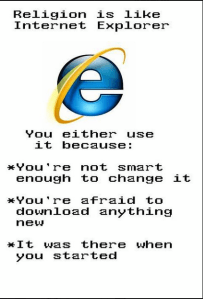 Did you know Internet Explorer is out of fashion? I didn’t, but then again, I’m a Mac person and Internet Explorer hasn’t bothered with us for years.
But what about the points that people of faith apparently have in common with Internet Explorer? According to this graphic, posted on an Atheism internet community, people like me are dumb, frightened and unwilling to question anything they grew up with.
Let me present you with a very different point of view:
This dude went to church as a child, but at the age of 16, his parents told him and his two brothers they were free to continue with faith, or drop it.
The decision was unanimous. The entire family walked away from even the shallowest pretense of faith.
For this one dude, it never came to a point of becoming an atheist, but he did get very angry at God and figured people who followed Jesus of Nazareth (who many people believe is God’s Son) were either naive children or frightened seniors.
That kind of attitude made him unpleasant to be around. And he knew it.
Then the day came, at age 42, when he became willing to change, willing to download something new, willing to seriously investigate what was there when he started.
After much discussion with mature, respectful Jesus followers, much reading of a wide variety of books from several very different points of view and after much thoughtful consideration, he decided to become a Jesus follower.
That person is ME.
Do I have all my questions answered? Nope. Do I understand everything in the Bible? Hardly. In the end, when I’m finished with this life, will either of these points matter? Not even a bit.
Because I accepted God’s gift to humanity (Jesus), I also accepted that He sacrificed His life for all the bad things I’ve done and all the good things I’ve failed to do. My slate is wiped clean. And as a result, I’ll spend eternity with Him in Heaven.
Does that mean I can just walk away and do whatever I want? Not unless I’m seriously deluded. If I take God’s gift seriously, then I’m overwhelmingly grateful for what Jesus has done.
That gratefulness opens the door for me to welcome Him into my heart and soul. Now He’s working to make me a better person – to myself, to my wife and stepchildren, to my parents and to everyone who doesn’t share my trust and faith in Him.
That gift is waiting for you, too. No matter what you’ve done (or not done), no matter how much you struggle with life. Interested? Post your thoughts below and let’s have a conversation.
Posted in Me & The World | Tagged Bible, Christianity, church, Faith, Frank King, Frank King Christianity blog, Frank King faith blog, Frank King religion blog, Frank King spirituality blog, Frank's Cottage, God, Internet Explorer, Jesus, religion, spirituality, theology | 12 Comments »
October 12, 2013 by Frank King Photos
 Prayer is a big part of my life and I can easily construct and speak a tour-de-force that will tickle your ears and touch your emotions.
But do my prayers, and the prayers of everyone else, make any difference? For me, the answer is this simple: it depends.
Am I praying to obtain something? Is it something I need or something I want – and do I really know the difference?
Am I trying to change God or me?
Am I praying for someone? If yes, am I framing my prayer with the presumption I know what’s best for this person?
How am I approaching prayer? Am I desperate? Sad? Angry? Going through the motions?
Do I subconsciously think God is grading my effort – and His response (or lack thereof) depends on how I do?
When you consider just these questions, it’s no surprise that, in his wonderful book Prayer: Does it Make Any Difference?, Philip Yancey, writes “We who barely comprehend ourselves are approaching a God we cannot possibly comprehend. No wonder some Christians through the centuries have felt more comfortable praying to saints or relying on intermediaries.”
So why pray? For serious followers of Jesus of Nazareth (who many people believe is the Son of God), one answer is easy and simple: because prayer was a foundation of Jesus’s life. In the four original-source biographies of His life, more than a dozen prayers by Jesus are recorded. And if you read those prayers, you’ll quickly realize Jesus prayed like it made a huge difference.
Here’s another good reason: when we pray, we open ourselves up to hearing or sensing what God wants to tell us. The website allaboutprayer.org puts it this way: “Prayer not only establishes a relationship with God, it is vital to maintaining our relationship with him.”
A relationship developed in prayer can have immense ramifications. According to the late author and Jesus follower Henri Noewen, “One of the discoveries we make in prayer is the closer we come to God, the closer we come to all our brothers and sisters in the human family.”
Of course, this can be scary because the potential is there to shake us out of our placid, comfortable lives. As Philip Yancey put it in another of his books, “Prayer is the act of seeing reality from God’s point of view.” And once we see that reality, we may never be the same.
In fact, if our praying is sincere, we can be transformed into more generous, loving and forgiving people who have a truer picture of who God is and what He wants to accomplish in this world.
And that means we can be more like Jesus.
Does this make sense? Post your thoughts below and let’s have a conversation.
Posted in Me & The World | Tagged Bible, Christianity, does praying matter?, Faith, Frank King, Frank King Christianity blog, Frank King faith blog, Frank King religion blog, Frank King spirituality blog, Frank's Cottage, God, Henri Noewen, Is prayer a waste of time?, Is praying a waste of time?, Jesus, Philip Yancey, prayer, religion, spirituality, theology, what difference does prayer make?, what good is prayer? | 4 Comments »
October 5, 2013 by Frank King Photos
 “I’m running from the burning man inside me.”
From the first moment I heard this lyric, by singer/guitarist/songwriter Marc Bonilla, I was entranced by the imagery it presents.
The lyric is found on the CD Keith Emerson Band featuring Marc Bonilla. Some of you classic rock fans might recognize Keith Emerson as the keyboard genius with the 1970s progressive rock giants Emerson, Lake & Palmer.
But back to the lyric, which resonated in three ways:
1. The burning man image hit me because all of us have a burning man (or woman) inside us. Burning – or at least, smouldering – with passions like these:
- Grudges we can’t (or won’t) release.
- Bad habits we’ve lived with for so long that we don’t even recognize how destructive they are.
- Attitudes that quietly, subtly poison us and our relationships.
2. We’re trying to run away from this burning man (or woman).
Somehow, during moments of clarity, we recognize at least some of the damage we’re doing to ourselves and those around us. We actually get it, that this burning man is making us miserable and, at some point, all this burning will hollow us out.
3. This burning man (or woman) is inside us. So I can run forever and not get away. I can travel in the fastest race car and it won’t make any difference.
I can even leave the planet on the space shuttle, but that burning man will still be with me. He’s a police sniffer dog I can’t shake, a shadow that never leaves me.
This might sounds hopeless to you, but it’s not, because there’s someone else who never leaves us. Consider these words from an ancient wisdom writer: “Your Spirit is everywhere I go. I cannot escape Your presence. If I go up to heaven, You will be there. If I go down to the place of death, You will be there.”
Sounds like the writer of this is talking about the ‘burning man’, right? But he’s talking about God, who created him, me and you. And he goes on to write, “You formed the way I think and feel. You put me together in my mother’s womb. I praise you because you made me in such a wonderful way.”
This is good news, at least in my book. But how can this make a difference in our lives? I suggest the answer lies in seriously checking out Jesus of Nazareth, who many people believe is the Son of God.
I found that when I decided to believe in and follow Jesus, He came to live inside me. And the longer He lives inside me, the more space he takes up and the less space there is left for the ‘burning man’.
Eventually, if I’m serious about my faith, Jesus will have the run of the house and the burning man will be left in the basement, shivering, cold and powerless.
Does this make sense? Post your thoughts below and let’s have a conversation.
Posted in Me & The World | Tagged Bible, burning man, Christianity, Faith, Frank King, Frank King Christianity blog, Frank King faith blog, Frank King religion blog, Frank King spirituality blog, Frank's Cottage, God, Jesus, Keith Emerson, Marc Bonilla, Psalm 139, religion, spirituality, theology | 7 Comments »
September 28, 2013 by Frank King Photos
 I found this graphic on the Internet and, as a fan of the long-running Simpsons TV show, it got my mental wheels spinning.
First, the fun stuff. Homer Simpson the hard worker?? If you’ve seen the Simpsons, you’ll know Homer works hard looking for ways NOT to work at all. 🙂
“Not a bad guy”. Maybe not. But a good guy? Well, who among us is really good?
Consider these words from one of the earliest and most important followers of Jesus of Nazareth: “There is no one doing what is right, not even one.”
Beyond that challenging statement, I ask: what is “good”? Am I still good if I routinely exceed the speed limit (which I do)? Am I still good if I pay a contractor under the table to avoid taxes (which I don’t)?
And what about ignoring my creator? As a serious follower of Jesus (who many people believe is the Son of God), I know that God is interested in every part of my life. So if I live as if He barely exists, am I still “good”?
One of the reasons I follow Jesus is because in the end, I have to admit I’m NOT good. And no matter how hard I work at it, I can never be good on my own.
I welcome Jesus into my life because He is bringing me closer to “good”. And for the many times I still fall short, his sacrificial death and resurrection wipes all my shortcomings off the books. God sees me as he sees His Son – perfect, without blemish.
The other thing that grabbed me about this graphic is the notion of spending Sundays (in church, I presume) hearing about going to Hell.
I imagine if you’re not a regular church attender, then you’re nodding in agreement with Homer’s assertion. But it’s no more true than his claim about working hard.
I regularly attend church services because through them, I learn more about how to live as a Jesus follower. I’m also surrounded by other Jesus followers who encourage me, support me and pray with & for me.
Does Hell come up? Now and then. However, serious Jesus followers aren’t fixated on it because we know we’re not going there. But we keep in mind all those we know who don’t follow Jesus. We want to spend eternity with them in Heaven, so we pray for them and, at church, we learn how to lovingly show them and tell them about the hope we have in Jesus.
If that sounds appealing to you, then step out on the ledge one Sunday. Go to a church service and talk to the people you meet there. It just might change your life. 🙂
Posted in Me & The World | Tagged Bible, Christianity, church, Faith, Frank King, Frank's Cottage, God, Homer Simposon quotes, Homer Simpson, Jesus, religion, Simpsons, spirituality, theology, why attend church?, why go to church? | 5 Comments »
September 21, 2013 by Frank King Photos
 Beyond being a proud stepdad to three wonderful young adults, parenthood – the 24/7, down-and-dirty real thing – is not and will not be part of my life. But I know for certain one thing my parents did right for me: they took me to church.
Despite moving several times, my parents continually had me and my two brothers attend Catholic mass with them until I hit age 16. For the most part, I found the experience a stand-up/sit-down/recite-this-standard-prayer exercise in boredom.
What probably didn’t help is that the experience didn’t seem much more interesting to my parents. The meaning and significance of a Catholic mass was never explained to me (I’m not sure Mom and Dad understood it, either), so when they told us we were old enough to decide for ourselves whether we wanted to keep attending, the result was no surprise. All of us brothers said “no thanks” and for me, that was the end of church for many years.
But the seed of something deep and spiritual was planted and, I’m glad to write, has blossomed into such significance that it influenced who I married and where I go to work.
So, I remain grateful for what Mom and Dad did all those decades ago, especially when I read a National Post blog by Barbara Kay on the subject of children and faith. One paragraph, in particular, stood out:
“Children are not satisfied with chaos theory or moral relativism. They want order, a system, a precise identity (my friend’s grandchild told a schoolmate he was ‘half Jewish, half Christmas’). They need an infallible ‘GPS’ to navigate their way through ‘mean’ playmates, unfair or insensitive teaching, the troubling deaths of pets and family members, rumours of war and natural disasters.”
So, imagine if I hadn’t had a childhood GPS? And just as important for young parents, imagine if your children don’t have a GPS? That’s why I write that even if you’re not quite sure where you stand with Christianity, even if you still have a ton of unanswered questions, even if some things make you scratch your head in confusion, set them aside and take your children to church.
If they aren’t regularly exposed to Sunday services, they will likely miss the chance to decide for themselves about a life of faith, about who Jesus is, and about the value of following Him. You will have made the decision for them, on a matter I believe is of supreme importance.
As Ms. Kay put it in her blog, “There is nothing to be lost in gifting children with God and religion, but much to be gained – for them as individuals and for society as a whole.”
Agree? Disagree? Put your thoughts in a comment below and let’s have a conversation.
Posted in Me & The World | Tagged Barbara Kay, Bible, Christianity, church, Faith, Frank King, Frank's Cottage, God, Is church a waste of time?, religion, spirituality, theology, why attend church?, why go to church? | 11 Comments »
September 14, 2013 by Frank King Photos
 “Being a Humanist means trying to behave decently without expectation of rewards or punishment after you are dead.” – Kurt Vonnegut (1922-2007)
I guess you won’t be shocked when I write that Vonnegut, the great American writer of such renowned novels as Slaughterhouse Five and Breakfast of Champions, was not a fan of “religion” (neither am I).
At various times in his life, he described himself as an agnostic and an atheist and, according to Wikipedia, believed people were motivated to join religions out of loneliness.
Who knows, maybe that’s true for some people. But that’s a debate for another essay. What intrigued me about this quote (posted on Twitter by the Huffington Post online newspaper) is Vonnegut’s notion of behaving “decently”.
We all have ideas about what that means and I’m sure some of those ideas are the same – don’t kill anyone or set their house on fire, patiently wait while seniors cross the intersection, help someone get their car out of the snow, etc.
But — and this is a pretty big ‘but’ — do you really want to place all your hopes on these commonalities? Consider just these few examples:
- It was only 200 years ago when behaving “decently” meant not whipping your slaves.
- Only 50 years ago, behaving “decently” included putting aboriginal children into residential schools, where they were stripped of their culture and often abused, sexually and physically.
- And right now, there are cultures where it’s considered decent behaviour to persecute Christians, throw homosexual people in jail and stone women who are accused of adultery.
My point? I can’t trust “humanists”, people of faith or even ME to figure out what is truly decent behaviour.
That’s just one reason why I decided to follow Jesus of Nazareth, who many people believe is the Son of God. I can trust His ideas about decent behaviour, because we know those ideas came straight from His father.
And those ideas, however difficult some may be (I’m still working on loving my enemies, for example) are as meaningful and truthful today as they were 2,000 years ago.
What about Vonnegut’s assertion about “expectation of rewards or punishment after you are dead”? Well, I’m not about to deny that this is part of my motivation for following Jesus. I want eternal life in Heaven, with Him. And I’m not the least bit shy about saying so.
But that’s definitely NOT my prime motivation for following Jesus and his ideas about decent behaviour. I do it because He knows better than I do about what’s wrong and right. And I can trust Him because like other Jesus followers, I believe He died to make up for all the wrong things I’ve done and all the right things I’ve failed to do. Then he came back to life to prove that He was (and is) who He claimed to be.
What He’s done is a glorious gift that I’m glad to accept. That same gift is offered to YOU, too. Are you interested in thinking about it? Post your thoughts below and let’s have a conversation.
Posted in Me & The World | Tagged agnostic, atheism, Bible, Christianity, Faith, Frank King, Frank's Cottage, God, humanism, Jesus, Kurt Vonnegut, religion, spirituality, theology, what is decent behaviour? What is decent behavior? | 22 Comments »
September 7, 2013 by Frank King Photos
 As a husband, one of the things I’m committed to doing each summer is help my wife weed the back yard garden. Oh, can’t you just sense the joy in those words? 🙂
The thing that strikes me about weeding is it’s like laundry: the job never, never, ever, ever, ever ends. Pull out a weed today and, within a week, watch something just as ugly and useless take its place. Never mind the weeds, ‘cause after awhile, you’re ready to pull out your hair.
In my more lucid moments, I see a connection between weeding and my life: remove something bad I’ve done today — or something good I neglected to do — and in a few days, it’s right back in my life.
Like laundry, it seems to be a never-ending cycle. And it usually leads to frustration and, even worse, simply giving up and giving in to our less charitable, more self-centred tendencies.
But there is a solution. Brace yourself, because it’s not a quick-fix from Doctor Phil or Oprah or the latest self-help bestseller. It’s….Jesus.
Yes, that’s what I wrote. Jesus. As in, the son of God, the Christmas child and the reason for Easter. Still with me? Then here’s the explanation: if you check out Jesus’s claims and then decide to get serious — and I truly mean SERIOUS — about a life of faith, then what you’ll do is invite Jesus into your life.
And when Jesus comes into your life, He starts to change you. He loves you so much – He died to make up for all the wrong you’ve done and the right you’ve failed to do – that He’s not content to leave you as you are, haplessly pulling up weeds that are all too ready to grow back.
As your relationship with Jesus grows, as you start attending church, reading His words and words about Him and having faith conversations with longtime Jesus followers, you’ll start to see the changes. One of His earliest followers puts it this way: “The fruit that the Spirit [of God] produces in a person’s life is love, joy, peace, patience, kindness, goodness, faithfulness, gentleness and self-control.”
In other words, you start to see less weeds to pull up. Of course, there will never come a time when there isn’t weeding to be done. For proof, just look at the news and the scandals that overwhelm some high-profile Jesus followers.
But if you’re serious and if you truly commit yourself to following Jesus and letting Him make you more like who God knows you can be, you’ll have more:
- resilience to withstand the hard times;
- strength to help others;
- contentment when the world screams that you need to buy more stuff and earn more money and;
- peace when you come to truly know where you will spend eternity.
Does this make sense? Post your thoughts below and let’s have a conversation.
Posted in Me & The World | Tagged Bible, Christianity, church, Faith, Frank King, Frank's Cottage, garden, gardening, gardens, God, Jesus, religion, spirituality, theology, weeding, weeds | 4 Comments »
« Newer Posts - Older Posts »
 “Sin” is not a word we use much anymore.






 Frank's Cottage