Feeds:
Posts
Comments

Posts Tagged ‘atheism’

13+-+1-1

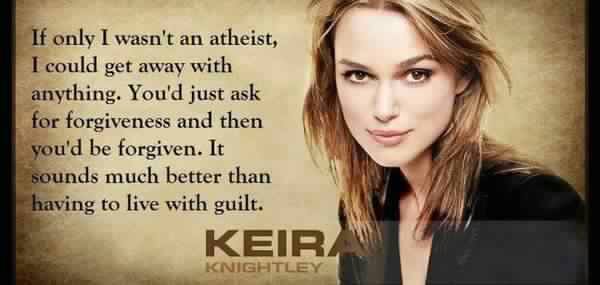
Actress Keira Knightley has earned adulation for the great movies she’s done since coming to fame in 2002 with Bend It Like Beckham. But do her thoughts on atheism and faith reflect reality?

I’m sure some folks agree with her. But for those who follow Jesus of Nazareth (who many people believe is the Son of God), forgiveness and guilt simply don’t work that way.

For Jesus followers, life isn’t a game where you do whatever you want, then sleepwalk through a hollow ritual of asking for forgiveness and assume God is a kindly, but dimwitted dolt who can’t see through your deception.

Consider these words from an ancient writer:

You [God] know when I sit down and when I get up. You know my thoughts from far away. You know where I go and where I lie down. You know everything I do. Lord, you know what I want to say, even before the words leave my mouth.

Does this sound like a creator Keira Knightley or anyone else can trick?

Forgiveness is available to everyone who accepts the gift God offers the world: Jesus. Primary source documents about His life indicate that Jesus died to make up for the wrong things we’ve done and the right things we’ve failed to do.

What Jesus did is a big deal. And those who truly accept that gift and make Him their lord and savior understand that. So they don’t treat it with contempt. In fact, a guy named Paul, who helped spread the good news about Jesus through the Mediterranean, addressed this very notion in one of his letters:

So, do you think we should continue sinning so that God will give us even more forgiveness? No! We died to our old sinful lives, so how can we continue living with sin?

Now, what about Keira’s assertion of living with guilt? If you’re still with me, you may have figured out by now that forgiveness is real and important and all-encompassing. In fact, for some people, it’s a life-changer and you can read one example here: http://wp.me/p2wzRb-6K

Forgiveness also means you’re no longer guilty. If you follow Jesus and sincerely ask for forgiveness, you’ll get it and the wrong you’ve done is wiped from the books. So there’s no need to “live with guilt”, as Keira puts it.

Does this make sense? Yes or no, post your comments below and let’s have a conversation.

Read Full Post »

Glass half fullIs the glass half-full or half-empty?

That’s the essence of what atheist blogger Staks Rosch is getting at when he wrote a piece for the Huffington Post called “Dear Pope, Atheists don’t need redemption”.

Here’s a key excerpt:

I don’t believe humans are evil sinners in need of redemption. I don’t see the glass as half empty. I think people are more nuanced than that. We do good things and we do bad things.

First of all, let me write that I would dearly LOVE to agree with Staks. In fact, for many years I was onside with his main points. And it’s hardly a stretch to say that yes, we do good things and bad things.

So what happened?

Simply put, I came to ask these questions: what do we do about the bad things we do? And what do we do about the good things that we FAIL to do?

I’m not talking about destroying skyscrapers or failing to stop genocide – for most of us, such “sins” are as relevant as contemplating life on Mars. I’m talking about when I’m blatently insensitive to my wife or find an excuse not to help a friend in need because it makes me uncomfortable.

What does Staks Rosch do about these things? Apparently, nothing except writing that “I have come to understand that people generally try to be the best they can.”

And to that point, I have to sadly disagree.

In well-off North America it’s easy to be distracted by shiny things (oooh, a new iPad! And look what dumb thing that politician/movie star did today!). But if you and I pay attention to what’s really happening in this world, we would have to admit that people generally DON’T try to be the best they can. I can think of no other explanation for:

  • Thousands of child soldiers in Africa;
  • Rampant sex slavery in southeast Asia (supported by western ‘sex tourists’);
  • Massive corruption in developing nations (aided by North American companies like engineering giant SNC Lavelin);
  • Cash-strapped western governments cutting social services, but propping up banks.

When I think about these things, I have no trouble believing this quote from one of the earliest and most influential followers of Jesus of Nazareth (who many people believe is the Son of God): “All have sinned and are not good enough to share God’s divine greatness.

Staks Rosch doesn’t face this truth in his blog. But lots of people do face it. And some of them, like me, decide to follow Jesus because we need REAL, PERMANENT good news.

The good news is by believing that Jesus sacrificed his life to wipe out the bad things we’ve done and the good things we’ve failed to do, we also welcome Him to change us. To make us more like Him.

And, if you believe life goes beyond 70 or so years on this planet, then that good news is permanent. When I’m done with this life, I’ll face God’s judgement. And I’ll come through that judgement scott-free because of what Jesus did for me.

He can do it for you, too. So, what do you think? Post your thoughts below and let’s have a conversation.

Read Full Post »

Deluded Does being born and raised into your “religious” faith make you a deluded person? Absolutely, according to atheist John Loftus. His fascinating essay is called “The Top Ten Marks of a Deluded Person” and I’m happy to engage John on all his points.

1. John says being born and raised into a faith makes you delusional for this reason: “Just taking the odds at face value, this is non-controversial and undeniable given the number of religions propagated around the globe and adhered to with utter and complete confidence as the one true faith.”
Do you understand that? Me neither. And I’ve read a lot of “religious” books and engaged in many debates with atheists. Maybe someone can explain it for me.

2. As an adult, never adopts nor cultivates the adult attitude of doubt. John says “All adults must revisit the religious faith taught to them by their parents,” and I absolutely agree.
God agrees, too. In a letter written by one of the earliest followers of Jesus of Nazareth, Jesus followers are encouraged to “work out your salvation with fear and trembling”. Did you know that, John?

3. Never reads widely or is exposed to other points of view in the media.
We agree on this one, too. I’m always saddened when I encounter Jesus followers who know nothing about other faiths or about the burning issues of the day. It’s embarrassing.

4. Does not travel widely, including travel into different cultures.
Not so fast, John. Maybe you have the resources to wander all over this glorious planet. But many, many people (some of them atheists), don’t. So that hardly makes anybody deluded.

5. Never studies deeply into the nature of his or her adopted faith.
Yes! I’m also embarrassed when I chat with fellow Jesus followers and get a blank stare when I mention a well-known Jesus follower or event in history. So now I can ask you, John: have you studied deeply into the nature of your atheistic faith?

6. Lies in order to defend one’s faith. “If you have to lie to defend your faith, then you need help,” John writes.
And I nod my head in vigorous agreement.

7. Preaches to people who think differently, rather than rationally engaging them.
Once again, John and I see the same way. That’s why Frank’s Cottage is focused on starting conversations with readers. I end every essay with that invitation.

8. Claims he or she does not need evidence to believe.
Ya, that’s a silly claim. Do I have all the evidence I want? Nope. If I did, it wouldn’t be called “faith”. But do I have enough? Absolutely. Just as I imagine John has enough to believe in his faith.

9. Must be convinced that his or her faith is impossible before seeing it as improbable.
John seems to think that if he can show that someone’s faith is improbable, that should be enough. OK, John. What if someone demonstrated that atheism is an improbable faith. Would you be willing to change your mind?

10. Must denigrate the sciences in order to have faith. “Faith demands it,” John added.
I disagree. As far as I’m concerned, science shows us more about God. And I’ve written about just a few of the Jesus followers currently starring in the science world here: http://wp.me/p2wzRb-3o.

So, am I deluded because I follow Jesus? Or are you surprised at how often John and I agreed? Post your thoughts below and let’s have a conversation.

Read Full Post »

CarInDitchI’ve been reading a blog by a guy named Derrick Miller, who wrote about his trip in and out of Christianity and, finally, to atheism.

It’s pretty interesting reading, and Derrick makes some good points about some of the challenges of being a Christian. Among them, he notes:

•   The difficulty of reading and comprehending some parts of the Bible;
•   The challenge of living the kind of life he thought would be pleasing to God;
•   Coming to some sort of conclusion about the purpose of the universe; and
•   Understanding why there are so many Christian denominations (more than 50 in Canada alone).

Can I address these difficulties in a credible way? Some of them, perhaps, but not all. I don’t believe many people can, simply because they are huge topics requiring an incredibly wide range of knowledge.

But there’s something larger here to address. Something that Derrick’s blog made very clear: he didn’t understand that Christianity isn’t primarily about comprehending all the Bible or the universe. It isn’t primarily about pleasing God by trying to emulate Mother Theresa or Billy Graham. And it’s certainly not about grasping all the viewpoints held by Christian churches.

In the end, the things that tripped up Derrick are merely colorful, shiny billboards on the road of life. Spend too much time staring at them and, like Derrick, you’ll drive off the road and land in a ditch.

Ultimately, Christianity is about a relationship between you and Jesus, who many people believe is the son of God. Plain and simple? Yes, but it’s very radical and utterly opposite to doing stuff and understanding stuff and reading stuff and getting our act together and, and, and…

I suspect if Derrick had encountered someone who could have explained this relationship and lived it out in front of him – a mentor or a Jesus-following friend or an interested pastor, for example – then his life would have been very different.

A mentor could have guided Derrick to resources that would provide a new and relevant understanding of the Bible.

A pastor could have shown Derrick that while it’s great to get his act together, he (a) could never be “good enough” for God – and didn’t have to, thanks to Jesus’ death and resurrection – and, (b) he didn’t have to even try on his own.

A Jesus-following friend could have made it plain to Derrick that there have always been, and always will be, unanswerable questions. Those questions are the evidence we egotistical humans need to remind us that God is God and we are NOT.

Are the things that put Derrick’s “car” into the “ditch” the same things that are keeping you from even sliding behind the wheel and turning the ignition key? Respond below and let’s have a conversation.

Read Full Post »

RickyGervaisThe online article is called “My Argument With God: How I went from Jesus-loving Christian to fun-loving infidel…in one afternoon”. Written by Ricky Gervais, it details how the British actor/comedian rejected his faith.

Fascinating reading? Definitely. The pivotal moment came when Gervais (who created the mega-successful TV comedy The Office) was just eight years old and was asked by his 19-year-old brother why he believed in God.

Here’s what happened next, straight from the article:

“(It was) just a simple question. But my mum panicked. ‘Bob,’ she said, in a tone that I knew meant “shut up”. Why was that a bad thing to ask? If there was a God and my faith was strong, it didn’t matter what people said.

“Oh…hang on. There is no God. He [Gervais’ brother] knows it and she knows it, deep down. It was as simple as that. I started thinking about it and asking more questions and within an hour, I was an atheist.”

That’s it. Gervais made a decision as a child, apparently without talking about it with his mother, brother or anyone else (the article doesn’t say to whom he asked his questions, so I’m assuming the ‘conversation’ took place inside his head). And the rest of the article makes it clear that he never bothered to revisit it.

Astonishing? From one point of view, not at all. I don’t think I’m being paranoid when I write that in most of Europe and North America, Jesus followers are held in contempt by a majority of the media, by the entertainment industry and by most atheists. That’s definitely the case in Canada, where I live. So Gervais made his life easier by joining the majority.

On the other hand, what leaves me stunned is that Gervais has apparently never reconsidered a decision made when he had pretty much no knowledge or experience about anything. Heck, his brain wasn’t even close to fully formed yet. And it’s a decision that even the most militant atheist or agnostic will probably agree is very important.

I wonder; are there any areas of my life where I’ve made important decisions as a child and have been too proud or ignorant to review them? How have these decisions made my life poorer? How have they closed off my mind and my heart to making changes?

Thankfully, one of those areas hasn’t been my spiritual life. I wrestled with questions about God, Jesus and faith for many years. I debated Jesus followers, read several books and finally decided (at age 41) that despite not having all my questions answered, the best thing I could do with my life and future is to follow Jesus, now and for all eternity.

What about you? Did you reject God and His son years ago and never revisit your decision? Are you humble enough to admit it might be worth reconsidering? Post a comment below and let’s have a conversation.

Read Full Post »

I’ve never met Mike Treder. In fact, I’d never even heard of Mike Treder until finding this meme. But I’m very grateful for him.

The thoughts of Mr Treder  – a former managing director of the U.S.-based Institute for Emerging Ethics and Technologies – gives me a gift-wrapped opportunity to deal with so many charges made against people of faith. So let’s get to it:

  • I’m not the least bit offended by atheists. I respect many of them because they’ve gone against our culture and actually thought (usually long and hard) about what they do and don’t believe and why.
  • I oppose ALL religious wars, jihads, crusades and inquisitions. No exceptions. And I’ve never met a single follower of Jesus of Nazareth (who many people believe is the Son of God) who thinks differently. In fact, Jesus gave this advice to all of us who follow Him: “If someone hits you on the side of your face, let them hit the other side too. If someone takes your coat, don’t stop them from taking your shirt, too.” Does that sound like someone who would ever advocate a holy war or inquisition?
  • I’m absolutely against censoring of free speech. That includes censoring people of faith. Are you that inclusive too, Mike?
  • Brainwashing of children is wrong. But denying information that would help children make their own decisions about something as important as faith is a form of brainwashing, in my opinion. And that’s equally wrong. So is brainwashing children to oppose faith. Where do you stand on this, Mike?
  • Murdering albinos?? Well, if there’s a wacko religious cult doing that somewhere, then I’m certainly as offended as you, Mike. In fact, ‘offended’ is too mild a word for how I would feel about something like this.
  • Forcing girls into underage marriages is demented, in my book, and no serious Jesus follower would ever advocate it.
  • Male and female genital mutilation is barbaric. So is stoning anyone for any reason at any time. Serious Jesus followers have nothing to do with either one.
  • I had to look up pederasty. Now that I know what it is (a homosexual relationship between a young man and a pubescent boy outside his immediate family, according to Wikipedia), I can say that I’m far more than “offended” by it, Mike.
  • Homophobia is definitely wrong and I’m always sorry and grieved when a fellow Jesus follower strays into that territory.
  • Rejection of science and reason? I love science because it’s God’s way of showing me how He works, so I’m offended when anyone rejects it. And so are many other Jesus followers. In fact, I wrote an essay about all the Jesus-following scientists out there, Mike. Here’s a link to it: http://bit.ly/Tgrt9p

How about you…did you ever expect an atheist and a serious Jesus follower to have so much in common? Post your response below and let’s have a conversation.

Read Full Post »

Crutch  [noun]: 1.  a long staff of wood or metal having a rest for the armpit, for supporting the weight of the body  2.  something that supports or sustains: ‘a crutch to the economy’

It’s a common charge laid against God and those who follow Jesus of Nazareth (who many people believe is God’s Son): “They’re just a psychological crutch for weak, needy types.”

There are two implications here. The obvious one is strong, independent people don’t need a “crutch”. They can – and supposedly do – make it on their own.

However, it seems to me we all have psychological crutches – the need to be loved, for example, and the need for companionship. Neither of these do a thing to provide our daily physical needs – food, water and shelter. In most cases, neither of them even supply an income. Yet very few people have ever declared love and companionship to be useless wastes of time. Why not?

Frank Harber, writing in a popular spiritual magazine, goes a step further: “Atheism – the belief that there is no God – can become a crutch for those addicted to a lifestyle contrary to God’s standards of morality.”

Author and former pastor Bob Prall has connected with this thought, noting, “If Christianity is a psychological crutch, then Jesus Christ came because there was an epidemic of broken legs.”

Harber goes on to declare, “Everyone needs assistance. The question is, what will you lean on? [Jesus of Nazareth] provides what atheism or other religions never can: spiritual fulfillment, peace, and forgiveness.”

The second, subtle implication is there is no God to rely on, so believers are just tricking themselves through their weakness of believing. The most famous proponent of this view is still Sigmund Freud.

“For Freud, God is made in humanity’s own image, the ‘ultimate wish-fulfillment,’ the end product of human desire for a loving father,” wrote Amy Orr-Ewing in Pulse magazine.

Orr-Ewing then makes this point: “The argument about projection cuts both ways.  After all, isn’t it equally possible to say that Freud and other atheists deny the existence of God out of a need to escape from a father figure, or to argue that the non-existence of God springs from a deep-seated desire for no father figure to exist?”

Leaving this important argument aside for a moment, I consider this “psychological crutch” question from a personal perspective. Before I became a Jesus follower, I:

  • lived on my own, quite happily, for almost 20 years;
  • had friendships and hobbies;
  • enjoyed spending time with my parents and brothers;
  • had romantic relationships; and
  • developed a satisfying, award-winning journalism career.

Do I sound like a weak person in need of a psychological crutch? If the answer is no, then how do people making this charge explain folks like me? Weigh in with your answer below and let’s have a conversation.

Read Full Post »

In my younger years, I was sure that two kinds of people made up a vast majority of North American Christianity: children who were too young to know any better and seniors too old and frightened to think clearly.

Yes, I knew it all – and without the annoying, time-consuming bother of checking out the claims of Jesus of Nazareth (who many people believe is the Son of God) or having any meaningful conversations with Jesus followers. All the knowledge I needed came from superficial newspaper articles or scornful remarks by equally ignorant friends and family members.

This ‘approach’ to faith went far beyond me. Consider these words, written in 2011 by blogger Chelsea Hoffman: “Atheism isn’t so bad; you don’t have to feel guilty for hanging up your entire existence on the idea that you’re being watched and judged by an archaic deity that is universally accepted among the science community to not even exist.”

The truth, as I’ve found out since becoming a Jesus follower in 2002, is startlingly different. Wikipedia lists a whopping 24 living scientists who stand in direct opposition to Chelsea Hoffman’s sweeping pronouncement.

And just in case you think – as I might have 10 years ago – that they’re all doddering seniors, consider just these two: Physician-geneticist Francis S. Collins (famous for helping to map the human genome) was only 56 when he published the 2006 bestseller, The Language of God: A Scientist Presents Evidence for Belief.

Collins, the former director of the National Institutes of Health in the United States, wrote, “Science is not threatened by God; it is enhanced” and “God is most certainly not threatened by science; He made it all possible.”

Astronomer Jennifer Wiseman is chief of the ExoPlanets and Stellar Astrophysics Laboratory in the Astrophysics Science Division at NASA Goddard Space Flight Center (wow!). She is also director of the American Association for the Advancement of Science’s Dialogue on Science, Ethics, and Religion.

I couldn’t find out Wiseman’s birth date, but she earned a Ph.D. in Astronomy from Harvard University in 1995, so she’s likely in her early 50s. Wiseman has commented on movies from a Jesus perspective, and written about how to encourage young Jesus followers in science. (You can find both online.)

She notes, “Churches and Christian schools are sometimes heavily influenced by the perception that Christianity and scientific processes (e.g., Big Bang cosmology, evolution, etc.) cannot mix, and that Christians must always have a ‘defensive’ stance toward science. This is tragic because our Christian friends can miss out on rejoicing in some of the discoveries that reveal God’s glory and creativity.”

I wish I’d known, before 2002, about Wiseman, Collins and all the other brilliant minds doing scientific work while having a fulfilling relationship with the creator of the universe and His Son. It might have changed my life much earlier.

Does this knowledge make any difference to you? Type your thoughts below and let’s have a conversation.

Read Full Post »

We live in a world that, in ways you and I can’t even discern, goes out of its way to discourage serious thinking.

That’s why even though I’m a man of faith, I admire many atheists; I know most of them have gone against our culture and actually thought, long and hard, about their beliefs.

That’s also why I was so interested in a July 2012 National Post interview with Justin Trottier. At the time, he was with the Centre for Inquiry, Canada’s most organized atheist group.

Trottier is a crusader against blind religious faith. And I’m 100 per cent with him. Only one example is needed to explain our shared position: blind religious faith was among the major reasons for the Sept. 11, 2001 terrorist attacks.

That said, beyond our obvious and dramatic differences, I want to highlight Trottier’s opposition to teaching religion to children. He told interviewer Charles Lewis that “robbing kids of critical faculties is a bad thing”.

From my vantage point, Trottier’s opinion sounds a lot like a characteristic of blind religious faith – in this case, believing there is no creator and teaching anyone otherwise is simply indoctrinating impressionable young minds.

In reading up on today’s best-known atheists (Richard Dawkins, Daniel Dennett, Sam Harris, the late Christopher Hitchens and Victor Stenger) I notice this militant absolutism is a common denominator.

Teaching faith to children simply gives them the opportunity to make up their own minds about what they do and don’t believe. How can I write this? Because I know that as soon as they are old enough to explore issues and weigh options, these young minds will be assaulted with an unending tsunami of images, events and opinions that are dead-set against faith.

Without any faith knowledge, the “fight” is over before it even begins. And if Trottier seeks to be a thoughtful and fair person, then I hope he will consider this incredible imbalance and change his stance.

What about you – are you a parent who’s unsure if there’s a God? Do you not know where you stand on the idea that not only is there a creator, but that He sent Jesus of Nazareth (who many people believe is His Son) to live, die and be resurrected for you and me?

Then set that aside for the sake of your offspring. Take them to church, let them hear about Jesus and allow them to make up their own minds. It’s a gift they deserve; a gift you won’t regret giving.

Read Full Post »

« Newer Posts