Feeds:
Posts
Comments

Posts Tagged ‘Frank King faith blog’

divisionI do love all those times — and you’d be surprised how many there are — when I, a man of faith, want to high-five atheists.

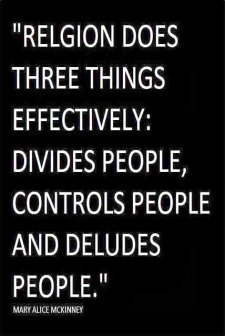
When I discovered this atheist meme (please, people, PROOFREAD the memes you generate before posting them), I certainly wanted to find the creator and tell him or her how much I appreciate this quote.

“Religion” divides people by ranking them, declaring some are better than others based on behaviour and adherence to group-think.

“Religion” controls people by declaring they must follow a long list of rules, most of which are gloriously petty and irrelevant to the big questions of life, death and eternity.

“Religion” deludes people by insisting they can earn their way into some sort of eternity with a creator if they only do enough good stuff, think enough ‘right’ thoughts and be enough of the kind of person that will win others’ approval.

I want nothing to do with “religion” because it has almost nothing to do with God.

“There is a difference, an important difference, between relating to God through doctrines, codes of conduct, inherited traditions, and relating to God directly, soul-to-soul, mind-to-mind, heart-to-heart,” writes pastor Bruxy Cavey in The End of Religion.

“Jesus [of Nazareth, who many people believe is God’s divine Son] taught this distinction, lived this message and was killed because of its implications.”

Does Jesus divide people? Absolutely. His message of love, acceptance and being a necessary intermediary between imperfect people and a perfect God split families and couples 2,000 years ago and it continues to do so today.

In fact, following Jesus and trusting that His sacrificial death makes up for all the wrong things I’ve done and all the right things I’ve failed to do has divided me from the rest of my biological family.

I’m not happy about this divide, but I’ve come to know that following Jesus is the most important thing I can do in this life and in the life to come. Furthermore, I’m now united with people of all races, genders and social/economic statuses who also follow Jesus.

Does Jesus control people? In a way, yes. When you trust in Him and commit yourself to seriously following Him, then he enters into your life and begins to change you. He’s working on me as you read this, making me more generous & less petty, more loving & less resentful, more charitable & less self-centred, more forgiving & less judgemental.

It’s a challenging, life-time project but I’m eternally grateful for what He’s doing because I’ve come to realize I can’t make me a better person on my own.

Does Jesus delude people? Just the opposite.

  • He reminds us of our complete and breathtakingly imperfect humanity.
  • He reminds us that God is perfect and that’s God’s standard for humanity to spend eternity with Him in Heaven.
  • He reminds us that even though we can never be perfect, we don’t have to be when we believe in Him and what’s He’s done for us through His life, death and resurrection.

In other words, when we accept the life-changing GIFT of Jesus, we can be better people now and, when this life is finished, we can spend eternity with Him.

Sound interesting? Yes or no, post your thoughts below and let’s have a conversation.

Read Full Post »

Religion is irrationalIs “religion” irrational, as this atheist graphic suggests?

First of all, I wouldn’t know because I’m not the least bit religious (and here’s why: http://wp.me/p2wzRb-i9). In fact, the world would be a much better place without religion.

So what about faith, which is a very different thing? Is it irrational? By the standards of our world, absolutely.

I don’t think it’s a stretch to declare that North American culture worships at the altars of science (don’t get me wrong, I find science quite fascinating), shopping, celebrity scandal, getting and staying rich, the latest technological gadgets and our next vacation.

All of these pursuits are pretty tactile; we can touch money and iPhones, suntan on a cruise ship, obsess over celebrities on our 60-inch flat-screen TVs, read all about the latest scientific discovery and stand in the middle of a crowded mall.

Can’t do any of that with faith. Can’t see or touch God, can’t make any money off Him (unless you’re one of those creepy televangelists) or obtain a vacation cottage or find out who’s wearing the black hat in the latest celebrity divorce spectacle.

Now, let’s think about what else is irrational in our world:

  • Love: as the 1960s anti-war song said, “what is it good for?” What can love achieve that a solid contract with a willing business/life partner can’t?
  • Superstition: Beyond the obvious (fear of black cats and walking under ladders) there’s “Beginner’s luck”, 666, Friday the 13th and cross your fingers. Can anyone credibly tell me these are rational?
  • Fashion: The sports jacket I wore five years ago is now a joke? Seriously?
  • Fear of flying: so it’s okay to be in a speeding vehicle but so much more dangerous to go on an airplane? Have you read any statistics lately?
  • Facial hair: it grows naturally on both genders, so what on earth possesses so many of us to shave it off?

As you ponder this list, consider the fact that most people who want nothing to do with faith accept many of these irrationalities without second thought. And that includes the atheist person who created the graphic that inspired this blog.

Why the double standard? Simple: faith is about something serious. Even more serious than love. It’s about how we view this world and how we think about what comes after this life ends.

Our culture constantly tells us not to bother with such things, but if you’ve read this far, then I bet you’re willing to think for yourself.

So consider this: not only is there a Creator of everything we see and experience, this creator is vitally interested in YOU. So interested, in fact, that He offers YOU a gift: His perfect Son, who came to this earth to live, die and be resurrected for YOU and everyone else who’s willing to accept that gift.

What do you think about this gift? Post your thoughts below and let’s have a conversation.

Read Full Post »

Hitler freewillMaybe you’ve seen this quote in social media. And, like the person who created this graphic, maybe you also think it’s silly.

But before you instantly agree and move on, give this graphic some thought. In fact, give it more thought than the person who created it.

The point is not whether God created good and bad people. The point is He created people with absolute freewill. In other words, people like YOU and me.

Did God know how Adolf Hitler would turn out? Quite possibly; followers of Jesus of Nazareth (who many people believe is God’s Son) believe God exists outside of space and time (even as He created them) so we can speculate that he was aware of the choices people would make.

So does that mean He suddenly changes His mind and stops someone like Osama Bin Laden from being born? I’m sure some folks would say yes.

If you’re one of them, this sudden denial of freewill is a slippery slope. If you believe God is perfect — a position held by serious Jesus followers — and stands in rightful judgement of his creations’ choices, then where do the limits on freewill end?

Should God also stop YOU from driving because He knows that one day, you’re going to hurt someone in an accident?

Should God have forced eternal singlehood on singer Kenny Rogers, actress Joan Collins, director James Cameron and TV host Larry King? Each was married at least five times; think of all the emotional pain and (possibly) financial hardship caused by all those divorces.

What about AK-47 machine gun inventer Mikhail Timofeyevich Kalashnikov? Wikipedia says Kalashnikov emphasized the weapon was for defensive purposes only and severely regretted the deaths it caused. But so what? Why not hold Kalashnikov and, by extension, God responsible for the actions of people Kalashnikov never even met?

Singer Amy Winehouse (1983-2011). There’s someone whose death we can certainly stick on God, right? After all, He should have denied her the right to ever touch a drop of alcohol, since it was a major factor in her death.

Casinos. Now there’s a good one. How dare God allow even one to be constructed, since gambling has contributed to freewill-loving people going bankrupt, to marriages and families breaking up, and to careers being destroyed.

Now let’s consider another element of freewill: The freedom to accept or reject the idea of a loving, perfect creator who has every right to judge you and me on all the wrong things we’ve done and the right things we’ve failed to do.

If you accept the idea, then how about the notion that this perfect creator wants His creations to spend eternity with Him — wants it so much that He sent His equally perfect Son to live among us and be put to death to pay for the sins of everyone who believes in His Son?

One of those believing people could be YOU, if you accept the gift of Jesus. What do you think? Post your thoughts below and let’s have a conversation.

Read Full Post »

Prayer-doubt 2.16No doubt about it: prayer is often a mystery, even to people who believe in it and practise it.

So I was intrigued by this graphic (found in an atheist internet community) because it asserts a viewpoint I haven’t seen before.

Indeed, doing a Google search of the question “Is prayer an act of doubt?” brought up almost no links. Apparently, most people (even those who doubt God’s existence) have never thought to pose the question.

So is praying an act of doubt? Blogger Juanita Ryan (www.JuanitaRyan.com) puts it very well when she writes: “We want to trust God. We want to have faith. But we have so many questions. So many things are unclear and uncertain.”

In western culture, doubting there even is a creator is common. So wondering if God is watching over everything is hardly rare.

But watching over everything is not the same as arranging everything. If you believe in God, then you probably believe in freewill. And that’s part of the mystery. How, when and where does freewill mix with God’s will? And how does all that work in His plan for this planet, for you and for me?

There are no definitive, truly satisfactory answers to those questions  And I’m fine with that. Questions like these are a powerful and necessary reminder that God is God. And I am NOT.

So are my prayers an act of doubt? Sometimes. Remember, as a man of faith (I follow Jesus of Nazareth, who many people believe is God’s divine Son), I’m surrounded by people — including my parents and brothers — who think praying to our creator is a joke, a quaint throwback to a time when Jesus was influential in my country (Canada).

Then I think about this point made by Juanita Ryan: “Where do we take our doubts if not to God? Where do we voice our uncertainties if not to God?”

Exactly. Just hours before Jesus was arrested on trumped-up charges, one of the original source documents of Jesus’ physical life on earth records that He spent anguished time on His own, praying to His Father about His fears and uncertainties.

“Jesus fell to the ground and prayed, “My Father, if it is possible, don’t make me drink from this cup [of betrayal, torture and death on a Roman cross]. But do what you want, not what I want”.

Right there is the biggest reason I can think of for praying. Jesus prayed. A lot. And he prayed about his uncertainties. And as a result, He was strengthened for the hard road ahead, so much so that He willingly carried out His Father’s plan to reconnect us defiant, sinful people to Him.

By trusting and believing in Jesus — His physical life and work, His death and resurrection — God no longer sees all the wrong things we’ve done and the right things we’ve failed to do. Jesus has paid the price for it all. So when this life is finished, those who trust and believe in Jesus will spend eternity with Him in Heaven.

Sound intriguing? Post your thoughts below and let’s have a conversation.

Read Full Post »

DawkinsForegivness 2.16I’ll bet there are folks out there who see this meme (helpfully supplied by an internet atheist community) and think “ya, why not just our forgive sins?” Maybe you’re one of those people.

First of all, I can confidently write that God is NOT trying to impress anyone. When you’re the creator of time, space and the universe, trying to impress anyone (even Himself) is just silly.

Second, this quote (by one of the world’s best-known atheists) displays a blatant ignorance — or outright rejection — of who God is.

Is God merciful? Yes. Does God want to forgive us for all the wrong things we’ve done and right things we’ve failed to do? Absolutely.

But God is also something else: perfect. And that’s His baseline standard for everything, whether we like it or not.

So why doesn’t He just forgive us? Well, why do we have courts? Why can’t we just ignore the dude who killed that guy in a bar fight? Why don’t we just overlook how she faked having cancer in order to bilk people out of thousands of dollars?

If these examples offend your sense of justice, then imagine how our creator feels about  our greed, our self-centredness, our violence, our willful ignorance and our cultural belief that we “deserve” the good life.

Is God judge and jury? You bet He is. Execution victim? Yes, that too.

If that last point seems strange, then understand that this is how it goes with those who follow Jesus of Nazareth (who many people believe is the Son of God): Knowing that we could never do enough or be enough to earn our way into Heaven, God paved the way for us. That way is through believing in and following Jesus.

One of Jesus’s followers describes Him this way: “He never sinned, and he never told a lie”. This is important and you’ll soon read why.

Jesus spent three years traveling around the Middle East with a band of followers, telling people the Kingdom of God (represented by Him) was near. He proved it by healing diseases, raising people from the dead and preaching revolutionary ideas like loving your enemies, refusing to retaliate when a wrong has been done to you and praying for those who hate you.

Then Jesus allowed conniving religious authorities to arrest him on trumped-up charges and convince political leaders to hand Him the ultimate punishment: death on a cross.

What they didn’t realize is that this death would pave the way to Heaven for anyone who believes in and follows Jesus. He paid the price that we should be paying.

Now, when God sees any Jesus follower, He doesn’t see the wrong things we’ve done and the right things we’ve failed to do. He only sees perfection. It’s like Jesus transferred His perfection onto anyone who believes in Him and follows Him.

There. I’ve done my best to explain why God doesn’t just forgive our sins. As you can see, He goes even further than that — sacrificing His Son for everyone who believes in Jesus.

Does this make sense? Yes or no, post your thoughts below and let’s have a conversation.

Read Full Post »

Dance of dogma 1.16When I saw this graphic on an Internet atheism community, I wasn’t sure why I saved it for Frank’s Cottage. Then I looked up the definition of “dogma”.

According to Wikipedia, dogma is “a principle or set of principles laid down by an authority as incontrovertibly true. It serves as part of the primary basis of an ideology or belief system, and it cannot be changed or discarded without affecting the very system’s paradigm, or the ideology itself.”

Hmm. Where does this apply? The more I thought about it, the more I realized: where DOESN’T it apply?

Every person on this planet follows some kind of “principle or set of principles laid down by an authority as incontrovertibly true.”

Evidence?

  • Business tycoons like Bill Gates and Warren Buffet are died-in-the-wool capitalists. They believe in and follow capitalist dogma and won’t have anything to do with any other economic system.
  • Remember communism? Some of its most famous practitioners — China’s Mao Tse Tung and Russia’s Vladimir Lenin — believed in and followed communist dogma their entire lives. They refused to have anything to do with democracy.

What about atheists? Based on my many, many interactions with them, most appear to follow dogma laid down by atheist authors Sam Harris, Christopher Hitchens (1949-2011) and Richard Dawkins.

These three routinely advance the position that there is absolutely nothing good about “religion” (I agree, and here’s why: http://wp.me/p2wzRb-i9) and that believing in a supreme creator is primitive superstition and harmful to humanity.

In the atheist Internet communities I often visit, these viewpoints are treated as dogma. In these communities, I never see posts that contradict these positions.

So, dogma applies to all of us. That leaves the question: which dogma do YOU follow? In your heart of hearts, do you believe that it’s all about having a comfortable, happy life now and never mind what comes after? Do you believe that when you die, all that you are will become nothing more than rancid worm food?

Do the dogmas I just mentioned leave you feeling cold and, perhaps, even a bit hopeless? Are you ready to re-examine them, despite the pressures of your friends, loved ones and our culture as a whole?

Then consider the claims of Jesus of Nazareth, who many people believe is the Son of God. Consider His astonishing, challenging wisdom. His miracles. His death – which wipes out ALL the wrongs committed by people who follow Him – and resurrection.

Talk to knowledgeable people about Him. If you don’t know any, then email me at fdking@hotmail.com and I’ll do my best to help. No matter what our culture insists, figuring out what dogma YOU follow is important stuff.

Read Full Post »

thinking, religionWhen this graphic (posted on an Internet atheism community) caught my attention, the first thing I thought was: Religion? Yech.

I’ve written often about the poison of “religion”. Not the dictionary version, which few people in our culture understand or care about. No, I’m writing about the version that most people think of as soon as the word is mentioned:

  • People who are smug and judgmental.
  • People who don’t really care what happens to others who aren’t in their religious group.
  • People who are happy to welcome others into their group/church, as long as THOSE people change themselves to fit in.
  • People who spend their time being angry, paranoid and opposing things, rather than supporting anything.
  • People on TV who promise wealth and a good life as long as you send them money.

I follow Jesus of Nazareth (who many people believe is the Son of God), so I want nothing to do with this “religion”. Indeed, He doesn’t either. In the four original-source biographies of His physical life on earth, some of Jesus’s most passionate words are against smug, arrogant, rule-obsessed “religious” leaders.

So what about the “thinking” part of this graphic? It’s easy to assume it’s true because in our culture, thinking people of faith are generally ignored by the media. Indeed, some of them may face such opposition to their faith in Jesus that they keep it hidden.

But they are out there. Here are just a few examples of these faith-filled thinkers, listed on Wikipedia:

Rosalind Picard (born 1962) is a Professor of Media Arts and Sciences at the Massachusetts Institute of Technology in the U.S. She’s also founder and director of the Affective Computing Research Group and co-director of the Things That Think Consortium. Picard says she was raised an atheist, but decided to follow Jesus as a young adult.

John Lennox (born 1945) is a mathematician, philosopher of science and pastoral adviser. His books include the mathematical The Theory of Infinite Soluble Groups and the faith-oriented God’s Undertaker – Has Science buried God?

Father Andrew Pinsent (born 1966), a priest, is the Research Director of the Ian Ramsey Centre for Science and Religion at Oxford University in England. He is also a particle physicist.

These three highly respected people think, therefore they are people of faith. This suggests the graphic that inspired this essay has little to do with reality. In the end, your level of intelligence has nothing to do with whether you believe in God and His Son.

Whether you believe in God and His Son has EVERYTHING to do with humility. A willingness to admit you don’t have all the answers (and never will, in this life); you don’t understand everything (and never will, in this life); and a realization that your life can be better, right now, because you believe in a loving God who offers this broken world the gift of His Son.

What do you think? Post your thoughts below and let’s have a conversation.

Read Full Post »

When I first saw this graphic, generously shared on an atheist internet community, my first reaction was “Hmm…wonder where I could buy a great shirt like this?”

I’m a person of faith who knows the world needs a cure for “religion”. You know, all that stuff that says you can torture, rape and kill ‘unbelievers’. (Or worse still, people who leave my “religion” for another “religion”.)

Am I overstating it? Then let’s examine the “religious” part of just one faith, Christianity. You may have experienced it:

  • People who appear to have it all together sitting in cold-hearted judgement of others.
  • People who sniff their disapproval of those with tattoos or nose rings.
  • People who claim they welcome others to their churches — as long as those people fit in, ’cause hey, we’re certainly NOT going to change for YOU.
  • People who seem to spend more time angrily opposing things than lovingly offering an alternative.

All this is how I see “religion”.

Is there a cure? Absolutely, but it’s controversial. It’s Jesus of Nazareth, who many people believe is God’s divine Son.

Still with me, but wondering what the heck I’m writing about? Good.

During His physical time on earth, Jesus had little use for the rituals of “religion” and the self-righteous, soulless lives it so often produces.

In  one of the four original-source biographies of Jesus’ life, He says this to people like you and me: “Burned out on religion? Come to me. Get away with me and you’ll recover your life. I’ll show you how to take a real rest. Walk with me and work with me—watch how I do it.”

In his book The End of Religion, Canadian pastor Bruxy Cavey writes “Notice how Jesus is not pointing toward a different and better religion, but instead He invites us to Himself as an alternative to the weary way of religion.”

Exactly. That’s the thing you might not know: being a Jesus follower isn’t about a religion. It’s about a person and how you and I can have a relationship with Him that starts in this life and stretches into eternity.

That means no guilt-induced rituals that create nothing but spiritual fatigue. It also means thoughtfully, consciously turning away from the elitism of “us versus them” and the smugness of judgmentalism.

When people honestly, humbly come to Jesus, they come knowing they are every bit as imperfect as the people they are tempted to judge. They come with the realization that it’s them who must change.

That was the case for me when I decided to believe in and follow Jesus at age 42. And it’s made me a better person.

Do you want to be a better person without the shackles of religion? Then check out Jesus, because He tells everyone who will listen that “anyone who drinks the water I give will never be thirsty again. The water I give people will be like a spring flowing inside them. It will bring them eternal life.”

Sound interesting? Yes or no, post your thoughts below and let’s have a conversation.

Read Full Post »

religiousWhat if I told you that I’m a serious man of faith who thoroughly, enthusiastically AGREES with this graphic?

Posted on an Internet atheism community, the message is probably aimed at followers of Jesus of Nazareth (who many people believe is the Son of God).

That said, I certainly don’t take any offence. Being “religious” no more makes a person “good” than going into MacDonald’s makes one a Big Mac.

In fact, I’ll go further and write that being “religious” is far more likely to make a person arrogant, petty, self-righteous and overwhelmingly judgmental.

Such characteristics should not be found in a devoted follower of Jesus. Indeed, one of his earliest followers wrote this:

“But what happens when we live God’s way? He brings gifts into our lives, much the same way that fruit appears in an orchard—things like affection for others, exuberance about life, serenity.

“We develop a willingness to stick with things, a sense of compassion in the heart, and a conviction that a basic holiness permeates things and people. We find ourselves involved in loyal commitments, not needing to force our way in life, able to marshal and direct our energies wisely.”

Compassion? A conviction that all of God’s creations (no matter how warped or broken they might be) are special? There’s precious little room for that in a person who’s busy being self-righteous and judgmental.

Let me be clear: Jesus followers are a long, long way from anything approaching “perfect”. There are still moments when I find myself spending more time opposing people and positions than supporting their right to free speech.

But that’s okay. Like it or not, all Jesus followers are a work in progress. If we’re serious about this journey with the Son of God, we strive to:

  • Regularly attend church (a hospital for sinners, NOT a museum of saints)
  • Read the original source documents about Jesus’s life on earth (which gives us insights on who God is, why He sent His Son and how we can live our lives like Jesus)
  • Give to charity, because as Jesus tells anyone willing to listen, “Give to others, and you will receive. You will be given much. It will be poured into your hands—more than you can hold … The way you give to others is the way God will give to you.”
  • Practise humility and humbleness, because Jesus tells His followers, “For those who make themselves great will be humbled, and those who humble themselves will be made great.”
  • Tell others about how following Jesus has changed our lives for the better and can do the same for them. Why? Because He clearly instructs his followers to “go everywhere in the world. Tell the Good News (about God and eternal life in Heaven) to everyone.”

That’s why I’m writing this essay for YOU to read. I want you to experience the same positive life change as me. I want you to know, like I know, that God loves YOU passionately and offers YOU the gift of His Son.

Interested? Yes or no, post your thoughts below and let’s have a conversation.

Read Full Post »

Christianity asking questionsWhen I found this graphic (kindly supplied by an Internet atheist community), my first thought was “All the answers? Wouldn’t that be nice!”

I can’t write about other faiths, but I can write about mine. As a follower of Jesus of Nazareth — who many people believe is God’s divine Son — I have all kinds of questions for which I’ve never found the answers. And likely never will.

Questions about the Bible. Questions about why Jesus did — and did not — do certain things. Questions about why this world is the way it is and why things never seem to really change.

I suspect most other Jesus followers have questions similar to mine. So right from the get-go, following Jesus is not among the faiths — I have no interest in ‘religion’ and here’s why: http://bit.ly/ReligionSlavery — that are targeted in this graphic.

In fact, there are examples of people asking challenging, emotional questions right in the Bible:

From a section called ‘Psalms’ – My God, my God, why have You forsaken me? Why are You so far from helping me, from the words of my groaning?

While He hung on a Roman cross, convicted of trumped-up charges, Jesus cried out a similar question – My God, my God, why have You left me alone?

Also from Psalms – Lord, how long until You heal me? Lord, why do You stay so far away? Why do You hide from people in times of trouble? How long will You forget me, Lord? Will You forget me forever?

These are just a few examples of people in the Bible who felt no restrictions on asking tough questions. In fact, if the Son of God could ask such a difficult question, why can’t the rest of humanity?

This freedom is just one reason why, in my 40s, I decided to follow Jesus. Now maybe you’re thinking “Ya, but you didn’t get your questions answered. So where’s the upside to your argument?”

The upside is my unanswered questions are a powerful, and very necessary, reminder that God is God. And I am NOT. An ancient prophet stated it very clearly: The Lord says, “My thoughts are not like yours. Your ways are not like mine. Just as the heavens are higher than the earth, so my ways are higher than your ways, and my thoughts are higher than your thoughts.”

Another upside? A wise pastor friend told me that, when this life is done, all my questions likely won’t matter anymore. I’ll be in Heaven for all eternity with Jesus. Questions? What questions?

What do you think? Post your thoughts below and let’s have a conversation.

Read Full Post »

« Newer Posts - Older Posts »