Feeds:
Posts
Comments

Posts Tagged ‘Frank’s Cottage’

DiscoveryOfSelf 2.14Isn’t it funny how life works? Actor Brad Pitt claims leaving “religion” behind helped him discover who his is. And yet, for millions of people around the world, entering a life of faith accomplished the same thing.

What fascinates me about this graphic (found on an atheist Internet community) is Pitt’s words about the “comfort” of “religion” (a word I dislike – it carries a ton of negative baggage).

I’m a serious follower of Jesus of Nazareth, who many people believe is the Son of God. Is my faith in Jesus a comfort? Of course it is. Just as a fat bank account or a prestigious career or a trophy spouse is a comfort for many others.

I’m comforted knowing that because I believe in and follow Jesus, His sacrificial death on a cross wipes my slate clean with the creator of the universe. God no longer sees the bad things I’ve done and the good things I’ve failed to do. He sees me as He sees Jesus – “in Him there is no sin” wrote one of His earliest followers .

But there’s something very uncomfortable about that, too. If I take what Jesus did for me seriously, then I’ll want to live up to His remarkable gift. I’ll want to welcome Jesus into my life so He can guide me away from bad behaviour and towards doing good.

You might think that’s easy to do and why on earth would I need Jesus to pull it off? I’ll tell you why: because it’s NOT easy to do. I miss the mark, of being the kind of person God knows I can be, so often that I don’t even realize it. And so does every other person on this planet.

It’s like we live blindfolded, believing everything our culture tells us, thinking we look so cool and “together” when, in God’s eyes — and He knows you and me better than we ever could — we are stumbling around like drunken fools.

That’s one part of the “discovery of self” that Brad Pitt mentioned. The other part is this: as a follower of Jesus, I know that God loves me more than my wife, more than my parents, more than my stepkids. More than all of them put together. That’s pretty remarkable, especially as most of us (whether we acknowledge it or not) live with a harsh critic in our heads.

Think hard about this: how often do you put yourself down? Do you even recognize all those occasions? Then consider this: God knows all your shortcomings. All the bad things you’ve done and the good things you’ve failed to do. Yet He loves you. And loves you so much that He offers you the gift of His son. All you have to do is accept it.

If you do accept that gift with a sincere heart (not just as a way to avoid judgement when this life ends), then you’ll start on a journey of self-discovery that will leave Brad Pitt’s in the dust.

Agree? Disagree? Post your thoughts below and let’s have a conversation.

Read Full Post »

If anyone knows how to stimulate conversation, it’s militant atheist and U.S. talk show host Bill Maher. That said, I’m not sure Bill ever thought this quote would be used to explain a truth about following Jesus of Nazareth.

Bill asks a great question here. It’s a question I asked before and after I decided to follow Jesus (who many people believe is God’s Son) more than 10 years ago.

After making that decision, I held up Bill’s question to the hard light of examination. And I pondered the nature of all us human beings. Then the answer came to me.

  • What message am I sending when I selfishly refuse to talk to my wife if I don’t get my own way?
  • What message am I sending when I use all my tax return for vacations or electronic toys instead of putting some aside for charity?
  • What message am I sending when I’m driving to work and I give someone the one-finger salute because I don’t care for his or her driving?
  • What message am I sending when I pay a contractor under the table and avoid the taxes I should be paying?

It’s the same message every time. And it’s this simple: “God, don’t even lay one finger on the devil”.

When I do wrong and/or fail to do right, I’m telling my creator that I’m siding with His opponent. In fact, let me go so far as to write that I’m informing God that I like the devil more than I like Him.

If you’re a little disturbed, good. I’m certainly disturbed when I find my actions broadcasting that message. And yet, I seem to do it almost as often as breathing. In fact, when I live my life without acknowledging God and His gift to everyone who will accept it, I’m goose-stepping to the beat of His opponent.

Now take my “sins” and multiply them by, oh, a trillion. Now you can see why God doesn’t just defeat the devil. Because the actions of all humanity tell Him, with numbing frequency and nauseating volume, that we don’t want Him to. And so He doesn’t.

There is a way out of this deeply vicious cycle. A way to ensure that my actions don’t help fill up the bottomless sea of ugly messages to God. And that way is to accept His gift.

Tell God you’re sorry for the bad things you’ve done and the good things you’ve failed to do. Tell him you accept Jesus as your saviour and acknowledge His death wipes your past, present and future slate clean. And invite Jesus into your life.

If you’re serious about this, then watch things start to happen. Amazing, life-changing things.  You’ll never be the same. And you won’t be siding with God’s opponent anymore.

Does this make sense? Yes or no, type your comment below and let’s have a conversation.

Read Full Post »

Eternal Damnation 2.14You know what? I agree with this graphic, which I found on an internet atheism community.

Sadly, there are people of faith who try to be “good” because of the threat of eternal damnation. I kinda feel sorry for them; they must feel pressured, hounded and even miserable.

That said, does this mean they are really “bad” people who are just trying to avoid being separated from God for eternity? Perhaps.

But let’s move on to the vast, vast majority of those who follow Jesus of Nazareth (who many people believe is God’s divine Son). For them, this graphic is as wrong as a snowstorm in July.

Indeed, for me and pretty much every Jesus follower I know, the threat of “eternal damnation” has nothing to do with our desire to be a “good person”. (And what qualifies as good? I address it in The Problem With ‘Good’: http://wp.me/p2wzRb-7j).

The want to be a good person comes because:

  • God wants us to be good
  • God has put his spirit inside us to help us be good
  • God wants to work through us to make this broken world a better place – and we’re not much use to Him when we’re only trying to be good to avoid “eternal torture”.
  • God offers everyone the gift of Jesus to guide us with His words, His sacrifice on a Roman cross (to make up for all the bad things we’ve done and the good things we’ve failed to do), and His resurrection. Jesus followers have accepted that gift, so we want to be worthy of all that we believe Jesus has done for us.

Here’s the thing: God offers everyone, including YOU, that gift of Jesus. All you have to do is accept it. Simply pray that you’re sorry for how you’ve fallen short of what God wants for you and, from now on, you want to accept Jesus as your lord and saviour – the man whose sacrifice makes up for how you’ve fallen short. Welcome that gift into your life.

Then, if you’re serious about what you’ve done, start reading original-source Jesus biographies (there are four, in total). Find a church and start attending. If that church doesn’t work for you, find another.

This process may seem tiresome, but it’s crucially important because when you’re surrounded by others who are serious about following Jesus, God can and will work through them to help YOU on your journey. And, just as cool, God can and will work through you to help them on their journeys.

Trust me, as someone who has been used by God for His mysterious, amazing purposes, there’s no feeling like it!

Does this make sense? Yes or no, post your thoughts below and let’s have a conversation.

Read Full Post »

God all-powerful? 2.14Is God all-powerful?

You’d think I would know better by now. And yet, I naively continue to be amazed at how some folks seem to willfully delude themselves and work like there’s no tomorrow to stay ignorant.

This graphic is a case in point. It was posted on an atheism internet community; in my experience, most of the people in these communities know the Bible pretty well. Then someone uploads a graphic like this…..

First of all God IS all-powerful. Consider these excerpts from ancient prophetic writings:

  • Look! I am the Eternal, the God of all living things. Is anything too difficult for Me?
  • God doesn’t come and go. God lasts. He’s Creator of all you can see or imagine.
  • There are things about God that people cannot see—his eternal power and all that makes him God. But since the beginning of the world, those things have been easy for people to understand. They are made clear in what God has made.

Now consider the evidence of hundreds of thousands of years: all the bad things me, you and the rest of humanity have done (and the good things we’ve failed to do). Could there be a clearer measure of proof that God is serious about the gift of freewill?

Indeed, God could have stopped Roman authorities from putting Jesus of Nazaareth (who many people believe is His divine Son) to death on trumped-up charges. But he allowed freewill to take its course.

In our day and age, God could have stopped Al Qaida from carrying out the 9-11 terrorist attacks. But once again, He allowed freewill to take its course. (You may not like that, but if He stopped that, then where would the limits on freewill end? I address that here: http://wp.me/p2wzRb-38.)

My point here is that God could easily force people to believe in Him. But what would be the point? To prove He’s powerful? Really? I don’t think the creator of time, space and the universe needs to prove a darn thing.

What He does want is for all of us to come to Him, through His son, because WE want to. Here’s how one of Jesus’s earliest followers put it: “God wants everyone to be saved and to fully understand the truth.”

The truth is this: “If you openly say, ‘Jesus is Lord’ and believe in your heart that God raised him from death, you will be saved.” That’s from the same early follower.

Saved from what? From being judged on all the bad things we’ve done and the good things we’ve failed to do. When I decided to follow Jesus, His sacrificial death on a Roman cross cleaned my account with God. God no longer sees my mistakes, my pettiness, my times of thinking I can do everything without Him. He sees me as perfect – just like Jesus.

Does this make sense? Post your thoughts below and let’s have a conversation.

Read Full Post »

Dead Man WalkingDead Man Walking is the name of a well-known 1995 film starting Susan Sarandon and Sean Penn. Until 2002, it was also the perfect description of my life.

The term comes from the United States prison system and generally refers to a death row inmate making his or her last walk to their place of execution.

So why did it once describe my life? In its more informal meaning, Dead Man Walking refers to any person in a doomed or untenable situation. And that’s where I was.

  • I lived how my family, friends, co-workers and neighbours wanted me to live:
  • Bigger was better.
  • Shopping was *never* a waste of time or resources.
  • I deserved luxurious, expensive vacations (even if I had to go into debt to pay for them).
  • I certainly didn’t waste much time thinking about the big, supposedly unanswerable questions of life.

If you’re still with me, then think about it for a moment: does my life before 2002 sound at all like your life today?

Living like that didn’t make me miserable, but it didn’t make me happy, either. I came to realize that playing the comparison game, which is what our culture relentlessly “suggests”, was a dead-end street. My life had as much meaning as an episode of Two and a Half Men; it was as shallow as a mud puddle. I was in a doomed or untenable situation.

So what changed? I always believed there had to be a creator for all that we see and, from time to time, I would ponder who or what that creator might be. And I pondered what might come after this life ends.

Finally, after much thought, reading and debates with people who value a relationship with God, I put my trust in God and in Jesus Christ, whom serious Christians believe is His Son.

At age 42, I was no longer a Dead Man Walking. I knew – and still know – why I’m here: to have a relationship with God through Jesus Christ; to do my best to represent Christ to everyone I encounter; and spend eternity with Him.

This relationship is teaching me to think about:

  1. people in a more compassionate way (as being loved by God, whether I like them or not)
  2. our Earth in a better way (it’s God’s planet, not mine to do with as I please) and
  3. my life in a deeper way (what is truly of value?).

Are you at a place where you’re willing to consider that maybe you’re in a doomed or untenable situation? And is my solution worthy of consideration? Post your thoughts below and let’s have a conversation.

Read Full Post »

sin-picture2There’s a simple sentence in the Bible that is mysterious, possibly offensive to some, and yet has great hope for all humanity.

The sentence comes from Paul of Tarsus, one of the people most responsible for spreading Christianity throughout the Mediterranean.

In one of his letters to churches he helped create, Paul wrote “all have sinned and fallen short of the glory of God.”

Huh? Reactions to this can range from bewilderment to indignant rejection. When I first encountered this sentence, I had these responses. But something kept tugging at me, so I puzzled and pulled at it until these facts emerged:

1.    Yes, we have all fallen short, somehow, of achieving the hopes and dreams God has for every single person on this planet. Even the people most idolized by North American society – Bill Gates, Oprah Winfrey, the late Steve Jobs, U2, Brad Pitt, the late Mother Teresa – could list regrets or occasions where they dropped the ball. If they can’t, then I’ll be bold and declare they are fooling themselves.

2.    Paul is being universal. Notice how he doesn’t say “please see the end of this letter for a list of exceptions.” Or, “the following groups have sinned a little less (or more)…”. No, he simple makes the statement and gets out.

So, what does this mean for all humanity? One inescapable, controversial truth: the intrinsic value of every person that ever was, is and will be is identical. That’s right, folks: my intrinsic value is the same as Pope Francis. And Billy Graham’s value is the same as the late Osama Bin Laden.

Are you recoiling in horror? I wouldn’t be surprised. Our culture encourages us to judge others by their deeds and “status”. You see it all the time, such as when professional athletes are allowed to “jump the cue” and get flu shots before the rest of us.

But I don’t think deeds and status are the barometer for God. I believe He loves us not for who we are or what we’ve done, but because He is love. He invented it and another quote in the Bible tells us God so loved the world – and that means everyone on it – that he gave his only son (Jesus Christ) and whoever believes in and seriously follows the son will go on living even after his or her body dies.

That statement doesn’t say God loved some people more than others. Like Paul’s sentence, it simply says He loves and that’s it.

Is there a challenge for us here? You bet. Think about this:

  • Would the 1994 genocide in Rwanda have occurred if we all took Paul’s words seriously?
  • Would the Nazis have carried out the Holocaust if they agreed with Paul?
  • Would there ever have been the horrific “honour killings” of women that still occur in Pakistan and India (and even in Canada!)?
  • What about the Hindu caste system that condemns some people to a life of poverty? Would it exist if Paul’s words resonated in the Hindu faith?

I know I stand condemned for things thought and done (or not done) because I haven’t always lived up to the facts behind St. Paul’s simple sentence. But as long as that sentence exists, there is hope for me. For you. For this world. Do you agree? Post your response below and let’s have a conversation.

Read Full Post »

Trustworthy 1.14Darn it, I guess I’m untrustworthy.

That was my reaction when I saw this graphic posted on the Internet.

Time and time again, I’ve “cleared my conscience” of my immoral acts by asking for forgiveness from my “imaginary friend”.

And it’s worked, too. I’ve been forgiven and had my conscience cleared. But then again, I follow Jesus of Nazareth (who many people believe is the Son of God), so I’m certainly not operating under the cynical world view of whoever created this graphic.

For example, I don’t treat the act of asking for forgiveness as a ticket to do whatever I like and then effortlessly get off the hook later on.

Because I follow Jesus, I know that He gave up his life to make up for all the wrong things I’ve done and all the right things I’ve failed to do. That’s serious business. And that’s why I don’t take forgiveness lightly.

Every time I do something wrong or ignore opportunities to do something right, I’m showing contempt for Jesus’ enormous sacrifice. And every time I come to God with a humble and sad heart, asking for forgiveness, I’m saying what Jesus did matters. What Jesus did really does give me an opportunity to do things differently.

Compared to the cynicism of whoever created this graphic, that’s the key difference in how Jesus followers view forgiveness. In our better moments, we don’t see it as ending there. In fact, asking for and receiving forgiveness is only the start of the process.

If we’re serious about it, then we open our hearts and minds to becoming the kind of person God knows we can be. We ask for His help in becoming that person and we read the original-source Jesus biographies to learn more about who a follower of Jesus should be and how we can get there.

We also go to church services to be surrounded by others who, for the most part, are on the same journey. In this way, we become the prime people God works through, in His mysterious way – to make each of us more like Jesus.

Being more like Jesus means:

  • 
Being kinder to everyone.
  • Being honest about our shortcomings and honestly seeking forgiveness from God and from each other when we fall short.
  • Seeing everyone – and I mean EVERYONE – as being loved equally by God.
  • Understanding that our world is damaged and God wants to work through us to repair it.
  • Standing up for the oppressed, for the weak, for the poor, just as Jesus did (and continues to do).
  • Being trustworthy, to prove, over and over, that the creator of this graphic is simply wrong.

You can join me on this journey. You can open your heart to God, to His gift of Jesus, and then watch in amazement as God begins to change your life.

What do you think? Post your reaction below and let’s have a conversation.

Read Full Post »

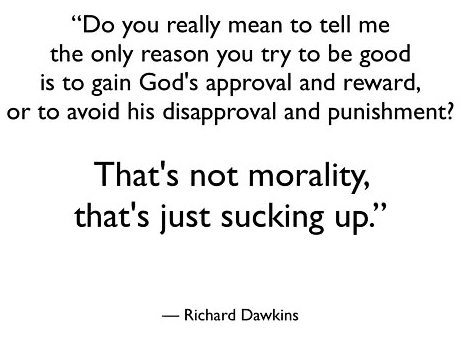
Missing The PointIs ‘sucking up’ really the only reason followers of Jesus of Nazareth (who many people believe is the Son of God) try to be good? I’m sure there are lots of people out there who believe that. And, sadly, I’m sure there are Jesus followers who do, in fact, live with this sentiment in mind.

I’m not one of them. And neither are most other people who know the truth of their faith. That’s why this graphic, found on an internet atheism community, so hugely misses the point — and that’s disappointing because the author is a shining star in the atheism world and probably knows the Bible inside and out. All that said….

I try to be good because I want to be the person God knows I can be. In fact, when I decided to follow Jesus (at age 42), I welcomed God’s holy spirit into my heart and mind to help me be a better person – because I simply couldn’t do it on my own.

I try to be good because, in one of the original source biographies of Jesus’ physical time on earth, He tells His followers “Anything you did for one of the least important of these brothers and sisters of mine, you did for me”.

I try to be good because, in a letter written by one of Jesus’s brothers, we’re told “Isn’t it obvious that God-talk without God-acts is outrageous nonsense?” In other words, I wouldn’t be much of a Jesus follower if my faith didn’t result in me at least attempting to do good.

I try to be good because one of Jesus’s earliest followers puts it this plain and simple: “God’s people should be bighearted and courteous”.

Finally, I try to be good because I believe Jesus was crucified to make up for the bad things I’ve done and the good things I’ve failed to do. Given His incredible sacrifice to wipe my slate clean with God, the least I can do to show my gratitude is try my best to get my act together.

Anyone who knows me also knows that I often fall short of being “good”. (Just ask my very patient wife.) But that’s why I follow Jesus. That’s why I attend church regularly, so God can use the pastor and other Jesus followers to encourage me and instruct me on being good.

What do you think of this? Post your thoughts below and let’s have a conversation.
Read Full Post »

Fear 12.13I’m still trying to work up some fear. If you see logic with this graphic posted on an Internet atheism community, then apparently that’s the basis of my faith (not “religion” – that’s a nasty word).

If I am to believe this graphic, then I came to a place of fear at age 42 – after reading many books from a variety of perspectives, debating several brave people and thinking long and hard about how this planet works.

After all that, I decided to follow Jesus of Nazareth — who many people believe is the Son of God — because I simply became more and more fearful.

NOT.

There’s no doubt that ‘fear of the lord’ is mentioned in ancient texts. Often, in fact. Here are just a few examples:

  • Wisdom begins with fear and respect for the Lord.
  • The fear of the Lord is the beginning of wisdom.
  • A simple life in the Fear-of-God is better than a rich life with a ton of headaches.
  • Happy is the one who always fears the Lord, but the person who hardens his heart to God falls into misfortune.

As I scanned these and so many other passages written by ancient prophets, it became plain that there are good reasons to fear the Lord:

1. Fear the possibility of disappointing Him. God knows my potential. He knows yours, too. In fact, He put that potential into you and me. So I fear not living up to that potential, of not truly letting Him into my life so He can make me all that I can be.

2. Fear mixing up who is in charge. I don’t know about you, but in North American culture, I need constant reminders that God is God. And I am NOT, no matter how many channels I can get on TV, no matter how many pills I can take to try and extend my life & health, no matter how often I’m told that I have control over everything.

3. Fear makes at least some sense when approaching the creator of space, time and the air you and I breathe. I heard one pastor liken it to approaching a massive, stunning waterfall like Niagara. We want to come close, but we also know that if we get too close, the water could drown us. And yet we still cautiously approach because it’s just so amazing, so glorious, so spectacular. We want to be in its presence.

Does this make sense? Yes or no, post your thoughts and let’s have a conversation.

Read Full Post »

PlaceholderGod 11.13I wonder: do I lack courage or intellectual honesty?

It’s a question I asked myself after seeing this meme on an internet atheism community.

I can say for certain that there are all kinds of important questions that I can’t answer and, I suspect, no one else can, either. Questions about stuff in the Bible, for example. Or questions about why our world is shot through with disease, violence and inequality.

But if you remember where I found this piece of internet art, you can probably guess – as I did – that whoever created it doesn’t think “God” is an explanation for anything.

If your whole being is trusting in science, then maybe you hope it will eventually figure out everything. And we’ll be left with no creator.

I follow Jesus of Nazareth (who many people believe is the Son of God) and so that’s not my hope. In fact, I know it will never happen.

Let’s get one thing straight, however. I like science. I like it a lot, primarily because it’s one of the ways God shows us how He works. I have lots of moments where I’ll read about discovery in physics or astronomy and think “Ah, that’s how God did it. Cool!”.

That said, science will never answer the most basic of all questions: Why are we here? What happens to us when we die? And I’m fine with that.

These unanswered questions are important because they remind me that even after all I can find out about God from ancient texts and writers, I still know that He is a mystery. To put it another way, God is God. And I am NOT.

“Trust God from the bottom of your heart; don’t try to figure out everything on your own.
Listen for God’s voice in everything you do, everywhere you go; he’s the one who will keep you on track.”

That’s from an ancient, God-inspired writer and it makes sense to me.

So how do you hear God’s voice? One way is to read original-source documents about the life of Jesus  and, when you encounter something you don’t understand (and trust me, you will), ask a knowledgeable Jesus follower. Or ask me (I’m no expert, but I can give it my best shot or direct you to where you can get a credible answer). Or visit a website like the Christian Apologetics & Research Ministry (http://carm.org/) and ask your question(s).

You can also start attending church. That’s where you’ll meet pastors and Jesus followers who will help you hear God’s voice.

Finally, you can pray. Prayer is a mystery (I wrote about that mystery here: http://wp.me/p2wzRb-9a), but it’s definitely worth doing, if for no other reason than Jesus, during his physical time on earth, prayed all the time.

Does all this make sense? Post your thoughts below and let’s have a conversation.

Read Full Post »

« Newer Posts - Older Posts »