Feeds:
Posts
Comments

Posts Tagged ‘Jesus Christ’

faithIf I’ve learned anything during my years of writing about faith, it’s that there are folks out there who absolutely DETEST that word.

Most of those people would vigorously agree with the graphic that inspired this essay, which I found on an Internet atheism community.

Maybe you’ve never given the word much thought, but now that you’ve read the graphic, you’re thinking “ya, it’s all about ignorance!”.

So let’s look at the word for a moment. The Pocket Oxford Dictionary defines faith as: 1. complete trust or confidence; 2. firm, especially religious, belief; 3. religion or creed; 4. loyalty, trustworthiness.

First off, I want nothing to do with “religion” and this blog explains why: http://wp.me/p2wzRb-eu.

Secondly, would anyone in their right mind credibly call someone like Henry Schaefer ignorant? Schaefer, a chemist, earned the 1979 American Chemical Society Award in pure chemistry. He also wrote Science and Christianity: Conflict or Coherence?

Here’s another person that no thinking person could ever label ignorant: Ard Louis teaches theoretical physics at Oxford, one of the world’s most prestigious universities. Before that, he managed to get rid of just enough ignorance to teach theoretical chemistry at Cambridge University.

What do Schaefer and Louis have in common? They follow Jesus of Nazareth, who many people believe is the Son of God. And there are many, many more Jesus followers who are making contributions in chemistry, physics, engineering and biomedical sciences.

Schaefer and Louis have what the Pocket Oxford calls “complete trust or confidence” in Jesus — His teachings, His death, His resurrection and the truth of what He said about His creator (who also happens to be your creator).

So what isn’t faith? A pastor at my church, Henry Shore, laid it out:

  • Faith is not a positive mental attitude.
  • Faith is not a belief in a force or in a formula
  • Faith is not psyching yourself up with wishful thinking
  • Faith is not believing I can accomplish anything if I put my mind to it.
  • Faith is not believing if I believe hard enough, like some TV preachers would have us believe, then it’ll become a reality.
  • Faith is not faith in our words, it is not faith in ourselves, it is not faith in faith.
  • True faith is in God. The focus isn’t on the faith; but on the object of our faith.

From a Jesus perspective, faith is having firm belief — based on a mix of evidence and belief — that there is a creator for all that you and I see and experience. And that creator offers you and me a gift: Jesus.

Look into that gift. Talk to knowledgeable Jesus followers about Him. Despite what your friends and family may tell you, this is important and serious stuff. And it’s good news.

Read Full Post »

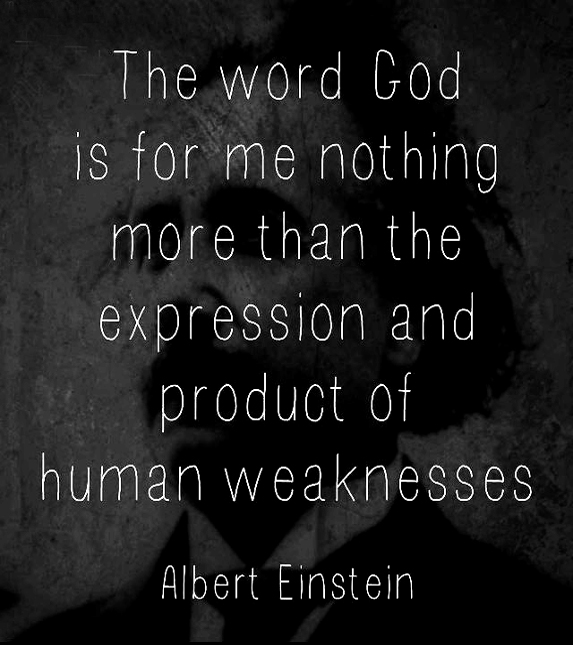
Albert Einstein God quoteDid Albert Einstein believe in God?

A quick Internet search reveals this question has been debated for many decades, even before the famed physicist (1879-1955) and secular Jew died.

According to Wikipedia, Einstein used many labels to describe his “religious” views, including agnostic (one who simply doesn’t know if there’s a God) and religious nonbeliever (which appears to be pursuing inner spirituality without any connection to a creator).

Whichever term you prefer, I get the feeling Einstein lived most, if not all, of his life as if there was no God. In other words, he likely had more in common with atheists than with people of faith.

All that said, what about the quote in the graphic that inspired this essay? In some ways, he and I are in absolute agreement.

I am weak. Just like every other person on this planet. Fear, mistrust and self-doubt are part of my makeup. Just as they are part of yours.

So rather than God being a product of my human weakness, God is the solution — but not the sort of distant, disinterested creator that Einstein may or may not have believed in. (Wikipedia’s Einstein entry indicates he once wrote, “I do not believe in a personal God and I have never denied this.”)

A creator who simply winds up the universe like a clock, then walks away and lets it run with no concern or involvement is not a creator I would bother with. Would you?

But a creator that inspired and energized the entire life, death and resurrection of Jesus Christ (whom serious Christians believe is God’s son)? Ah, that’s a God who’s making a difference in this broken world.

According to the Bible (which a majority of Christians take very seriously), that God offers this world a gift: Jesus, his life, teachings, sacrificial death and resurrection.

In ‘John’, one of four Bible accounts of Jesus life, a creator who cares about this world and everyone in it, “didn’t go to all the trouble of sending his Son merely to point an accusing finger, telling the world how bad it was. He [Jesus] came to help, to put the world right again.

Because all of us are weak, because all of us do wrong and fail to do right, I call that good news. And by accepting the gift of Jesus, we accept a perfect, eternal source of energy, confidence and love to help us overcome our weaknesses.

In addition, we have the encouragement (and often, the example) of other Jesus followers. When I join them in church, in prayer/discussion groups, in trips to help people in the developing world, I benefit from (and help contribute to) a synergy: the whole becomes greater than the sum of its parts.

Do you want to get in on this? Yes or no, type your thoughts below and let’s have a conversation.

Read Full Post »

Mike O'BrienUntil his death in 2015, I’d never heard of Mike O’Brien. You probably hadn’t either. But something he wrote sure grabbed my attention. This is the start of a story about O’Brien in the Calgary Herald:

In his final blog posting, Mike O’Brien said he exuded faith — faith in his radiologist, surgeons, nurses, pharmacists and counsellors — but not in God.

“Of course, I may be wrong. I often am. Fortunately, if God really exists, I’m confident he’ll look at my overall record and let me slide on the faith/skeptic issue. It just sounds like the kind of decent thing he’d do,” he wrote.

I need to satisfy your curiosity before going any further. O’Brien, who died of cancer at age 51, warranted a newspaper article because of his roles in several Canadian TV series, including the comedy cult favourite Corner Gas.

So, what about Mike’s blog post?

I can certainly understand why a hideous disease like cancer might turn a person into an atheist. A life-threatening condition tends to drive the victim into the arms of God or into the arms of…well, nothing, I guess.

The thing is, Mike exuded faith in an entire team of people. And, sadly, all those people could not stop what was happening to him.

Meanwhile, Mike ignored his creator. Now, considering what happened to him, you might say “well, what good did Mike’s creator do for him? He died of cancer!”

On the surface, I get that. But hang on; what if relieving Mike of his four-year painful struggle meant bringing him home? That might not be what his loved ones wanted, but do we hugely imperfect humans always know what’s best?

Sadly, I’m not sure the story goes like I just put it. I’m glad Mike left this world confident that if there’s a creator, that creator would “look at my overall record and let me slide on the faith/skeptic issue”.

But where on earth would such confidence come from? How does Mike, or anyone else on this planet, know how their overall record really looks?

The God that many people believe in is active in this world. He created us to have a relationship with Him – now and for all eternity. We messed that up by going our own way and, so often, doing what Mike did: claim He doesn’t even exist and this planet – heck this universe – somehow came from nowhere.

To repair that broken relationship, God has done far more than what Mike might call the “decent thing”; He offers us a gift: Jesus of Nazareth, who many people believe is God’s Son.

Jesus lived an extraordinary life, offered love and forgiveness to folks you and I wouldn’t turn our head to glance at, then died to make up for all the wrong things we’ve done and all the right things we’ve failed to do. To finish it off, he came back to life after three days, showing God’s power to do whatever God wants.

All we have to do is accept the gift of Jesus. Then we can have more than Mike’s vague optimism. We can have complete confidence that when this life ends, God will absolutely overlook our many, many shortcomings and welcome us into His presence forever.

Interested? Post your thoughts below and let’s have a conversation.

Read Full Post »

atheism humanityWhen I read this graphic on an Internet atheism community, I started searching my mind.

When was the last time anyone — even my wife — “demanded” I get up early every Sunday and go to church? I’m still searching and still haven’t found a single instance.

In my faith, Sunday church services are important because they bring together followers of Jesus of Nazareth (who many people believe is the Son of God) to:

  • strengthen each other;
  • learn together how to be better Jesus followers, and;
  • pray together and for each other and for a world that I think we can all admit isn’t doing very well.

So has it ever happened where one Jesus follower has demanded or “guilted” another into attending church services? I’m sure it has, but I’ll venture to write that those occasions are truly regrettable. No one should ever be forced to attend “religious” events. It should *always* be voluntary.

What about “overdressing”? Um, welcome to 1955; they want their suits, fedoras, dresses and white gloves back.

In a vast majority of North American churches, what you wear is pretty much irrelevant. The church I attend includes teens in jeans and T-shirts, seniors in suits and dresses, middle-aged men in cowboy boots and even recent African immigrants who love wearing their colourful ceremonial outfits. For many years, I haven’t gone to church wearing anything fancier than jeans and a golf shirt.

Are there churches where your clothing matters? Yes. But a majority of those churches are in decline; God doesn’t care what you wear to church, since He knows you inside and out and isn’t fooled by fancy and expensive outfits.

Apologize for being human? I suppose some people might think that’s what happens. But what really happens, in most churches, is people apologize for the wrong things they’ve done and the right things they’ve failed to do.

Let’s be plain here: in all the original source documents of His life, Jesus of Nazareth never once asked a single person to “apologize” for being human. And He still doesn’t today.

Bruxy Cavey, a Canadian pastor, tweeted this about our humanity: “I’m only human.” There is nothing “only” about being human.

Why did Bruxy tweet that? Because God made you and I and everyone else human. God made His Son human. So to “apologize” for that or feel bad about that is to insult our creator.

Finally, “nobody really knows where all this came from”? Well, where (and who) else would it come from but God?

In the end, while I very much appreciate the work done by dudes in lab coats (their work often tells me how God does stuff) I’d rather trust my creator. Because I love Him and follow His Son, I have a better life NOW. And I have ETERNAL life with Christ. Not even the most celebrated scientist can offer me that.

What are your thoughts? Post them below and let’s have a conversation.

Read Full Post »

Embracing FreedomSometimes, I’m amazed at all the things atheists and Jesus followers have in common. That was my reaction when I saw this graphic posted in an Atheist internet community.

I consider following Jesus of Nazareth (who many people believe is the son of God) to be freedom.

Freedom to wonder. I can wonder how God does stuff like creating planets, creating babies and creating the mysterious relationship between my free will and His will. I can wonder how Jesus was God AND human at the same time (this is a core belief for serious Jesus followers). I can wonder how He can (and does) love people who are simply beyond my pathetic ability to even tolerate.

Freedom to explore. I can explore science, just like atheists and just like Christian scientists such as Francis S. Collins (who helped map the human genome). I can explore different faiths and understand how they’re different from following Jesus. I can explore who and what God is, even as I know I’ll never get all the answers (and that’s OK).

Freedom to doubt. I can read parts of the Bible where people who feel abandoned by God cry out to Him. In one section, called Psalms, the writer states “Has our Lord rejected us forever? Will he never again speak to us? Has God forgotten what mercy is?” I can feel amazement that this is in the Bible — amazement and relief, because it means I’m NOT condemned if (well, when is more accurate) I ask the same questions.

Freedom to be me. A key part of following Jesus is that human beings are not only accepted, they are LOVED by God for exactly who they are. Right now. With all our faults, jealousies, doubts, fears, misplaced anger, pettiness, greed, self-centredness and ludicrous sense of entitlement.

How do I know this? Because one of the four original source documents of Jesus’ life says “God loved the world so much [and that includes you and me, with all our quirks and faults] that he gave his only Son, so that everyone who believes in him would not be lost but have eternal life.”

No one has “damned you into sin from birth”. It simply happened, whether you and I like it or not. We enter this world thinking only of ourselves; everything revolves around us. And to a certain extent, we carry at least some of that thinking right through to adulthood and old age.

Everything DOESN’T revolve around us. You and I are NOT God. And to the extent that we (encouraged by our culture) believe that we are, that is sin. Like it or not.

So I say, embrace reason. Embrace the God who wants to embrace YOU. Accept the gift He offers you — the Son who:

  • brought extraordinary ideas to the world (like loving your enemies);
  • died to make up for the wrong things you and I have done and the right things we’ve failed to do, and;
  • came back to life to prove He’s God and the Bible’s predictions about Him are true.

What do you think? Post your thoughts below and let’s have a conversation.

Read Full Post »

Christianity death cultI think I need to do a search. I need to find all these Christians who are looking forward to dying. According to this graphic, the earth is apparently overwhelmed with suicidal followers of Jesus of Nazareth.

OK, so maybe I’m just having a little fun. But I have to wonder why anyone in the atheist community (which is where I found this graphic) could so thoroughly believe such a notion that they would create a graphic to tell the world.

While I’m sure there are some Jesus followers out there who want to die (perhaps a few on their death beds, for example), I’ve yet to meet even one of them.

In the meantime, what about “wasting their lives”? The Jesus followers who are still in the Nepal helping victims of the devastating 2015 earthquake are certainly doing something that most people would call productive.

Same for the Jesus followers who join Samaritan’s Purse around the world helping survivors of earthquakes, wildfires, volcanoes, tornadoes, floods, tsunamis and cyclones. Wasting their lives looking forward to death? Really?

Should I wonder about the Jesus followers who put their lives on the line (again with Samaritan’s Purse) fighting the deadly Ebola Virus in Liberia in 2014? Was that just a death wish?

Now, about the central figure of Christianity: was He a human sacrifice? In some respects, yes.

Most Jesus followers believe the original source documents that state God put His love on the line for us through Jesus (who many people believe is God’s Son).

A letter from one of Jesus’s first followers explains it like this: “Christ himself suffered when he died for you, and with that one death he paid for your sins. He was not guilty, but he died for people who are guilty. He did this to bring all of you to God.”

Nothing you or I can do will make up for the wrong things we’ve done and the right things we’ve failed to do. Nothing. Indeed, all of us go wrong every day, in ways we don’t see because we live in a world that suggests “if it feels good, do it” and “it’s only wrong if you get caught”.

The only difference between you and me is I’ve figured this out. I know I can’t come close to God’s standard of perfection. But because I follow Jesus, I don’t have to. Jesus did the heavy lifting for me.

Oh, one more thing. After doing that heavy lifting, He came back to life. Paul, an ancient missionary who spent much of his life telling people about Jesus, wrote a letter that says “But Christ really has been raised from death”.

In fact, that’s such a central part of following Jesus that in the same letter, Paul wrote “if Christ has not been raised from death, then your faith is for nothing; you are still guilty of your sins.”

Paul spent most of his life telling people this. And God worked through him to start churches and spread Christianity throughout the Mediterranean.

So much for a death cult, eh?

Does this make you rethink what you thought you knew about following Jesus? Yes or no, post your thoughts below and let’s have a conversation.

Read Full Post »

Faith and evidenceSo, who insisted that Christianity is built entirely on faith? That’s never been my viewpoint and I’m struggling to think of even one Christian who makes this notion their line in the sand.

And yet, someone in an atheist Internet community posted this graphic and figured it would cause lots of people to nod in agreement.

But making a statement in a graphic doesn’t make it true. It would be like me insisting all atheists are militant, arrogant and patronizing. Equally false.

Before I get going here, let me make it clear that faith is definitely a key part of following Jesus of Nazareth (who many people believe is the Son of God). In fact, one of Jesus’s ancient followers spells it out: “Whoever comes to God must believe that He is real and that He rewards those who sincerely try to find Him.”

But nowhere does any of the ancient source documents about Jesus claim that evidence is irrelevant. Indeed, evidence is mentioned at key points.

Consider the resurrection of Jesus, which is one of the most important parts of Christianity. In a letter from a missionary named Paul (who spent much of his life telling people about Jesus), he wrote that after rising from the dead, “Christ appeared to more than 500 other believers at the same time. Most of them are still living today, but some have died.”

That certainly reads like evidence to me, especially as the underlying message is ‘if you don’t believe me about the resurrection, then go ahead and investigate for yourself’. If following Jesus is built entirely on faith, why would any of his ancient followers make this statement?

Here’s another example, from one of the people Jesus personally trained to follow after Him: “We didn’t repeat crafty myths when we told you about the powerful coming of our Lord Jesus Christ. Quite the contrary, we witnessed his majesty with our own eyes.” Again, more evidence.

The website FaithFacts.org has this take on the faith vs. evidence debate:
Blind faith is faith without evidence, which would be superstition. The Bible does not call us to blind faith. The Bible calls us to faith in evidence. We submit that various truth claims, including Christianity, should be evaluated on the evidence.

I can tell you, without any hesitation, that if I was called to follow Jesus based solely on faith, I probably wouldn’t be a follower today. I was presented with evidence, then asked to make a leap of faith based on that evidence and based on the logic of following Jesus. I made that leap and have never regretted it.

So, where do you stand? Does a mix of faith and evidence make sense to you when considering Jesus? If it does, have you done any research? You may have friends or family members who discourage checking out the claims of Jesus, but this is important stuff.

Do the work. And if you still have questions, check out the Christian Apologetics and Research Ministry (http://carm.org/). Or email me at fdking@hotmail.com. I’ll do my imperfect best to help.

Read Full Post »

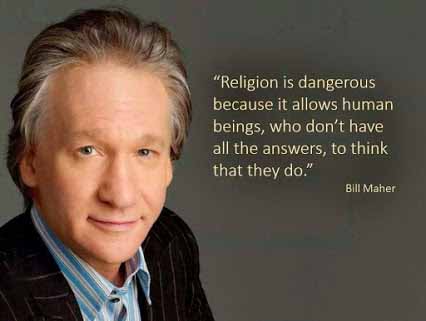
Bill Maher atheismFirst of all, “religion” certainly is dangerous, and for more reasons than Bill Maher lists in this meme. Like Maher (a well-known TV host/political commentator/atheist), I want nothing to do with “religion” and I explain why here: http://wp.me/p2wzRb-cP.

Now, what about “faith” (an entirely different thing) being dangerous? Are there people out there who believe their faith affiliation supplies all the answers to every question? Sadly, yes.

In my faith, saying Jesus of Nazareth — who many people believe is the Son of God — is the answer to everything is superficial and, in my opinion, shows a disturbing lack of thought.

(Then again, we live in a culture that discourages thoughtful living, so this shouldn’t be a surprise.)

I have all kinds of questions that following Jesus doesn’t answer:

  • Is there life on other planets?
  • If there is life on other planets, do they know about God?
  • Why is our world set up so people and animals kill and eat each other to survive?
  • When is Jesus going to return (as primary source Jesus biographies say He will)?
  • Why is spirituality so repugnant to some people and so welcome to others?
  • And finally, how did hip-hop ever become popular? 😉

What’s truly fascinating is that Jesus Himself didn’t know the answers to all the questions. Before He was crucified on a Roman cross, one of his followers asked when He would return. Jesus replied “No one knows when that day or time will be. The Son and the angels in heaven don’t know when it will be. Only the Father knows.”

Does this bother some Jesus followers? Probably. But it doesn’t bother me; serious Jesus followers like me believe He is God AND man and when He was physically on earth, Jesus set his Godhood aside. Thus the lack of knowledge about His return.

But what about my questions? There was a time when some of them, especially the third question, disturbed me greatly. I’m not nearly so disturbed today, but these unanswered questions are still important.

Our culture tends to suggest we can be God, with all the wisdom, all the technology and all the resources to command our lives and destinies. But my questions (which I don’t believe science can ever answer) are important and necessary because they remind me that God is God. And I am NOT.

So what about you; do your unanswered questions keep you from seriously investigating what it means to follow Jesus and be transformed by His love, His life, His death and His resurrection? Post your thoughts below and let’s have a conversation.

Read Full Post »

More than words 4.15When I first encountered this graphic on an Internet atheist community, I thought “No way!”

But upon investigation, I’ve concluded that the ‘charge’ is correct. Jesus of Nazareth, who many people believe is the son of God, did *not* make a blanket I-love-you statement about all of humanity.

So why do people like me insist that Jesus does, indeed, love me, YOU and everyone else? Let’s look at the evidence:

1.  Among the most famous statements in ancient documents comes from one of the four primary-source biographies of Jesus’ physical life on earth. It states “God expressed His love for the world in this way: He gave His only Son so that whoever believes in Him will not face everlasting destruction, but will have everlasting life.

Does it make even a bit of sense that God would not want Jesus to love the world the way He does?

2.  In that same biography, Jesus tells his followers “A thief is only there to steal and kill and destroy. I came so they [people who believe in Him] can have real and eternal life, more and better life than they ever dreamed of.

Again, why would Jesus care about the kind of lives people are living if He didn’t love them?

3.  One of Jesus’ earliest and most influential followers told people that “Christ had no sin. But God made him become sin. God did this for us so that in Christ we could become right with God.

This passage refers to one of the basic tenets following Jesus, that He died on a Roman cross to make up for all the wrong things we’ve done and all the right things we’ve failed to do. Why would Jesus do this if he didn’t love humanity? Why?

4.  One of the original-source Jesus biographies noted a crucial time in His life. Jesus, knowing he was about to be arrested on trumped-up charges and eventually put to death, went off on his own and prayed “Father, if you are willing, please take this cup of suffering away from me. Yet I want your will to be done, not mine.

Why would he pray this if he wasn’t in complete union with what His Father wanted? His Father — who created you and me — wanted to take away the inevitable negative judgment on everyone who has done wrong and failed to do right (and that means every person on this planet). Why would God  — and by extension, Jesus — want to do this if He didn’t love me and YOU?

After offering up all this evidence, I’m reminded of “More Than Words”, the 1990s pop hit by Extreme. Some of the lyrics go like this:
More than words is all I ever needed you to show
Then you wouldn’t have to say that you love me
‘Cause I’d already know.

Exactly. Jesus doesn’t say He loves me. Or you. He went further and proved it by his life, death and resurrection. And all this is offered as a gift to YOU. Are you interested in accepting it? Yes or no, post your thoughts below and let’s have a conversation.

Read Full Post »

Hate 3.15As soon as I saw this graphic on an atheist website, I felt sorry for Patricia Ruth Barker. Sorry that she ever thought she had to “hate” anyone before becoming an atheist.

Who taught Patricia this kind of warped thinking? Did she consider murderous terrorist groups and decide this is how “religious” people think? (I follow Jesus of Nazareth, but I’m absolutely not “religious” and this blog reveals why: http://wp.me/p2wzRb-cP.)

Did she interact some religious people who, sadly, DO hate gay people and people of other faiths and figure this is standard thinking for spiritual people?

Since encountering this graphic, I’ve racked my brain to think of all the Jesus followers I’ve met who hate gays or people of other faiths. I can’t come up with a single person. And when I do encounter these misguided people, I’ll remind them of these passages from ancient documents and original-source biographies of Jesus (who many people believe is God’s Son):

  • Anyone who does not love does not know God, because God is love.
  • God loved the world so much [and that means EVERY PERSON in it] that He gave His only Son, so that everyone who believes in Him would not be lost. but have eternal life.
  • God is love. Whoever lives in love lives in God, and God in him.

Most Jesus followers take these passages seriously. They tell me that Jesus  came for ALL people — gay or straight, Christian or Muslim or Atheist or Buddhist, criminal or Nobel prize winner, male or female, young or old. No exceptions. Ever.

This is one of the reasons I decided in my 40s to follow Jesus and trust in what He’s done for everyone who believes in Him. He died on a Roman cross to make up for ALL the wrong things I’ve done and ALL the right things I’ve failed to do. He made up for all the times when, despite my best efforts, I end up living as if there is no loving creator who wants to be part of my life.

I also follow Jesus because I know that by doing so, I welcome Him into my heart, mind and soul to make me more like Him. That means hating ONLY the wrong things I’ve done and the right things I don’t do.

It also means I believe in what many people call the “Golden Rule”: Do for others what you want them to do for you.

I want atheists and people of other faiths to respect me. So I darn well better respect them. When that exchange takes place, I get to tell them, like I’m telling you now, about my faith in Jesus and how He can change them (and YOU) for the better – for now and for all eternity.

What are your thoughts on this? Post a comment below and let’s have a conversation.

Read Full Post »

« Newer Posts - Older Posts »