Feeds:
Posts
Comments

13+-+1-5I love this challenging quote. At the same time, I’m mystified as to why atheists consider it so credible, given that it was spoken by a man (definitely a brilliant man) who died in 1931. It’s hardly a stretch to write that there’s been a whole lot of research done since then.

Without getting into boring details of studies and terminologies (anyone who needs that stuff can certainly find it online), I’ll toss out a few interesting tidbits.

On life after death: In 1991, Pam Reynolds had a near-death experience while undergoing surgery for a brain aneurysm.

Reynolds was kept literally brain-dead by the surgical team for 45 minutes. Despite being clinically dead, when Reynolds was resuscitated, she described some amazing things — like interacting with deceased relatives.

According to Time magazine, as many as 18 percent of people brought back from death after a heart attack said they’d had a near-death experience.

On the existence of Heaven: In 2008, neurosurgeon Eben Alexander III suffered an E coli meningitis infection which attacked his brain and plunged him deep into a week-long coma. Brain scans showed that his entire cortex was not functioning.

Against all odds, Mr. Alexander woke up a week later. And he claimed to have experienced something extraordinary: a journey to Heaven.

In his book Proof of Heaven: A Neurosurgeon’s Journey into the Afterlife, he asserts that there is an eternity of perfect splendor awaiting us beyond the grave, complete with angels, clouds, and departed relatives.

On a personal God: The Internet is overflowing with blogs and articles from people who have experienced God in an intimate, personal way. So I’ll contribute two quotes:

  • “God even knows how many hairs you have on your head” (from one of the original source documents on the life of Jesus of Nazareth – even my wife, who knows me better than anyone, can’t make that claim).
  • “Before I made you in your mother’s womb, I knew you” (passed along by an ancient prophet).

Granted, none of this is the scientific proof that many people demand. But let’s be honest: the creator and master of time, space and universe, who’s responsible for the air you are breathing right now, will ALWAYS be beyond proving or disproving.

God will ALWAYS be past our ability to fully comprehend. Looking for a metaphor? It would be like asking a porcupine to understand the theory of relativity.

So let’s look beyond this to what we CAN understand:

1. God created YOU.

2. God wants to have a personal, eternal relationship with YOU, but there’s a barrier in the way: the wrong things you’ve done (including living your life as if He doesn’t exist) and the right things you haven’t done.

3. You can never do enough to make up for the wrong things you’ve done and the right things you haven’t done.

4. You don’t have to. Jesus, who many people believe is God’s son, did the heavy lifting for you when he died to make up for the moral crimes of everyone who accepts Him and believes in Him.

5. All you need to do is accept the gift of Jesus; make Him your lord and saviour, so you can see your life transformed NOW and have eternal life with Him.

Does this make sense? Yes or no, post your thoughts below and let’s have a conversation.

Solution that isn't 6.14Our culture loves to toss the word “karma” around. I see it referenced in newspaper columns, online blogs and conversations at coffee shops.

But is it really the solution to anything, as this internet graphic suggests?

Yes, there is a certain logic to karma, which Wikipedia defines as “the universal principle of cause and effect. Our actions, good and bad, come back to us in the future, helping us to learn from life’s lessons and become better people.”

From the perspective of a follower of Jesus of Nazareth (who many people believe is the Son of God), there’s even some evidence to support it. One of Jesus’ earliest followers wrote: What a person plants, he will harvest. The person who plants selfishness, ignoring the needs of others—ignoring God!—harvests a crop of weeds. But the one who plants in response to God, letting God’s Spirit do the growth work in him, harvests a crop of real life, eternal life.

But is that karma? No. A faith research website (www.carm.org) explains the difference: “The law of karma, which makes morality like a law of nature, does not allow for the possibility of forgiveness.  Its consequences are inevitable and inescapable. Because God is personal, and because persons can forgive, God can forgive us of our sins.  Moreover, He has done so through Jesus.”

So, will karma solve anything? Not for me. I don’t want to be locked in a prison of cause and effect. And I don’t want karma to take the place of revenge.

Serious Jesus followers know and try their best to follow this directive, written by one of the ancient prophets: Forget about the wrong things people do to you. Don’t try to get even. Love your neighbour as yourself.

Do we fall short of that directive? Without a doubt. But now you know the ideal Jesus followers strive for. And you know more about God — the only being truly worthy of judging us for the wrong things we’ve done and the right things we’ve failed to do.

If you’re like me, you’ll admit that the ledger of wrong things done and right things not done is pretty long.

But there’s a way out — a way that karma will never offer you. That way is Jesus. He is God’s gift of love to anyone who is willing to accept that gift.

When you accept that gift and declare yourself a follower of Jesus, then you also believe that when He was put to death on a Roman cross, He took on the moral crimes of everyone who calls him saviour.

As a result of that, when God looks at a follower of Jesus, all He sees is the perfection Jesus bought for us. We are as pure as Jesus.

However, please note: That’s not a free pass to do whatever you like and cynically rely on Jesus to clean up the resulting mess. If you take that gift of love seriously, you’ll want to be with other Jesus followers, building each other up, holding each other accountable and allowing God to do amazing things in your life.

Does this sound interesting? Post your thoughts below and let’s have a conversation.

Religion bad 5.14

A challenging graphic, isn’t it? I saw it on an atheist Internet community and knew it would be good for Frank’s Cottage. Mostly because I’m in full agreement.

Religion, from my point of view, often does BAD things in our world.

  • Religion says that because the group I belong to is right, then everyone else must be wrong. And it’s a pretty short trip from there to believing I can do whatever I want to “wrong” people.
  • Religion says I have to do things, or NOT do things, in order to get in good with whatever god is at the top of that group.
  • Religion says if I blow up a building or murder a doctor who performs abortions, I’m doing a good thing.
  • Religion says I’m supposed to have it all together and if I don’t, then others (who obviously DO have it all together) will judge me and exclude me from their social group.
  • Religion insists that certain behaviours are wrong (such as having an occasional alcoholic drink or getting a tattoo), even if my holy book is absolutely silent on them.

So where does all this religion get us? I like the response of Bruxy Cavey. In his book The End of Religion, this Canadian pastor writes, “Religion does not lead people to God any more than empty cups quench your thirst”.

To me, religion leads to an empty charade of a life. Or the sickening horror of thinking you’re doing good by blowing up a building or murdering a doctor who performs abortions.

Another pastor, Mark Driscoll explains the difference between religion and Christianity (my faith) this way:

Religion is humanity trying to reach up to God. The message of Christianity is God reaching down to people. Religion is about what people have to do to be right with God.  Christianity is about what God has already done to provide us the opportunity to be right with Him.

Religion says you must earn your salvation by doing good deeds or certain acts and not doing evil. Christianity says all we need to do is believe that Jesus Christ [who many people believe is God’s son] has already paid the price for the evil we have done.

And before you protest, yes, every human being on this planet (and that certainly includes ME) has done evil. Even the late Mother Teresa did evil — that’s one reason she dedicated her life to following Jesus. She wanted — and received, as far as serious Jesus followers are concerned — the benefit of Jesus paying the price for all her wrongs through His sacrificial death at the hands of Roman officials. That benefit is eternity in Heaven with her saviour.

“Jesus did not come to offer an alternative religion, but an alternative to religion,” Bruxy Cavey wrote in The End of Religion. “He did not call people to leave one lifeless shell for another, but to live life beyond the borders of religious rules, regulations, rituals, and routines.”

Does this Jesus — and all He’s done for everyone who believes in and follows Him — appeal to you? Yes or no, post your thoughts below and let’s have a conversation.
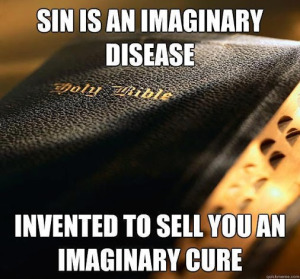
is sin imaginary?At first I was reluctant to interact with this atheist person, who was commenting on a Frank’s Cottage essay (and the graphic to the left), and you’ll realize it in my initial responses. All too often, I’ve been disappointed to find that people who believe there is no God simply want to score points and win debates over people they look down on.

But Jill was different and when I realized it, we ended up having a good conversation. Read on and see if you agree with me:

Jill: I think the topic of sin is interesting. From my perspective, the graphic is meant to show that in order to sell the “cure”, you have to make people believe they are sick, right?

Pharmaceutical companies have figured out the same thing. They want to sell more drugs. What better way to sell more drugs than to convince people through commercials that they might have a whole list of diseases which they pitch all over media. And by reinforcing the sin/sick concept over and over it keeps people flocking back to church or to their doctors for the cure.

I believe there is a big difference between the word ‘sin’ and words like ‘mistake’, ‘error’, etc. They are not interchangeable.

Frank: Thanks, Jill. Guess it’s a matter of perspective.

Jill: Isn’t sin the hook which churches use to keep people returning each week? Christianity is based upon original sin.

Frank: Perhaps that’s the perspective of some non-Christians….

Jill: I really resent watching people being told they are broken. I sometimes wonder if there is any data to link religiosity to depression. There is no perfect standard by which we should be judged.

Frank: Yes, your resentment would be expected in the non-believing world. And for me as a follower of Jesus Christ, there absolutely is a perfect standard by which we should be judged.

Jill: Do you ever feel depressed to be compared to a perfect standard for which you will never meet?

Frank: Nope, I never feel depressed about that. Because Jesus of Nazareth is my lord and savior, God sees me as He sees Jesus: perfect, without a single blemish. 🙂

Jill: I’m glad to read that, Frank. It makes me feel a little better. But why sin then? If God sees you as he sees Jesus, why is sin such an important part of Christianity?

Frank: Great questions! Why sin? Because of the gift of freewill. Serious Jesus followers believe God knew this would be the result of giving us freewill, but He did it anyway because He wanted (and wants) a REAL relationship with real people, rather than goose-stepping robots.

Serious Jesus followers believe sin is important because in the end, it’s a rejection of God. It’s telling Him we know better than Him how to live our lives. And thousands of years of history have shown how horribly wrong this is.

In addition, serious Jesus followers believe God is perfect and cannot stand the sin that all human beings commit. But rather than condemn us all, we believe God sent His son as a gift to everyone who wishes to accept the gift. And that gift (a) clears away the sin and (b) strengthens us to see our sin clearly and avoid it more in the future.

Jill: But he’s God, for goodness sake. He could have created perfect beings, couldn’t he? He could have created goose-stepping robots if he wanted to, correct?

Instead, he created humans with flaws, which he already knows about because he’s omniscient. Then he grows frustrated with them and causes great harm to many. Whose fault is that?

Frank: Yes, He could have created perfect beings who were in perfect relationship with Him. And it would be a real as a TV “reality” show.

Serious Jesus followers believe the viewpoint that humans are made in God’s image. That means the emotions we experience are the emotions He experiences. Pain, frustration, anger, joy, etc. Goose-stepping robots would be as useless to Him as they would be to us.

Jill: How do you know those are the emotions God experiences? How do you tell the difference between real emotions as God experiences them and human emotions which humans project upon God? Couldn’t “in His image” be just a physical descriptor? Or a metaphor for something else?

Frank: I know these are the emotions God experiences because the Bible – which serious Jesus followers trust as absolutely reliable – depicts God with those emotions.

In addition, I guess “in His image” could be a physical descriptor because we all resemble Jesus – human beings with two arms and two legs and a face that expresses every emotion known to humans.

=============

So, what do you think? Is the idea of ‘sin’ — and the way to escape the prison it creates for every person on this earth — more real to you now? And what about that ‘escape’? Do you want to know more about it? Type your thoughts below and let’s have a conversation.


Good Christians 5.14Have you encountered Jesus followers like those described in this graphic? I’m pretty sure the answer is YES. In fact, I’m sad to write that there may be one or two of you out there who would name ME as one of those people.

All too often, those of us who claim we are Jesus followers act the same as everyone else on this planet. We are obnoxious, two-faced, self-righteous sinners who are usually ready to point out the errors of others while ignoring our own shortcomings.

Sometimes, we even go so far as to claim we are being persecuted while we are busy persecuting others.

There are times when people wish we would do what our leader did when He was physically on earth: help those for whom our culture has little time or regard.

Jesus did that repeatedly, treating people from other tribes and cultures with respect, defending a woman caught in adultery from heartless “religious” leaders, having dinner with people who were scorned by arrogant authorities and more.

I’m glad to tell you there are many examples of Jesus followers who behave in ways that make it clear, without any need to declare it, that they ARE good Jesus followers. Here are a few:

  • I know of many Jesus-following doctors and nurses who volunteer to serve in hospitals in the developing world.
  • We often read in the news about church leaders protecting people from heartless deportation or from death during violent times.
  • Most major North American cities have Jesus ministries whose entire reason for existing is to feed and shelter homeless people.
  • Canadian Catholic humanitarian and theologian Jean Vanier started a worldwide network of non-profit communities called “L’Arche”. Those communities provide homes and support services for mentally challenged people. Vanier certainly wasn’t perfect, but he did follow Jesus to the best of his ability.

There are many more examples, but you get the point. In each case, these Jesus followers are being the hands and feet of Jesus to a world that we all know isn’t doing well.

Could Jesus followers be doing more? Of course we could. That’s why we gather at churches (or “do” church online), to understand how we can overcome our shortcomings and be “good” Jesus followers. Without having to tell people that’s what we are.

What about you and your failures — the bad things you’ve done and the good things you’ve failed to do? Do you want to know how you can overcome them through an awesome power that’s truly beyond your understanding? Then check out Jesus. He’s God’s gift to everyone who’s willing to accept that gift.

What are your thoughts? Post them below and let’s have a conversation.

Sin+is+an+imaginary+disease+invented+to+sell+you+an+imaginary+cureI’d never heard anybody call “sin” an imaginary disease, so when I saw this graphic posted on the Internet, it instantly grabbed my attention.

“Sin” has become a strange and cliched term in our culture. Either something is “sinful” (a favourite positive term in TV commercials for rich foods like chocolate) or it’s something most of us associate with annoying, badly dressed TV evangelists.

So I looked up the term. The Christian Apologetics and Research Ministry website defines it this way:

Sin is the breaking of God’s law.  If God says “Do not lie” and you lie, then you have broken His law and sinned.  The reason God says to not lie, not cheat, etc., is because these laws reflect the moral purity of His nature.  Therefore, the law is a reflection of the character of God.

Dictionary.com is a little briefer:
Any act regarded as such a transgression, especially a willful or deliberate violation of some religious or moral principle. Any reprehensible or regrettable action, behavior, lapse, etc.; great fault or offense: It’s a sin to waste time.

Maybe that’s not a “sin” to you. So let’s use less loaded words: Misdeed. Mistake. Error. Wrongdoing. Imperfection. Moral crime.

Whatever your preferred term, I can’t for a minute believe it’s an “imaginary disease”. Is there even a single person on this planet who hasn’t done or said something they regret? Or NOT done or said something and regretted that?

It seems crystal clear to me that this is a universal human condition. We “invented” it and, sadly, we live it out every day.

So what about the “imaginary” cure? The person who created this graphic is probably an atheist and so believes if the “disease” isn’t real, then there’s no need for a cure.

But if you’re comfortable in disagreeing with the former, then the latter is no longer imaginary.

For people like me, the cure is wonderfully simple: Jesus of Nazareth, who many people believe is the son of God. Jesus is God’s gift to humanity, given to all who believe that He died to make up for our sins. All we have to do is accept the gift.

Obviously, this doesn’t mean we will avoid the consequences of our actions (or inactions). But it does mean that, if we truly believe Jesus offers the way to eternal forgiveness and if we sincerely ask for that forgiveness, we will receive it from the creator and master of time, space and the universe. No matter what.

(Looking for an incredible example? Then read this Frank’s Cottage blog about the ‘Son of Sam’: http://wp.me/p2wzRb-6K)

So, does the cure for your “disease” interest you? Yes or no, post your answer below and let’s have a conversation.

Bertrand RussellHow’s that for a challenging statement, eh?

When I found this graphic on an Internet atheism community, I knew I had to grab it and explore the viewpoint — as much for me as for you.

To start with, I emailed the graphic to a wise and thoughtful pastor friend. Here’s how Ross Carkner responded:

I would have thought that it would be impossible for a person to sit at the bedside of a dying child and NOT believe in God.  I am hard-pressed to think of a better place in which to find God – amidst the crippling heartache and shattered dreams of parents, siblings and family.

It is the convenience of living in the western world, overflowing with an optimism fueled by a seemingly never ending supply of individualism and materialism, which insists that life is grand!

Life is not grand.

Sure, life is filled with mounds of joy and the pursuit of happiness. But pain, disappointment and death also fall like rain. Every single day.

Sooner or later, we must come to grips with the reality, no matter how painful it is, that we live in a broken and hurting world.

The gift of God is His presence and that in His plan there is a promise of better things to come. This world isn’t all there is, but right now, it is all that we have. We live in brokenness, but God is already working out His plan.

Doesn’t that give you lots to think about?

It occurs to me that behind the statement in the graphic, made by a renowned 20th century philosopher/atheist/writer, is this question: How can one sit by the bedside of a dying child and still believe God is good?

First, let’s remember that no “religion” has ever promised that life would be perfect for even one person. In my faith, Jesus of Nazaareth (whom many people believe is the Son of God) told his followers: “In this world you will have troubles. But be brave! I have defeated the world!

So what does “I have defeated the world” mean? I like the answer provided by blogger Jack Zavada:

God doesn’t spare us from [our troubles], he doesn’t shield us from [our troubles], but He does deliver us. We may come out the other side with scars and losses, but we will come out the other side. Even if our suffering results in death, we will be delivered into the hands of God.

That’s the key part of the question about the goodness of God. If you believe this world and this life is all there is, then the idea of God delivering you from your ills – and, in the case of the graphic that sparked this essay, your child’s ills – is simply utter nonsense. And you have no hope.

But if you somehow know that 70-plus years on planet Earth can’t be the entire story, then consider God’s gift of His Son. Jesus’ sacrificial death and resurrection clears the way to eternal life for you, your children and anyone else who accepts that gift and makes Jesus Lord and Savior.

Does this makes sense? Yes or no, post your thoughts below and let’s have a conversation.

Religion industryWhen I saw this graphic in an Internet atheism community, it made me laugh.

Is “religion” a multi-billion dollar “industry”? Yes. In 2012, the Economist magazine estimated the U.S. Catholic Church spends about $170 billion a year.

Furthermore, According to the Leadership Network, senior pastors of the largest 209 churches in North America earned (including allowances for housing) between $85,000 and $265,000 in 2012.

Now it’s time for other facts:

The Economist estimates that 57 per cent of the Catholic church’s U.S. spending went to Catholic health care networks, 28 per cent to colleges, six per cent to day-to-day operations at local parishes and dioceses, and 2.7 per cent to national charities. Do any other “industries” spend their money like this?

The median church in the U.S. has 75 regular participants in worship on Sunday mornings, according to the National Congregations Study. I imagine the number is very similar in my country, Canada. Can anyone credibly insist that these churches are raking in cash?

According to PayScale.com, the average Canadian pastor’s salary is between $34,876 and $74,500.  According to the National Association of Church Business Administration, the average U.S. pastor received $28,000 in 2012.  In addition, the association notes one out of five pastors has to work a second job to support himself and his family.

While the graphic I’ve included here drips with cynicism, most reasonable people can see that the reality is very different. While “religion” may be an “industry” for some people, a vast, vast majority of people who follow Jesus of Nazareth (considered by many to be the Son of God) are in it because they feel called by God.

Senior pastors, youth pastors, denominational leaders, church administrative assistants, bishops, archbishops, etc. will do “everything in their power” to keep on following where God leads.

For me, that meant moving across Canada to accept a position with a faith-based organization. Are we “benefitting financially”? If you translate that as having enough to own a very average home (on two salaries, including my wife’s, who works for a bank), then yes.

For other people, that means working in dangerous places like South Sudan, providing medical care to refugees. Or teaching people how to avoid the deadly Ebola virus in Africa. Are they “benefitting financially”? Not even a little. In many cases, they don’t own a house or a car.

So what does all this mean to you? It means that while there are some bad apples in “religion”, almost all people working in the faith “industry” are there because they want to make a difference in a world that we all know isn’t doing very well.

Many of them found their lives transformed for the better when they decided to follow Jesus. They realized that God was offering them a gift in Jesus; follow Him and God no longer sees the bad things they’ve done and the good things they’ve failed to do. Jesus’ sacrificial death on a cross cleaned their slate, so God sees them as He sees His son: pure and perfect.

God offers YOU that gift, too. Interested? Post your thoughts below and let’s have a conversation.

Jesus Is AliveGeorge Carlin (1937-2008) was an extraordinary comedian and social critic who never made a secret of his contempt for spirituality and organized religion.

So while I don’t know if he actually said the crude and confrontational words in this graphic, I certainly wouldn’t be surprised.

Either way, let’s take a few minutes to examine the quote:

1. No, followers of Jesus of Nazareth (who many people believe is the Son of God) DON’T worship a “dead Jew” – Jesus followers worship a living person who transcends any kind of “organized religion”.

How do I know Jesus lives? First of all, I know He rose from the dead after his crucifixion by Roman authorities. In a letter to early Jesus followers, Paul, a missionary who spread the message of Jesus throughout the Mediterranean, wrote. “After [His resurrection], Christ appeared to more than 500 other believers at the same time. Most of them are still living today, but some have died.”

In other words, Paul is telling his readers that if they don’t believe him about Jesus coming back from the dead, there are hundreds of people who can back him up. That strikes me as very, very credible.

Increasing the credibility of this fact is that Jesus predicted all this. In one of the four source documents of his life, Jesus told his followers that, “I, the Messiah, am going to be betrayed and killed and three days later I will return to life again.”

2. Now you might be saying “So what? That was 2,000 years ago. Where is he now?” Great question. Now, Jesus is where He told His followers He would be – in Heaven, (a) advocating for people who follow Him, (b) living in their hearts and (c) changing their lives.

An early Jesus follower addresses this: “So Christ can save those who come to God through him. Christ can do this forever, because he always lives and is ready to help people when they come before God.”

Blogger Steve Simms writes about this on his website (http://stevesimms.wordpress.com/), noting “I have personally known hundreds of people who have been transformed and set free through an encounter with Jesus, including dozens of drug addicts and alcoholics.”

3. By now, I’m sure you have an idea about what I’m gonna write about the “on a stick” part of the Carlin quote. Yes, churches almost always have a cross prominently displayed. Yes, many Jesus followers have a cross somewhere on their bodies (mine is a Celtic cross, connecting to my Irish heritage, that I wear around my neck).

But I certainly don’t worship the cross and neither do any Jesus followers I know. We need and want to see it often because we want and need to be reminded that we, like every other human being (including YOU) have missed the mark of who God wants us to be. We’ve fallen short, ignored the love of our creator, gone our own way and messed up — often in ways we can’t see.

The cross reminds us of what Jesus did for us — His sacrificial death wipes our slate clean with God. When we believe in and follow Jesus, God sees us as He sees His son — perfect, without a single blemish.

So what do you think? Post your thoughts below and let’s have a conversation.

PerpetualStateOfFear 4.14First of all, let me make this clear: Star Trek ROCKS. Even the not-so-great movies — Star Trek V: The Final Frontier (1989) and Nemesis (2002) — were still at least mildly entertaining.

What grabbed my attention about this graphic, posted in an atheism Internet community, is two things:

1. The Spock character never said these words;
2. That said, I absolutely agree with them.

What kind of a god would ever demand constant fear from his creations? Certainly not the God I believe in, or Jesus of Nazareth, who many people believe is God’s Son.

An ancient document by one of Jesus’s earlist followers addresses this topic in a very reasonable way: Where God’s love is, there is no fear, because God’s perfect love takes away fear. It is his punishment that makes a person fear.

That makes a great deal of sense to me. While I don’t fear God the way this graphic suggests, what I do fear is this:

  •  Disappointing Him by failing to constantly strive to be the person He knows I can be.
  •  Saddening Him by ignoring the opportunities He gives me to tell others about how He changed my life through Jesus and how their lives can be made better the same way.
  •  Insulting Him by living my life as if He doesn’t exist.
  •  Belittling Him by not fully acknowledging everything He did for me (and for you, too) by offering the gift of Jesus, who died to make up for the sins of everyone who believes in Him and follows Him.

I like how the United Church of God website puts it:
“God does not want us to be in continual terror of Him, though that may be where we start in our relationship with Him. Proper, mature fear of God means having a healthy reverence and respect for the most powerful Being in the universe and the laws He has set in place for our own benefit.

I also appreciate the words of Christian Post columnist Dan Delzell:
“Think about a family. Parents who dearly love their children also discipline their children appropriately for their good. In those families, children know they are loved. They also have the ‘fear’ of discipline should they choose to push the limits and disobey. That is not a bad fear. It actually is a very necessary part of family life.”

I see logic in wanting to worship a deity like this. Do you? Yes or no, post your thoughts below and let’s have a conversation.