Feeds:
Posts
Comments

Posts Tagged ‘atheism’

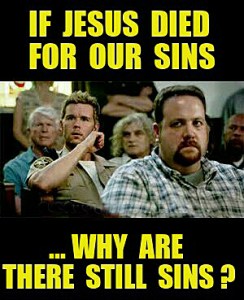
2.16Great question, isn’t it? As soon as I saw this meme, I knew it touched on an important topic that many folks just don’t understand.

First of all, let’s get the facts straight. Nowhere in the original source documents about His life does it even hint that Jesus of Nazareth — whom many people believe is God’s divine Son — died to wipe out sin. Nowhere.

So why did He die? Let’s see what the ancient writers say about that:

Because we broke God’s laws, we owed a debt—a debt that listed all the rules we failed to follow. But God forgave us of that debt. He took it away and nailed it to the cross. (From a letter by one of Jesus’ earliest followers).

Another version of that same letter (written in ancient Greek) translates the excerpt like this: All sins forgiven, the slate wiped clean, that old arrest warrant canceled and nailed to Christ’s cross.

In case one excerpt isn’t enough, check these out:

I [Paul, a missionary who told people throughout the Mediterranean about Jesus] told you the most important truths: that Jesus died for our sins, as the Scriptures [other ancient writings] say; that he was buried and was raised to life on the third day, as the Scriptures say.

Jesus had no sin, but God made him become sin so that in Jesus we could be right with God.

Jesus redeemed us from that self-defeating, cursed life by absorbing it completely into himself. Do you remember the Scripture that says “Cursed is everyone who hangs on a tree”? That is what happened when Jesus was nailed to the cross: He became a curse, and at the same time dissolved the curse.

Now maybe you’re not convinced. Maybe you’re thinking “that’s just other people talking about Jesus. That’s not Jesus Himself”. So read this, from one of four original source documents about Jesus’ life:

Jesus took bread and spoke a prayer of thanksgiving. He broke the bread, gave it to [His apostles], and said, “This is my body, which is given up for you. Do this to remember me.”

Why would Jesus give up his body if it wasn’t for something truly epic, truly world-changing like wiping out the wrongs of everyone who believes in Him and follows Him?

In fact, Jesus was fulfilling a prophesy made hundreds of years before his physical life on Earth. Isaiah, a prophet, predicted the future when he wrote this:

He [Jesus] was being punished for what we did. He was crushed because of our guilt. He took the punishment we deserved, and this brought us peace. We were healed because of his pain.

So why is there still sinning? Because God gave us very imperfect creatures the gift of freewill and that means we use it to do wrong and fail to do right.

But as you can see from all the quotes above, there’s a solution: believe in Jesus – His life, ministry, death and resurrection. Become His follower. Then watch how He changes your life.

Interested? Post your thoughts below and let’s have a conversation.

Read Full Post »

DawkinsForegivness 2.16I’ll bet there are folks out there who see this meme (helpfully supplied by an internet atheist community) and think “ya, why not just our forgive sins?” Maybe you’re one of those people.

First of all, I can confidently write that God is NOT trying to impress anyone. When you’re the creator of time, space and the universe, trying to impress anyone (even Himself) is just silly.

Second, this quote (by one of the world’s best-known atheists) displays a blatant ignorance — or outright rejection — of who God is.

Is God merciful? Yes. Does God want to forgive us for all the wrong things we’ve done and right things we’ve failed to do? Absolutely.

But God is also something else: perfect. And that’s His baseline standard for everything, whether we like it or not.

So why doesn’t He just forgive us? Well, why do we have courts? Why can’t we just ignore the dude who killed that guy in a bar fight? Why don’t we just overlook how she faked having cancer in order to bilk people out of thousands of dollars?

If these examples offend your sense of justice, then imagine how our creator feels about  our greed, our self-centredness, our violence, our willful ignorance and our cultural belief that we “deserve” the good life.

Is God judge and jury? You bet He is. Execution victim? Yes, that too.

If that last point seems strange, then understand that this is how it goes with those who follow Jesus of Nazareth (who many people believe is the Son of God): Knowing that we could never do enough or be enough to earn our way into Heaven, God paved the way for us. That way is through believing in and following Jesus.

One of Jesus’s followers describes Him this way: “He never sinned, and he never told a lie”. This is important and you’ll soon read why.

Jesus spent three years traveling around the Middle East with a band of followers, telling people the Kingdom of God (represented by Him) was near. He proved it by healing diseases, raising people from the dead and preaching revolutionary ideas like loving your enemies, refusing to retaliate when a wrong has been done to you and praying for those who hate you.

Then Jesus allowed conniving religious authorities to arrest him on trumped-up charges and convince political leaders to hand Him the ultimate punishment: death on a cross.

What they didn’t realize is that this death would pave the way to Heaven for anyone who believes in and follows Jesus. He paid the price that we should be paying.

Now, when God sees any Jesus follower, He doesn’t see the wrong things we’ve done and the right things we’ve failed to do. He only sees perfection. It’s like Jesus transferred His perfection onto anyone who believes in Him and follows Him.

There. I’ve done my best to explain why God doesn’t just forgive our sins. As you can see, He goes even further than that — sacrificing His Son for everyone who believes in Jesus.

Does this make sense? Yes or no, post your thoughts below and let’s have a conversation.

Read Full Post »

Dance of dogma 1.16When I saw this graphic on an Internet atheism community, I wasn’t sure why I saved it for Frank’s Cottage. Then I looked up the definition of “dogma”.
According to Wikipedia, dogma is “a principle or set of principles laid down by an authority as incontrovertibly true. It serves as part of the primary basis of an ideology or belief system, and it cannot be changed or discarded without affecting the very system’s paradigm, or the ideology itself.”

Hmm. Where does this apply? The more I thought about it, the more I realized: where DOESN’T it apply?

Every person on this planet follows some kind of “principle or set of principles laid down by an authority as incontrovertibly true.”

Evidence?

  • Business tycoons like Bill Gates and Warren Buffet are died-in-the-wool capitalists. They believe in and follow capitalist dogma and won’t have anything to do with any other economic system.
  • Remember communism? Some of its most famous practitioners — China’s Mao Tse Tung and Russia’s Vladimir Lenin — believed in and followed communist dogma their entire lives. They refused to have anything to do with democracy.

What about atheists? Based on my many, many interactions with them, most appear to follow dogma laid down by atheist authors Sam Harris, Christopher Hitchens (1949-2011) and Richard Dawkins.

These three routinely advance the position that there is absolutely nothing good about “religion” (I agree, and here’s why: http://wp.me/p2wzRb-i9) and that believing in a supreme creator is primitive superstition and harmful to humanity.

In the atheist Internet communities I often visit, these viewpoints are treated as dogma. In these communities, I never see posts that contradict these positions.

So, dogma applies to all of us. That leaves the question: which dogma do YOU follow? In your heart of hearts, do you believe that it’s all about having a comfortable, happy life now and never mind what comes after? Do you believe that when you die, all that you are will become nothing more than rancid worm food?

Do the dogmas I just mentioned leave you feeling cold and, perhaps, even a bit hopeless? Are you ready to re-examine them, despite the pressures of your friends, loved ones and our culture as a whole?

Then consider the claims of Jesus of Nazareth, who many people believe is the Son of God. Consider His astonishing, challenging wisdom. His miracles. His death – which wipes out ALL the wrongs committed by people who follow Him – and resurrection.

Talk to knowledgeable people about Him. If you don’t know any, then email me at fdking@hotmail.com and I’ll do my best to help. No matter what our culture insists, figuring out what dogma YOU follow is important stuff.

Read Full Post »

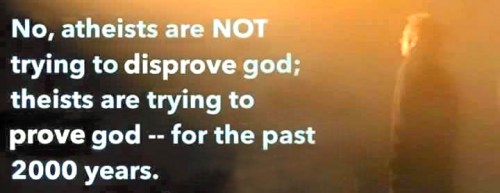
Proving God 12.15I must be hanging out with the wrong people. I’ve been following Jesus of Nazareth (who many people believe is the Son of God) for more than a decade and I STILL haven’t met even one other Jesus follower who is trying to “prove” God. Not one.

Oh, I’m sure there are a few out there, wracking their brains on this absolutely unsolvable conundrum when they could be doing something useful.

If this graphic (kindly supplied by a Facebook atheism group) has any truth, then you’d think these few “theists” (people who believe in a creator) would realize the futility of their quest and simply move on.

It’s plain and simple: if God wanted us to “prove” His existence, it would have happened by now. He knows better than to allow such a thing. Because if it did happen, then atheists would be denied the freedom to declare there is no creator.

And if the endless horrors of human history absolutely PROVE anything, it’s that God is all about freewill. No matter how high the cost.

The result of that freewill is people can walk around saying God is fiction and laugh at people who do believe in Him and His divine Son.

Is there evidence for God? Absolutely.

  • The universe is evidence.
  • The materials used to create the computer I’m using now are evidence.
  • Sunrises and sunsets are evidence.
  • Jean Vanier (the extraordinary Canadian Jesus follower who, despite his many imperfections, created the worldwide “L’Arche” homes for severely challenged people) is evidence.
  • Poetry is evidence.
  • The continuing impact of Jesus is evidence.

I chose to examine this evidence (and much more) and declare it’s enough to convince me there is a creator and He offers an amazing, gobsmacking gift to anyone who is willing to accept it: Jesus.

Indeed, I’ve come to recognize that to know Jesus is to know God. Because of the life, death and resurrection of Jesus, I can know that God:

  1. Loves this world and everyone in it: “God loved the world so much that He gave His only Son, so that everyone who believes in Him would not be lost but have eternal life” (that’s from one of the primary-source biographies of Jesus’ physical life on Earth).
  2. Hates the wrong things we do and right things we fail to do: “It is your sins that separate you from your God. He turns away from you when he sees them” (from one of the ancient prophets).
  3. Offers His son to everyone: “God did not send Jesus to judge the world guilty, but to save the world through Him” (also from one of the primary-source biographies of Jesus’ physical life on Earth).
  4. Is extraordinarily patient with us: “God is restraining Himself on account of you, holding back the End [of the world] because He doesn’t want anyone lost. He’s giving everyone space and time to change (from one of the people Jesus personally trained to follow Him).
  5. Is forgiving: In one of the primary-source biographies of Jesus’ physical life on Earth, Jesus said “Father, forgive them; they don’t know what they’re doing.” At that time, He was dying on a Roman cross.
  6. Is unchanging: “I am the Lord—I do not change” (from one of the ancient prophets).

I could go on, but you surely get the point. Move past this tiresome, pointless ‘proving God’ thing and think about inviting him — through His Son — into your life.

Interested? Yes or no, comment below and let’s have a conversation.

Read Full Post »

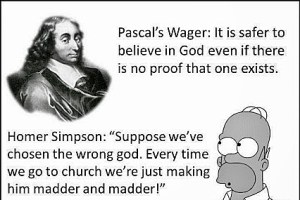
The Right GodAh, Homer Simpson. Even a dolt like him occasionally raises questions that are worth answering. This is one of them.

In case you don’t know, 17th century mathematician, philosopher and physicist Blaise Pascal formulated his philosophy based on the Christian idea of God. Since that time, there have been many challenges to the wager, but let’s deal with the one put into Homer’s mouth by the writers of The Simpsons.

Let me ask you: did four or five “gods” create the universe? What about the air you’re breathing right now — did a committee of “gods” come up with that? Our brains, our opposable thumbs, our ability to recognize right and wrong — did “god” #3 do all that during a very busy day at the office? Or was it #1?

If what I’m writing here seems a bit ludicrous, that’s exactly the point.

So why the Christian god? I bounced the question off a wise pastor. Here’s a bit of Ross Carkner’s thoughts:

“To begin with, we are talking about The Almighty as recorded in the Bible who has no equal. Poor Homer is concerned about all the lesser gods who are duking it out for a share of last place in the god contest.

“These lesser gods have often been put in place, not by their own claims, but the claims we make for them. The Bible records God as making His own claims …. so I do not worship a god of my own making, I worship the God who makes everything!

Here’s another viewpoint, from John Morris of the Institute for Creation Research: “There is one infallible way to know [what is the right god]—one sure test, and no other. The one God who can defeat death is the only God who can give life!”

That god is the God who offers a gift to humanity: Jesus of Nazareth, who many people believe is His Son. Primary source documents on His life all declare that three days after death, Jesus was brought back to life. That’s right, by “the only God who can give life!”

Now what about God getting “madder and madder” if we don’t worship Him? If the twists and turns of human history have proven anything, it’s that God is all about freewill — that includes us deciding who we want to declare as creator.

Ross Carkner weighs in again at this point:
“Is this God an ego maniac? Does the Almighty crave our attention? or is He more in tune with my redemption? My needs? My crisis? Since He is more concerned about my fulfillment — my fullness of life in Him, his reaction to my choosing lesser gods is not anger, but sadness.”

Exactly. So what do you think about Pascal’s Wager now? Does it make sense? Yes or no, post your thoughts below and let’s have a conversation.

Read Full Post »

religion God evidenceBefore I attempted to write about this graphic (found, as always, on an Internet atheism community), I went to Dictionary.com, to look up the meaning of “evidence”:
1. That which tends to prove or disprove something; ground for belief; proof.
2. Something that makes plain or clear; an indication or sign: “His flushed look was visible evidence of his fever.”
3. Data presented to a court or jury in proof of the facts in issue and which may include the testimony of witnesses, records, documents, or objects.

Based on that, please consider these facts:

The Earth: How did it come to be that this planet we live in is so perfectly attuned to support life – and not just one species of life, but millions? Even the size of this planet and its distance from the sun are just right to make our existence possible. Who did this? Elvis? Justin Bieber?

The universe: our solar system and who knows how many thousands of others. Our galaxy and innumerable other galaxies. Black holes, stars, comets, etc., etc. Has even a genius like Stephen Hawking told us who created it all?

“Through my scientific work, I have come to believe more and more strongly that the physical universe is put together with an ingenuity so astonishing that I cannot accept it merely as a brute fact,” wrote former University of Adelaide theoretical physics professor Paul Davis in his book The Mind of God.

Our consciousness: In The Case for a Creator, former journalist Lee Strobel interviewed many scientific minds and noted “many scientists are concluding that the laws of chemistry and physics cannot explain our experience of consciousness”.

Indeed, Strobel quotes philosopher Michael Ruse who conceded “no one, certainly not [believers in Charles Darwin’s theory of evolution] seems to have any answer” to the question of the origin of human consciousness. Hmm…it’s starting to look like God did it.

Beyond these questions, I showed the graphic that sparked this essay to a wise pastor. Here’s a little of what Ross Carkner had to say:

“The twin towers of New York City’s World Trade Center were made of tons of concrete and miles of steel, the best that we are able to build. Thousands of people depended on those buildings every day. They trusted their lives in the strength of the towers; but it was insufficient.

“Even the tried, tested and true in the physical world — the very things that we live in, work in, travel in are all quite capable of letting us down. Can I then say I do not believe in buildings???”

Then there’s the question of personal experience. Ross writes:

“My experience [of God] may not be evidence enough for you, but then again it might. [In fact,] my experience is considered acceptable evidence in court — it forms my witness while on the stand.”

So an atheist like Dan Barker may not have any evidence for the existence of God, but Ross Carkner does in his own life story. That evidence is credible enough to be used in court trials.

If you wonder whether there’s a God, is that fact credible enough to make a difference to you? What about our Earth, the universe and YOUR consciousness? Post your thoughts below and let’s have a conversation.

Read Full Post »

thinking, religionWhen this graphic (posted on an Internet atheism community) caught my attention, the first thing I thought was: Religion? Yech.

I’ve written often about the poison of “religion”. Not the dictionary version, which few people in our culture understand or care about. No, I’m writing about the version that most people think of as soon as the word is mentioned:

  • People who are smug and judgmental.
  • People who don’t really care what happens to others who aren’t in their religious group.
  • People who are happy to welcome others into their group/church, as long as THOSE people change themselves to fit in.
  • People who spend their time being angry, paranoid and opposing things, rather than supporting anything.
  • People on TV who promise wealth and a good life as long as you send them money.

I follow Jesus of Nazareth (who many people believe is the Son of God), so I want nothing to do with this “religion”. Indeed, He doesn’t either. In the four original-source biographies of His physical life on earth, some of Jesus’s most passionate words are against smug, arrogant, rule-obsessed “religious” leaders.

So what about the “thinking” part of this graphic? It’s easy to assume it’s true because in our culture, thinking people of faith are generally ignored by the media. Indeed, some of them may face such opposition to their faith in Jesus that they keep it hidden.

But they are out there. Here are just a few examples of these faith-filled thinkers, listed on Wikipedia:

Rosalind Picard (born 1962) is a Professor of Media Arts and Sciences at the Massachusetts Institute of Technology in the U.S. She’s also founder and director of the Affective Computing Research Group and co-director of the Things That Think Consortium. Picard says she was raised an atheist, but decided to follow Jesus as a young adult.

John Lennox (born 1945) is a mathematician, philosopher of science and pastoral adviser. His books include the mathematical The Theory of Infinite Soluble Groups and the faith-oriented God’s Undertaker – Has Science buried God?

Father Andrew Pinsent (born 1966), a priest, is the Research Director of the Ian Ramsey Centre for Science and Religion at Oxford University in England. He is also a particle physicist.

These three highly respected people think, therefore they are people of faith. This suggests the graphic that inspired this essay has little to do with reality. In the end, your level of intelligence has nothing to do with whether you believe in God and His Son.

Whether you believe in God and His Son has EVERYTHING to do with humility. A willingness to admit you don’t have all the answers (and never will, in this life); you don’t understand everything (and never will, in this life); and a realization that your life can be better, right now, because you believe in a loving God who offers this broken world the gift of His Son.

What do you think? Post your thoughts below and let’s have a conversation.

Read Full Post »

PROOFHooo, boy. There’s a lot to unpack in this graphic, isn’t there?

Kindly presented by an Internet atheist community, I grabbed it because it presents such a wonderful opportunity to tell you the truth about the creator and master of time, space and the universe.

1.  If there were proof that a god exists, atheists would be denied the freedom to claim that God doesn’t exist. And if God has proven anything over the centuries, it’s that He’s all about free will.

Want proof? One of the early followers of Jesus of Nazareth (who many people believe is the Son of God) said “God wants everyone to be saved and to fully understand the truth.” That’s right, God wants everyone to be saved. He doesn’t force a single person. It’s up to us.

Another ancient writer goes further: “Today you must decide who you will serve … But as for me and my family, we will serve the Lord.” See? More free will. In fact, the entire existence of atheism is proof of free will.

2.  Like it or not, God wants us to come to Him in faith. The evidence comes from one of Jesus’s early followers: “Without faith no one can please God. Whoever comes to God must believe that he is real and that he rewards those who sincerely try to find him.”

So the very thing that many atheists hold in contempt is the very thing that God is all about. He wants a relationship with free-thinking people. He’s not interested in programming soulless robots to do His bidding because no matter how you look at it, that’s NOT a relationship.

3.  The “facts” that “could be repeated, tested and demonstrated” is for logic and mathematics, not for the creator of time, space and the universe. As Matt Slick puts it on the Christian Apologetics and Research Ministry website:

How do you “prove” there is a Great Being outside of our universe? Do we look for footprints in a riverbed? Do we examine evidence under a microscope and say, “A ha! There’s God!”? That would be the wrong approach. If God exists, He would be beyond our universe, non-material, and transcendent.

For me, the evidence of God is the universe. No God means no universe, no Frank’s Cottage, no you or me.

For me, the evidence of God is Jesus. Original-source biographies of His physical life on earth refer to Jesus as God’s Son at least four times. There’s no provable reason to believe that’s not so.

For me, the evidence of God is the set of morals that are common to a majority of people on this planet.

Where did these morals come from? How do we really know that it’s wrong to kill, to rape, to steal, to lie, to defraud, to cheat on our spouses?

Why are these moral absolutes? Because they were implanted inside us by our creator. And we clearly see what happens when these implants are ignored (see: ISIS, the Taliban, Nazi Germany, the Pol Pot regime, Josef Stalin and whoever has committed the latest mass murder).

So what do you think….do I, as a follower of Jesus, have a fiction that I simply want to believe? Yes or no, post your thoughts below and let’s have a conversation.

Read Full Post »

What About Money? Usually, when I encounter graphics on internet atheism communities, they’re created by people who know the Bible as well (if not better) than many Jesus followers.

Sadly, whoever is responsible for this one is an exception.

The actual quote, from a section of the Bible called ‘1 Timothy’, goes like this: “For the love of money is the root of all evil.”

Now I’m not surprised that this truth was misstated. Many of us have heard it put exactly how it is in the graphic. But I’m sure you can see the significant difference.

Money never has been and never will be the root of all evil. Jesus of Nazareth, who many people believe is the Son of God, never said it was.

But He did state this, in an original-source biography of of His physical life on earth: “You cannot serve two masters at the same time. You will hate one and love the other, or you will be loyal to one and not care about the other. You cannot serve God and money at the same time.”

Whether or not you care about Jesus, His point is absolutely worth considering. Do you ‘serve’ money? When all is said and done, is it the driving force in your life? Is it the driving force in mine? It’s a good question for us to consider frequently because the more you love money:

  • The more you’ll do to get as much of it as possible.
  • The more you’ll sacrifice in your family and personal life.
  • The more you’ll turn a blind eye to the wrong things you do (and the right things you fail to do).
  • The more you’ll listen to people who are similarly driven to get more.

Think about all these things.

The accurate Bible quote about money that I mentioned above kinda negates the question posed in this graphic. But I’ll tackle it just the same.

Churches ask for money because it’s mandated in ancient documents. One of the four accounts of Jesus’ physical life on earth (may people believe He is still here, in spirit), notes this scene:

“Jesus looked up and saw some rich people putting their gifts to God into the Temple collection box. Then he saw a poor widow put two small copper coins into the box. He said [to his followers], ‘This poor widow gave only two small coins. But the truth is, she gave more than all those rich people. They have plenty, and they gave only what they did not need. This woman is very poor, but she gave all she had to live on’.”

Note two things about this excerpt:
1.  Jesus has nothing negative to say about giving to a “religious” institution.
2.  He makes a very clear point about what giving really means.

Beyond churches needing money to keep the lights on and (in Canada, where I live) the winter snow out of the parking lot, churches ask for money to do good.

For example, the church I attend has a million-dollar annual budget to support more than 20 non-profit organizations. These organizations supply food to the hungry, help troubled teens, provide emergency disaster relief, support churches in the developing world and much more.

Most churches that are truly committed to following Jesus are just like mine. God loves everyone — including the atheist who created the graphic that inspired this blog — so churches and the people who attend should show the same love.

Do we fall short on this? Absolutely. But please remember: churches are not museums for saints; they’re hospitals for sinners.

As far as I can see, every person on this planet is a long way from perfect. But by following Jesus and allowing Him to work in your life, you can come closer to sainthood. Interested? Yes or no, post your thoughts below and let’s have a conversation.

Read Full Post »

When I first saw this graphic, generously shared on an atheist internet community, my first reaction was “Hmm…wonder where I could buy a great shirt like this?”

I’m a person of faith who knows the world needs a cure for “religion”. You know, all that stuff that says you can torture, rape and kill ‘unbelievers’. (Or worse still, people who leave my “religion” for another “religion”.)

Am I overstating it? Then let’s examine the “religious” part of just one faith, Christianity. You may have experienced it:

  • People who appear to have it all together sitting in cold-hearted judgement of others.
  • People who sniff their disapproval of those with tattoos or nose rings.
  • People who claim they welcome others to their churches — as long as those people fit in, ’cause hey, we’re certainly NOT going to change for YOU.
  • People who seem to spend more time angrily opposing things than lovingly offering an alternative.

All this is how I see “religion”.

Is there a cure? Absolutely, but it’s controversial. It’s Jesus of Nazareth, who many people believe is God’s divine Son.

Still with me, but wondering what the heck I’m writing about? Good.

During His physical time on earth, Jesus had little use for the rituals of “religion” and the self-righteous, soulless lives it so often produces.

In  one of the four original-source biographies of Jesus’ life, He says this to people like you and me: “Burned out on religion? Come to me. Get away with me and you’ll recover your life. I’ll show you how to take a real rest. Walk with me and work with me—watch how I do it.”

In his book The End of Religion, Canadian pastor Bruxy Cavey writes “Notice how Jesus is not pointing toward a different and better religion, but instead He invites us to Himself as an alternative to the weary way of religion.”

Exactly. That’s the thing you might not know: being a Jesus follower isn’t about a religion. It’s about a person and how you and I can have a relationship with Him that starts in this life and stretches into eternity.

That means no guilt-induced rituals that create nothing but spiritual fatigue. It also means thoughtfully, consciously turning away from the elitism of “us versus them” and the smugness of judgmentalism.

When people honestly, humbly come to Jesus, they come knowing they are every bit as imperfect as the people they are tempted to judge. They come with the realization that it’s them who must change.

That was the case for me when I decided to believe in and follow Jesus at age 42. And it’s made me a better person.

Do you want to be a better person without the shackles of religion? Then check out Jesus, because He tells everyone who will listen that “anyone who drinks the water I give will never be thirsty again. The water I give people will be like a spring flowing inside them. It will bring them eternal life.”

Sound interesting? Yes or no, post your thoughts below and let’s have a conversation.

Read Full Post »

« Newer Posts - Older Posts »