Feeds:
Posts
Comments

Posts Tagged ‘Christianity’

The Right GodAh, Homer Simpson. Even a dolt like him occasionally raises questions that are worth answering. This is one of them.

In case you don’t know, 17th century mathematician, philosopher and physicist Blaise Pascal formulated his philosophy based on the Christian idea of God. Since that time, there have been many challenges to the wager, but let’s deal with the one put into Homer’s mouth by the writers of The Simpsons.

Let me ask you: did four or five “gods” create the universe? What about the air you’re breathing right now — did a committee of “gods” come up with that? Our brains, our opposable thumbs, our ability to recognize right and wrong — did “god” #3 do all that during a very busy day at the office? Or was it #1?

If what I’m writing here seems a bit ludicrous, that’s exactly the point.

So why the Christian god? I bounced the question off a wise pastor. Here’s a bit of Ross Carkner’s thoughts:

“To begin with, we are talking about The Almighty as recorded in the Bible who has no equal. Poor Homer is concerned about all the lesser gods who are duking it out for a share of last place in the god contest.

“These lesser gods have often been put in place, not by their own claims, but the claims we make for them. The Bible records God as making His own claims …. so I do not worship a god of my own making, I worship the God who makes everything!

Here’s another viewpoint, from John Morris of the Institute for Creation Research: “There is one infallible way to know [what is the right god]—one sure test, and no other. The one God who can defeat death is the only God who can give life!”

That god is the God who offers a gift to humanity: Jesus of Nazareth, who many people believe is His Son. Primary source documents on His life all declare that three days after death, Jesus was brought back to life. That’s right, by “the only God who can give life!”

Now what about God getting “madder and madder” if we don’t worship Him? If the twists and turns of human history have proven anything, it’s that God is all about freewill — that includes us deciding who we want to declare as creator.

Ross Carkner weighs in again at this point:
“Is this God an ego maniac? Does the Almighty crave our attention? or is He more in tune with my redemption? My needs? My crisis? Since He is more concerned about my fulfillment — my fullness of life in Him, his reaction to my choosing lesser gods is not anger, but sadness.”

Exactly. So what do you think about Pascal’s Wager now? Does it make sense? Yes or no, post your thoughts below and let’s have a conversation.
Read Full Post »

orange-gift-box1If you’ve read any of the material on Frank’s Cottage, you’ll know that I often refer to Jesus of Nazareth – who many people believe is the Son of God – as God’s gift to anyone who is willing to accept Him.

What I haven’t written about is some of the things that could very well happen to you if you accept that gift.

If you’ve spent the majority of your life not following Jesus, you’ll be challenged to change the way you think about almost everything. Your worldview simply can’t stay the same.

You’ll also need to become comfortable with mystery, because as much as we can know God through ancient documents and through Jesus, much of Him will remain a mystery until we’re done with this life.

If you live in the Middle East or many parts of Asia, telling anyone that you follow Jesus could set you up for job loss, torture, imprisonment or violent death.

According to the The Pew Research Center, in 2018, Jesus followers were persecuted in 145 countries, more than any other faith group (Muslims were second, Jews were third).

If you live in the “developed world” (North America, most of Europe, Australia/New Zealand, some parts of Asia), you’ll be constantly exposed to behaviours and attitudes that go against the teachings of Jesus.

You’ll find these behaviours and attitudes dominate your workplace, the media and the lives of most of your friends and relatives. Indeed, you unconsciously supported and participated in those behaviours. Now, if you’re serious about following Jesus, you must change.

One of the most significant changes will be how you think about people who don’t follow Jesus. When you finish with your life, you’ll meet God and He won’t see any of the wrong things you’ve done and right things you’ve failed to do. He’ll only see His Son’s perfection. But that will NOT be the case for all the people around you. What are you going to do about that?

If you’re the first person in your family (biological and extended) to follow Jesus, don’t be surprised that it creates a significant barrier between yourself and them.

In one of the original-source biographies of Jesus, He tells His followers “Don’t think I’ve come to make life cozy. I’ve come to cut—make a sharp knife-cut between son and father, daughter and mother, bride and mother-in-law—cut through these cozy domestic arrangements and free you for God.”

If you live in middle class comfort (like me), you’ll be constantly challenged by Jesus to consider your lifestyle — how you spend your free time, the size of your house, the number of vehicles you own, how much time and money you allocate to charity.

Is all this serving to dissuade you from considering a life of faith in Jesus? Good. Because following Jesus is not a hobby or a pleasant Sunday pastime. And He’s not interested in lukewarm “fans”.

Jesus wants to invade your life, make you the person God always meant for you to be, and have you serve as His ambassador to a world that desperately needs real hope — in this life and the life to come. And it’s a hope YOU will have if you accept the gift of Jesus.

Are you ready?

Read Full Post »

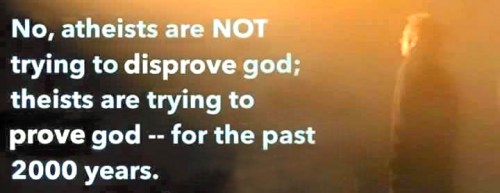
religion God evidenceBefore I attempted to write about this graphic (found, as always, on an Internet atheism community), I went to Dictionary.com, to look up the meaning of “evidence”:
1. That which tends to prove or disprove something; ground for belief; proof.
2. Something that makes plain or clear; an indication or sign: “His flushed look was visible evidence of his fever.”
3. Data presented to a court or jury in proof of the facts in issue and which may include the testimony of witnesses, records, documents, or objects.

Based on that, please consider these facts:

The Earth: How did it come to be that this planet we live in is so perfectly attuned to support life – and not just one species of life, but millions? Even the size of this planet and its distance from the sun are just right to make our existence possible. Who did this? Elvis? Justin Bieber?

The universe: our solar system and who knows how many thousands of others. Our galaxy and innumerable other galaxies. Black holes, stars, comets, etc., etc. Has even a genius like Stephen Hawking told us who created it all?

“Through my scientific work, I have come to believe more and more strongly that the physical universe is put together with an ingenuity so astonishing that I cannot accept it merely as a brute fact,” wrote former University of Adelaide theoretical physics professor Paul Davis in his book The Mind of God.

Our consciousness: In The Case for a Creator, former journalist Lee Strobel interviewed many scientific minds and noted “many scientists are concluding that the laws of chemistry and physics cannot explain our experience of consciousness”.

Indeed, Strobel quotes philosopher Michael Ruse who conceded “no one, certainly not [believers in Charles Darwin’s theory of evolution] seems to have any answer” to the question of the origin of human consciousness. Hmm…it’s starting to look like God did it.

Beyond these questions, I showed the graphic that sparked this essay to a wise pastor. Here’s a little of what Ross Carkner had to say:

“The twin towers of New York City’s World Trade Center were made of tons of concrete and miles of steel, the best that we are able to build. Thousands of people depended on those buildings every day. They trusted their lives in the strength of the towers; but it was insufficient.

“Even the tried, tested and true in the physical world — the very things that we live in, work in, travel in are all quite capable of letting us down. Can I then say I do not believe in buildings???”

Then there’s the question of personal experience. Ross writes:

“My experience [of God] may not be evidence enough for you, but then again it might. [In fact,] my experience is considered acceptable evidence in court — it forms my witness while on the stand.”

So an atheist like Dan Barker may not have any evidence for the existence of God, but Ross Carkner does in his own life story. That evidence is credible enough to be used in court trials.

If you wonder whether there’s a God, is that fact credible enough to make a difference to you? What about our Earth, the universe and YOUR consciousness? Post your thoughts below and let’s have a conversation.

Read Full Post »

thinking, religionWhen this graphic (posted on an Internet atheism community) caught my attention, the first thing I thought was: Religion? Yech.

I’ve written often about the poison of “religion”. Not the dictionary version, which few people in our culture understand or care about. No, I’m writing about the version that most people think of as soon as the word is mentioned:

  • People who are smug and judgmental.
  • People who don’t really care what happens to others who aren’t in their religious group.
  • People who are happy to welcome others into their group/church, as long as THOSE people change themselves to fit in.
  • People who spend their time being angry, paranoid and opposing things, rather than supporting anything.
  • People on TV who promise wealth and a good life as long as you send them money.

I follow Jesus of Nazareth (who many people believe is the Son of God), so I want nothing to do with this “religion”. Indeed, He doesn’t either. In the four original-source biographies of His physical life on earth, some of Jesus’s most passionate words are against smug, arrogant, rule-obsessed “religious” leaders.

So what about the “thinking” part of this graphic? It’s easy to assume it’s true because in our culture, thinking people of faith are generally ignored by the media. Indeed, some of them may face such opposition to their faith in Jesus that they keep it hidden.

But they are out there. Here are just a few examples of these faith-filled thinkers, listed on Wikipedia:

Rosalind Picard (born 1962) is a Professor of Media Arts and Sciences at the Massachusetts Institute of Technology in the U.S. She’s also founder and director of the Affective Computing Research Group and co-director of the Things That Think Consortium. Picard says she was raised an atheist, but decided to follow Jesus as a young adult.

John Lennox (born 1945) is a mathematician, philosopher of science and pastoral adviser. His books include the mathematical The Theory of Infinite Soluble Groups and the faith-oriented God’s Undertaker – Has Science buried God?

Father Andrew Pinsent (born 1966), a priest, is the Research Director of the Ian Ramsey Centre for Science and Religion at Oxford University in England. He is also a particle physicist.

These three highly respected people think, therefore they are people of faith. This suggests the graphic that inspired this essay has little to do with reality. In the end, your level of intelligence has nothing to do with whether you believe in God and His Son.

Whether you believe in God and His Son has EVERYTHING to do with humility. A willingness to admit you don’t have all the answers (and never will, in this life); you don’t understand everything (and never will, in this life); and a realization that your life can be better, right now, because you believe in a loving God who offers this broken world the gift of His Son.

What do you think? Post your thoughts below and let’s have a conversation.

Read Full Post »

PROOFHooo, boy. There’s a lot to unpack in this graphic, isn’t there?

Kindly presented by an Internet atheist community, I grabbed it because it presents such a wonderful opportunity to tell you the truth about the creator and master of time, space and the universe.

1.  If there were proof that a god exists, atheists would be denied the freedom to claim that God doesn’t exist. And if God has proven anything over the centuries, it’s that He’s all about free will.

Want proof? One of the early followers of Jesus of Nazareth (who many people believe is the Son of God) said “God wants everyone to be saved and to fully understand the truth.” That’s right, God wants everyone to be saved. He doesn’t force a single person. It’s up to us.

Another ancient writer goes further: “Today you must decide who you will serve … But as for me and my family, we will serve the Lord.” See? More free will. In fact, the entire existence of atheism is proof of free will.

2.  Like it or not, God wants us to come to Him in faith. The evidence comes from one of Jesus’s early followers: “Without faith no one can please God. Whoever comes to God must believe that he is real and that he rewards those who sincerely try to find him.”

So the very thing that many atheists hold in contempt is the very thing that God is all about. He wants a relationship with free-thinking people. He’s not interested in programming soulless robots to do His bidding because no matter how you look at it, that’s NOT a relationship.

3.  The “facts” that “could be repeated, tested and demonstrated” is for logic and mathematics, not for the creator of time, space and the universe. As Matt Slick puts it on the Christian Apologetics and Research Ministry website:

How do you “prove” there is a Great Being outside of our universe? Do we look for footprints in a riverbed? Do we examine evidence under a microscope and say, “A ha! There’s God!”? That would be the wrong approach. If God exists, He would be beyond our universe, non-material, and transcendent.

For me, the evidence of God is the universe. No God means no universe, no Frank’s Cottage, no you or me.

For me, the evidence of God is Jesus. Original-source biographies of His physical life on earth refer to Jesus as God’s Son at least four times. There’s no provable reason to believe that’s not so.

For me, the evidence of God is the set of morals that are common to a majority of people on this planet.

Where did these morals come from? How do we really know that it’s wrong to kill, to rape, to steal, to lie, to defraud, to cheat on our spouses?

Why are these moral absolutes? Because they were implanted inside us by our creator. And we clearly see what happens when these implants are ignored (see: ISIS, the Taliban, Nazi Germany, the Pol Pot regime, Josef Stalin and whoever has committed the latest mass murder).

So what do you think….do I, as a follower of Jesus, have a fiction that I simply want to believe? Yes or no, post your thoughts below and let’s have a conversation.

Read Full Post »

Sin Eater 11.15While on a plane flight, I watched an episode of the American TV crime drama “The Blacklist”, staring the brilliant James Spader.

Besides enjoying the taut suspense, I was intrigued by an apparent power that Spader’s character had: he could suppress the terrible memories of people he wanted to protect.

“I’m a sin eater,” he tells co-star Megan Boone, who portrays a deeply troubled FBI profiler, in a 2015 episode. “I absorb the misdeeds of others, darkening my soul to keep theirs pure. That is what I’m capable of.”

How’s that for an amazing ability? Imagine if a real person could do such a thing? It certainly didn’t make Spader’s character, FBI fugitive Raymond Reddington, a happy person. So would a real life person use such a power?

Well, prepare yourself for a little controversy because a real person DOES have that power and uses it all the time.

His name? Jesus of Nazareth, who many people believe is the son of God.

Stick with me while I explain.

More than 2,000 years ago, Jesus was physically on this earth, walking around Israel with a band of rag-tag followers and telling anyone who would listen that God was not a far-off, angry entity.

He was (and is) in the hearts and minds of anyone who would welcome Him, passionately loving that person and offering them an eternal place in Heaven.

The problem? This perfect God could not, and cannot, stand the “sin” that you and I commit. That means the wrong things we do every day and the right things we fail to do every day. That means turning our backs on God and living like He doesn’t exist.

God sent Jesus to fix that through an extraordinary process: Jesus, who was (and is) as perfect as His Father, became our sin eater, absorbing our misdeeds and taking the punishment for them by dying on a Roman cross.

Anyone who believes in Jesus and follows Him has their sins absorbed and their soul made pure through his sacrificial death and resurrection three days later.

This means when this life is finished and His followers appear before God, the wrong things they’ve done and the right things they’ve failed to do are wiped out. Jesus followers are as pure in God’s eyes as Jesus Himself.

This strikes me as a pretty good deal. That’s why, after much consideration, after reading many books and after debating with some brave Jesus followers, I decided to accept that deal.

So Jesus lives in my heart and mind. The more I listen to His leading, the better my life is.

This same deal is available to you, no matter what you’ve done (or not done), no matter how dark (or light) your soul may be.

Interested? Yes or no, post your thoughts below and let’s have a conversation.

Read Full Post »

What About Money? Usually, when I encounter graphics on internet atheism communities, they’re created by people who know the Bible as well (if not better) than many Jesus followers.

Sadly, whoever is responsible for this one is an exception.

The actual quote, from a section of the Bible called ‘1 Timothy’, goes like this: “For the love of money is the root of all evil.”

Now I’m not surprised that this truth was misstated. Many of us have heard it put exactly how it is in the graphic. But I’m sure you can see the significant difference.

Money never has been and never will be the root of all evil. Jesus of Nazareth, who many people believe is the Son of God, never said it was.

But He did state this, in an original-source biography of of His physical life on earth: “You cannot serve two masters at the same time. You will hate one and love the other, or you will be loyal to one and not care about the other. You cannot serve God and money at the same time.”

Whether or not you care about Jesus, His point is absolutely worth considering. Do you ‘serve’ money? When all is said and done, is it the driving force in your life? Is it the driving force in mine? It’s a good question for us to consider frequently because the more you love money:

  • The more you’ll do to get as much of it as possible.
  • The more you’ll sacrifice in your family and personal life.
  • The more you’ll turn a blind eye to the wrong things you do (and the right things you fail to do).
  • The more you’ll listen to people who are similarly driven to get more.

Think about all these things.

The accurate Bible quote about money that I mentioned above kinda negates the question posed in this graphic. But I’ll tackle it just the same.

Churches ask for money because it’s mandated in ancient documents. One of the four accounts of Jesus’ physical life on earth (may people believe He is still here, in spirit), notes this scene:

“Jesus looked up and saw some rich people putting their gifts to God into the Temple collection box. Then he saw a poor widow put two small copper coins into the box. He said [to his followers], ‘This poor widow gave only two small coins. But the truth is, she gave more than all those rich people. They have plenty, and they gave only what they did not need. This woman is very poor, but she gave all she had to live on’.”

Note two things about this excerpt:
1.  Jesus has nothing negative to say about giving to a “religious” institution.
2.  He makes a very clear point about what giving really means.

Beyond churches needing money to keep the lights on and (in Canada, where I live) the winter snow out of the parking lot, churches ask for money to do good.

For example, the church I attend has a million-dollar annual budget to support more than 20 non-profit organizations. These organizations supply food to the hungry, help troubled teens, provide emergency disaster relief, support churches in the developing world and much more.

Most churches that are truly committed to following Jesus are just like mine. God loves everyone — including the atheist who created the graphic that inspired this blog — so churches and the people who attend should show the same love.

Do we fall short on this? Absolutely. But please remember: churches are not museums for saints; they’re hospitals for sinners.

As far as I can see, every person on this planet is a long way from perfect. But by following Jesus and allowing Him to work in your life, you can come closer to sainthood. Interested? Yes or no, post your thoughts below and let’s have a conversation.

Read Full Post »

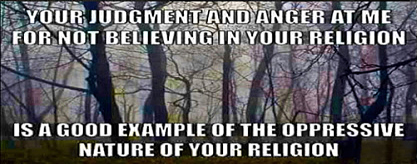
When I first saw this graphic, generously shared on an atheist internet community, my first reaction was “Hmm…wonder where I could buy a great shirt like this?”

I’m a person of faith who knows the world needs a cure for “religion”. You know, all that stuff that says you can torture, rape and kill ‘unbelievers’. (Or worse still, people who leave my “religion” for another “religion”.)

Am I overstating it? Then let’s examine the “religious” part of just one faith, Christianity. You may have experienced it:

  • People who appear to have it all together sitting in cold-hearted judgement of others.
  • People who sniff their disapproval of those with tattoos or nose rings.
  • People who claim they welcome others to their churches — as long as those people fit in, ’cause hey, we’re certainly NOT going to change for YOU.
  • People who seem to spend more time angrily opposing things than lovingly offering an alternative.

All this is how I see “religion”.

Is there a cure? Absolutely, but it’s controversial. It’s Jesus of Nazareth, who many people believe is God’s divine Son.

Still with me, but wondering what the heck I’m writing about? Good.

During His physical time on earth, Jesus had little use for the rituals of “religion” and the self-righteous, soulless lives it so often produces.

In  one of the four original-source biographies of Jesus’ life, He says this to people like you and me: “Burned out on religion? Come to me. Get away with me and you’ll recover your life. I’ll show you how to take a real rest. Walk with me and work with me—watch how I do it.”

In his book The End of Religion, Canadian pastor Bruxy Cavey writes “Notice how Jesus is not pointing toward a different and better religion, but instead He invites us to Himself as an alternative to the weary way of religion.”

Exactly. That’s the thing you might not know: being a Jesus follower isn’t about a religion. It’s about a person and how you and I can have a relationship with Him that starts in this life and stretches into eternity.

That means no guilt-induced rituals that create nothing but spiritual fatigue. It also means thoughtfully, consciously turning away from the elitism of “us versus them” and the smugness of judgmentalism.

When people honestly, humbly come to Jesus, they come knowing they are every bit as imperfect as the people they are tempted to judge. They come with the realization that it’s them who must change.

That was the case for me when I decided to believe in and follow Jesus at age 42. And it’s made me a better person.

Do you want to be a better person without the shackles of religion? Then check out Jesus, because He tells everyone who will listen that “anyone who drinks the water I give will never be thirsty again. The water I give people will be like a spring flowing inside them. It will bring them eternal life.”

Sound interesting? Yes or no, post your thoughts below and let’s have a conversation.

Read Full Post »

ImpressingYourselfWhen I encountered this graphic, posted on Facebook by a cousin, the rusty cogs in my mind started to creak.

Will people judge me (and you?) Absolutely. Like it or not, ALL of us judge — each other, what we watch on TV or the Internet, what we hear on the radio, what we read in tweets, Facebook posts or text messages.

We judge (often without realizing it) words, appearances, clothing, hairstyles, actions, possessions — you name it. There pretty much isn’t anything we don’t judge (or assess, if you prefer that term).

There’s something I found that addresses this tendency and provides wise words that can serve anyone well.

Don’t condemn others, and God won’t condemn you. God will be as hard on you as you are on others! He will treat you exactly as you treat them.” (From one of the original-source biographies of Jesus of Nazareth, who many people believe is the Son of God).

Most of us have heard the first part (another translation phrases it like this: judge not, lest you be judged), but the second part is just as important. Since all us judge, the key is HOW do we judge? Is it with wisdom, maturity and compassion?

As a Jesus follower, I know that’s how I want God to judge me when this life is finished. So I should be asking His help to make me the right kind of judge.

What about the rest of the graphic? Does it really make sense to live your life to impress yourself? What does that really mean?

For some people, it might mean impressing yourself with a big house, vehicles that make your neighbours drool with envy and at least one ridiculously large flat-screen TV.

Other people might look in the mirror and be impressed with what they see if they have a trophy wife (or husband) glued to their arm like eye candy.

What about careers and professional achievement? Does the title “chief executive officer”, “chairman of the board” or “PhD” on a business card impress you?

One of the reasons I follow Jesus is because I know that the Creator of time, space and the universe is so NOT impressed by the things that our culture considers impressive.

Another ancient prophet points out this life-changing truth: “People judge others by what they look like, but I [God] judge people by what is in their hearts.”

What’s in my heart? Like most other people, I can be petty, jealous, resentful, lazy and self-centred. That’s why I believe in, and follow, Jesus.

By following Jesus, I give Him permission to come into my life and begin a transformation — making me more like Him and less like the world. So I’m slowly becoming LESS petty, jealous, resentful, lazy and self-centred.

And because I follow Jesus, when my life on this earth is done and I go to meet God, He won’t see my faults. He’ll only see His Son’s perfection. And I’ll be welcome into Heaven to spend eternity with Jesus.

Does this sound attractive? Yes or no, post your thoughts below and let’s have a conversation.

Read Full Post »

Saying YES Jesus prayWell, how’s THAT for a challenging graphic?

And, as if the words aren’t tough enough, the person who posted the graphic in an internet atheism community added this note: “Remember: God LOVES them, just not enough to help. It’s really OUR fault…”

Stay with me while I unpack all this and, if I do a decent job, point you in an entirely different direction.

1.  Jesus of Nazareth (who many people believe is the Son of God) didn’t say “no”. He turned to his followers and told us He wants to work through US to say YES.

That’s why there are organizations like Samaritan’s Purse, World Vision, Compassion, International Justice Mission, Food For The Hungry, Christian Medical & Dental Associations and many more.

These organizations provide emergency food, water and shelter after disasters; medical/dental care in desperately poor developing nations; agriculture training for impoverished farmers; basic literacy and vocational education for women.

Some Jesus-following organizations rescue people from slavery and sex trafficking, others put their staff at risk fighting life-threatening diseases like Ebola.

The work of these aid organizations is ongoing and never-ending. In other words, it’s Jesus saying YES, again and again and again.

2.  After reading #1, does it really sound like God loves them, just not enough to help? Really?

3.  The atheist commenter is right: In many, many ways, it’s really OUR fault.

  • WE support economic systems that keep rich nations rich and and poor nations poor.
  • In developed nations like Canada, where I live, WE come up with justifications for greed like “let’s help our poor before we help the poor elsewhere”. Then we DON’T help because “I pay taxes for government social programs to help them.”
    Not only is that ridiculous and stone-hearted, it also ignores the FACT that being poor in countries like Canada, the United States, Britain, France, Sweden, Australia, etc. is NOTHING like being poor in Haiti, Senegal, Somalia, Afghanistan, Zimbabwe, etc. There’s simply no comparison and no explanation should be necessary.
  • It’s really OUR fault (I’m referring to humanity in general, as opposed to God’s fault) because so many of the politicians, business leaders, bureaucrats and army leaders in struggling countries are horribly corrupt. They simply don’t care if their people are starving.

4.  So after reading all this, maybe you’re thinking “why doesn’t God just fix all this?” Sometimes, I think that too. Then I remember the precious gift of freewill. God gave it to us and human history has proven that He rarely interferes with that gift. No matter how badly we misuse it. Part of the reason for that gift is God wants to have a relationship, through His Son, with free-thinking people like me, YOU and every other human.

I decided to say YES to that relationship because it’s made my life better now and, when this life is finished, it’ll give me eternity with Him in Heaven.

What do YOU say to that relationship offer? Accept or reject, post your thoughts below and let’s have a conversation.

Read Full Post »

« Newer Posts - Older Posts »