Feeds:
Posts
Comments

Posts Tagged ‘Frank’s Cottage’

Bill Cosby. Lance Armstrong. Mel Gibson. Tiger Woods. What do these people have in common? All of them achieved fame in our culture. And all of them turned that fame into notoriety. Consider the facts:

  • Actor-comedian Bill Cosby has been a star since the 1960s. Thanks to the astounding eight-season, award-winning success of TV sitcom The Cosby Show, he became known as America’s favourite Dad.
    Then the accusations started – at least 20 women claimed to have been sexually assaulted by Cosby over a period of many years, sometimes after he drugged them. He was set to likely spend the rest of his life in prison, until being released on a technicality in 2021.
  • Mel Gibson was one of the most handsome, popular and successful actors on the planet (ever heard of the Lethal Weapon movies? Braveheart?) when allegations of racism and domestic violence, coupled with drunk driving arrests, destroyed his reputation.
    He was shunned in Hollywood for a decade, only making a comeback through directing 2016’s Hacksaw Ridge.
  • Tiger Woods is still trying to regain the form that made him far and away the best and most popular golfer on earth. It all went south in 2009 when his marriage to Elin Nordegren exploded in very public allegations of serial infidelity. Several high-profile sponsors dropped him.
  • Lance Armstrong gained worldwide fame and adoration for winning seven Tour de France cycling titles and creating the multi-million-dollar Lance Armstrong Foundation, which funds the fight against cancer.
    When allegations of long-term performance-enhancing drug use were proven in 2013, Mr. Armstrong was stripped of his titles and several major sponsors dropped him. He also resigned as chairman of his foundation.

All these men have their pictures in what might be called the Hall of Infamy. All were what the The Globe and Mail newspaper labelled “demigods” who fell flat on their faces and enraged their fans, who thought they could do no wrong.

What’s so interesting is the lesson we can learn from these men is as old as humanity. And it seems every generation has to learn it.

Consider what Jesus of Nazareth (who many people believe is God’s Son) told some of His followers: “Fake Messiahs and lying preachers are going to pop up everywhere. Their impressive credentials and dazzling performances will pull the wool over the eyes of even those who ought to know better.”

I get what Jesus is saying because I’ve had the wool pulled over my eyes. Years ago, I trusted an author to have found the secret to living with grace and serenity – until I found out she was a bigamist juggling a lie-filled double life. I got rid of her books after that.

So who can you and I believe in who’s not going to leave us dangling off the cliff of crushing disappointment and betrayal? Who can we trust who really does have our best interest at heart, who understands everything we’re going through and won’t leave us, no matter how bad things get?

How about God, who offers the gift of Jesus to every person on this planet?

Read Full Post »

In my younger years, I was sure that two kinds of people made up a vast majority of North American Christianity: children who were too young to know any better and seniors too old and frightened to think clearly.

Yes, I knew it all – and without the annoying, time-consuming bother of checking out the claims of Jesus of Nazareth (who many people believe is the Son of God) or having any meaningful conversations with Jesus followers. All the knowledge I needed came from superficial newspaper articles or scornful remarks by equally ignorant friends and family members.

This ‘approach’ to faith went far beyond me. Consider these words, written in 2011 by blogger Chelsea Hoffman: “Atheism isn’t so bad; you don’t have to feel guilty for hanging up your entire existence on the idea that you’re being watched and judged by an archaic deity that is universally accepted among the science community to not even exist.”

The truth, as I’ve found out since becoming a Jesus follower in 2002, is startlingly different. Wikipedia lists a whopping 24 living scientists who stand in direct opposition to Chelsea Hoffman’s sweeping pronouncement.

And just in case you think – as I might have 10 years ago – that they’re all doddering seniors, consider just these two: Physician-geneticist Francis S. Collins (famous for helping to map the human genome) was only 56 when he published the 2006 bestseller, The Language of God: A Scientist Presents Evidence for Belief.

Collins, the former director of the National Institutes of Health in the United States, wrote, “Science is not threatened by God; it is enhanced” and “God is most certainly not threatened by science; He made it all possible.”

Astronomer Jennifer Wiseman is chief of the ExoPlanets and Stellar Astrophysics Laboratory in the Astrophysics Science Division at NASA Goddard Space Flight Center (wow!). She is also director of the American Association for the Advancement of Science’s Dialogue on Science, Ethics, and Religion.

I couldn’t find out Wiseman’s birth date, but she earned a Ph.D. in Astronomy from Harvard University in 1995, so she’s likely in her early 50s. Wiseman has commented on movies from a Jesus perspective, and written about how to encourage young Jesus followers in science. (You can find both online.)

She notes, “Churches and Christian schools are sometimes heavily influenced by the perception that Christianity and scientific processes (e.g., Big Bang cosmology, evolution, etc.) cannot mix, and that Christians must always have a ‘defensive’ stance toward science. This is tragic because our Christian friends can miss out on rejoicing in some of the discoveries that reveal God’s glory and creativity.”

I wish I’d known, before 2002, about Wiseman, Collins and all the other brilliant minds doing scientific work while having a fulfilling relationship with the creator of the universe and His Son. It might have changed my life much earlier.

Does this knowledge make any difference to you? Type your thoughts below and let’s have a conversation.

Read Full Post »

While on the Internet the other day, I found a website that discussed the problem of young people abandoning the Christian church.

Interesting stuff, but what really grabbed my attention was this comment made by an anonymous reader:

Christianity is based on a leap of faith, right? Islam is based on a leap of faith, right? All religions have no empirical proof and are based on a leap of faith. How then can one religion possibly claim that any other religion is wrong, since they are all based on the same leap of faith?

Perhaps you agree with these thoughts. I can write, quite easily, that I’ve never had a problem with the lack of “empirical proof” in Christianity or any other faith. Do you really think this is an accident? I don’t. Consider this: If we had empirical proof of God’s existence, wouldn’t that deny our freedom to be atheists?

If I know anything about God, it’s that He has a rock-hard commitment to free will. That means you and I can deny His existence or, even more dramatic (and sad….), we can commit unspeakable evil in His name. And, to the casual, superficial observer, we can do it without any sort of penalty. We can also do extraordinary good in His name and live lives of amazing influence and value. I think the late, great Mother Theresa tops that list.

What about one faith group claiming to be exclusively right? The faith I belong to certainly advances that point of view. But that’s not something conjured up on a whim; serious followers of Jesus of Nazareth trust in the words He tells his followers “I am the way, the truth, and the life. The only way to the Father is through me.”

Am I supposed to ignore that? Was Jesus just a little full of himself that day? If I go down that path, then Jesus becomes nothing more than a cool dude with some good ideas. Maybe that works for some people, but it’s hardly the basis for a faith that’s going to help people like me deal with our faults and seriously consider what happens after this life ends.

Serious Jesus followers are not interested in occasionally checking in with a funky guru; we want a transformed life, now and after this existence is done. In our better moments, we want to leave behind the “it’s all about you” mentality of our culture; that’s a point of view that discourages thinking about serious issues and insists “whoever has the most toys (when he/she dies) wins”.

In your better moments, do you also see the emptiness of this kind of thinking? Post your comments and let’s have a conversation.

Read Full Post »

Is God male or female? Does it matter?

It certainly did to a blogger with Australia’s Sydney Morning Herald. I stumbled upon one of Lawrence Money’s essays, called “We need to upgrade God”, and am fascinated by the points he made.

Money read an article about an unspeakably sad funeral of a two-year-old Australian girl. He reacted ferociously to the story’s mention of a sign that hung on the wall of the church that said Our God Reigns From Above With Wisdom, Love and Power.

“Surely if the God above had such wisdom, his power would have been be used to protect such an innocent life,” he wrote. “And love? You create a little life, allow just enough time for her family to embrace her, then sit by and watch her slaughtered. That’s some weird kind of love.”

Money pinned the blame for all this on the fact that God is usually seen as a male. “Would a female God, who gave her only begotten daughter, have allowed such atrocities? I doubt it,” he wrote.

In the end, he declared “I’d like a female god, please. I want an upgrade.”

I understand where Money is coming from. Sometimes, when I look at our broken world, it seems so many problems are rooted in the male gender.

But should I, or Money, be attributing human (male or female) weaknesses to the creator of the universe? Doing so would reduce God to little more than a Clark Kent-style superman (or woman). That’s why I don’t think the issue of gender is worth debating.

So then, what about God allowing the murder of children or terrorist attacks or the flourishing slave trade?

Money believes a God of wisdom, power and love would stop such horrors in their tracks. Okay, let’s suppose God does what Money demands. What then?

  • Should He stop marital infidelity? (It does lead to broken families, psychological trauma and sometimes murder.)
  • What about speeding? (It often causes accidents and death.)
  • Shouldn’t He also take away beer and wine? (They contribute to alcoholism, broken lives and death.)

Where should it stop, Lawrence? All these things come from a gift of freewill – a gift that many people believe God proved for all time when He allowed the political and religious authorities of the day put His Son, Jesus of Nazareth, to death.

Do you really want God to take back that gift? Do you want to be a robot? Because without freewill, we’re just a race of goose-stepping, brain-dead automatons.

Yes, without freewill, we would not turn our backs on God, His gift of Jesus and His plan for each and every life. But the evidence makes it clear that God is not interested in such a soulless and unhuman arrangement. He wants a real relationship with us that we’ve entered with our minds and hearts fully aware and alive.

Do you want that kind of relationship? Yes or no, post your thoughts below and let’s have a conversation.

Read Full Post »

In 2012, I stumbled onto an amazing online article about – get this – Germany finally paying off its war debt. Think that’s amazing? Well, hang on; the article was referring to Germany’s *First World War* debt.

According to The Local, a German online newspaper, the final payment, about $94 million, was handed over in 2010 to private investors. Those investors held bonds issued by the German government many decades ago to help pay for damages the victorious Allies charged Germany after the First World War ended in 1918.

That initial bill? A stunning 132 billion Deutsche Marks, or 89 billion Canadian dollars. Does that sound onerous? Well, in today’s world, a comparable figure is more than $200 billion. Yikes.

At the time, the cost was crippling to the German economy and that’s just how the bitter Allies wanted it, in part to ensure Germany could never recover enough to re-arm and start another war. No comment is needed on the success of that policy.

But something did strike me as comment-worthy and that’s the comparison with my life and yours.

Like it or not, we’ve all done wrong somewhere, sometime in our lives. In fact, I’ve dropped the ball more often than National Hockey League star Sidney Crosby scores goals.

Like it or not, there’s a penalty to be paid for all those bad things you and I have done or, just as important, the good things we haven’t done. And that penalty is far worse than what was forced on Germany. Even 90 years of payments wouldn’t be enough to get rid of it.

I don’t know about you, but the last thing I want to do, when this life ends, is look God in the face and try to avoid that debt by conjuring up a pile of believable excuses. It’s just one reason why I decided to follow Jesus of Nazareth. And it’s a good reason for you to consider it.

People like me believe Jesus is God’s Son and He died for all the wrong things we did and for all the right things we failed to do. When we believe in Jesus and claim Him as our savior, the penalty is wiped off the books. He paid it for us.

I found this proof in a letter written by a man who had a life-changing spiritual encounter with Jesus: “If you belong to Christ Jesus, you won’t be punished. God’s Holy Spirit will give you life that comes from Christ Jesus and will set you free from sin and death.”

That sounds pretty good to me. So, are you thinking about how to rationalize your misdeeds? Or does it make more sense to join folks like me, claim Jesus for yourself and walk away from a German-sized debt?

Read Full Post »

I almost missed the irony. There I was, at my car dealership, pondering a Thanksgiving blog while mentally fuming about the repair cost and what I thought was the endless wait for my Ford Focus.

Finally, a few synapses in my brain connected and I grudgingly admitted how thankless I was for having a career and the resources to buy and maintain a vehicle.

Famed novelist Aldous Huxley (best known for Brave New World) once said “Most human beings have an almost infinite capacity for taking things for granted.”

I think I’m a charter member of that group.

Journalist Robert Brault notes, “There is no such thing as gratitude unexpressed.  If it is unexpressed, it is plain, old-fashioned ingratitude.”

Wow, I have a gold-plated, lifetime membership to that club, too.

This past summer, my wife & I visited an RV dealer to inquire about repairs to our two-year-old, storm-damaged tent trailer. While there, we happened to check out some new models on the showroom floor and fell in love with a trailer which didn’t have to be put up and taken down, and came with the luxury of a full bathroom.

Were we grateful for the tent trailer we already had? Are you kidding? We talked about that showroom model for weeks, examining potential payment schemes, considering our other  financial obligations, how much we could get in trade for the tent trailer, how much longer and more comfortable our camping season could be, and on and on.

Gradually (I think the glaciers lost a few inches while this process meandered along), we concluded the purchase didn’t make sense and the tent trailer was quite adequate. Indeed, we used it in September for a wonderful week of mountain camping.

What happened to us? For awhile, we bought into the message our culture pushes with hurricane-like relentlessness: You deserve it. Go ahead and be selfish.

This message suggests we should have everything. Now.  No matter what the financial, relational, or environmental cost. Because we’re worth it. And – goes the subtle inference – since we’re worth it, why should we be grateful?

My commitment to following Jesus of Nazareth (who many people believe is the Son of God) tells me that, on my own, I don’t deserve it. I drop the ball more often than a bad outfielder. I’m worse than a blindfolded darts player when it comes to hitting the target of what I’m meant to be.

But consider this excerpt from one of the primary source documents about Jesus: God loves the world [that includes me and you] so much, “He gave his Son, His one and only Son. And this is why: so that no one need be destroyed; by believing in Him, anyone can have a whole and lasting life.”

This means Jesus, God’s son, makes up for all my screw-ups, all my pettiness, all my selfishness. And by following Jesus, I’m opening the door to Him making me a better person.

So, when my wife and I sit down for Thanksgiving dinner, we know we have a lot more than a tent trailer to be grateful for. And we’ve figured out to whom we should express thanks. Have you?

Read Full Post »

Is this a story of doom and gloom? Or something else altogether?

The article, on CNN’s Belief Blog, recounts the results of an international census study by a team of mathematicians. The study concludes, “Organized religion will all but vanish eventually from nine Western-style democracies.”

Those countries, according to the mathematicians, are Ireland, Canada, Austria, the Czech Republic, Finland, Switzerland, Australia, New Zealand, and the Netherlands.

The study’s authors base their report on two assumptions:

  1.  It’s more attractive to be part of the majority than the minority and in the countries named, people who are not part of any organized religion are the fastest growing group.
  2.  In these nine countries, there are “social, economic and political advantages” to being unaffiliated with any organized religion.

What attracted me to this article is the whole idea of belonging to an “organized religion”. I don’t think I’m stating it too strongly when I write that those two words are even less popular than “tax increase”.

And I have a pastor to back me up.

Ross Carkner, of Whitby Baptist Church in Ontario, told me this study isn’t even mildly alarming.

“You could be talking to a real Jesus follower and ask them about organized religion and they’d say ‘I’m not interested’. So I’m not in the least bit concerned.”

There’s something else at play in this study, something the authors don’t bother to consider. They seem to assume that being part of a religious group is the same as belonging to the Kiwanis Club or a lawn bowling league. For some people, that may be the case and they might, indeed, drift out of “organized religion” based exactly on the authors’ two assumptions.

But were those people ever really part of a faith group? For serious Jesus followers like the ones Ross was referring to, it doesn’t matter how popular the group is because it’s not about the group. It’s about a living, day-to-day relationship with God through His son, Jesus. And that transcends any popularity contest or sociological label.

I would be a pretty sorry Jesus follower – and a despicable example to people who don’t follow Him – if I examined the state of my faith, decided it was as solid as Jello, then bailed out.

So what about you? Are you interested in being part of a group? Or are you intrigued by a living faith that transcends groups, disregards popularity, and ignores study results? If you’re reading this because you’re willing to consider the latter, then ponder what Jesus told one audience: “Are you tired? Burned out on religion? Come to me . . . and you’ll recover your life. I’ll show you how to take a real rest. Walk with me and work with me – watch how I do it. I won’t lay anything heavy or ill-fitting on you.”

What do you think? Post your comment below and let’s have a conversation.

Read Full Post »

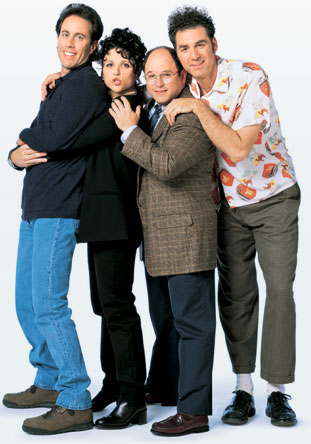
How did I not see this amazing, hilarious, and thoughtful Seinfeld episode when it was first aired?

For a few seasons, Seinfeld – that brilliant, inventive TV sitcom – was a cultural blockbuster, creating catch phrases and situations that millions across North America embraced and used as their own ‘insider’ language.

The episode that fascinates me concentrates, in part, on the relationship between principal character Elaine Benes and her boyfriend, David Puddy.

Benes (played by Julia Louis-Dreyfus) finds out Puddy (Patrick Warburton) is “religious”. This sets up all sorts of conversations between the two, plus other principal characters Jerry and George Constanza.

Here’s a sample of dialogue:

Elaine: I borrowed Puddy’s car and all the presets on his radio were Christian rock stations.

George: I like Christian rock. It’s very positive. It’s not like those real musicians who think they’re so cool and hip.

Elaine: So, you think that Puddy actually believes in something?

Jerry: It’s a used car; he probably never changed the presets.

Elaine: Yes, he is lazy.

Jerry: Plus, he probably doesn’t even know how to program the buttons.

Elaine: Yes, he is dumb.

Jerry: So you prefer dumb and lazy to religious?

Elaine: Dumb and lazy, I understand.

First off, ye gotta love George’s casual dissing of Christian musicians and his breathtaking ignorance. Did you know, for example, that singer/songwriter/guitarist Bruce Cockburn is a Christian? I’ve never heard a single critic knock him for his artistic ability.

Second, the notion of Elaine preferring a dumb and lazy boyfriend to one who is “religious” is not only funny, it’s a remarkably accurate assessment of our culture. From what I can tell, most people would rather spend hours debating the behaviour of the latest Hollywood bad boy/girl than even think about spirituality and life’s big questions.

There’s no doubt that celebrity antics hold the same sort of fascination we feel when we drive past a car wreck. But in the end, does it make any difference in our lives?

Some more priceless Seinfeld dialogue:

Elaine: So, you’re pretty religious?

Puddy: That’s right.

Elaine: So is it a problem that I’m not really religious?

Puddy: Not for me.

Elaine: Why not?

Puddy: I’m not the one going to hell.

Yikes! If any serious follower of Jesus of Nazareth (who many people believe is God’s Son) has used words like this with you, I apologize here and now. It’s no exaggeration to write that anyone who takes his or her faith seriously is never blasé about the fate of friends, family, and loved ones. I’ve eaten veggie burgers that tasted more real than the faith Puddy displays.

Real Jesus followers sacrifice themselves in the same way they believe Jesus took on our failures and misdeeds when Roman authorities hung him on a cross. An ancient document about Jesus says “First we were loved, now we love. God loved us first.”

If you encounter a person who seems somehow different because he/she knows this amazing truth, then you’ve met the real thing and I hope you walk away thinking about your life and your fate.

Read Full Post »

For a few years, I didn’t much like Kiss singer/bassist Gene Simmons. At the time, his epic ego and claims of endless sexual conquests (which, thankfully, we no longer hear about) were major turn-offs.

All that said, I felt like I was downing an ice-cold drink on a sweltering day when I read an article about his 2011 appearance on the U.S. cable TV talk show Chelsea Lately.

Interviewed by host Chelsea Handler, Simmons was surprisingly frank and humble when put on the spot about his sexual infidelities.

With longtime girlfriend (and, since 2011, wife) Shannon Tweed in the audience, Simmons said “I’m damaged goods, and I need Shannon in my life. I need her to fix what’s wrong with me.”

Wow! For a man who has bragged about bedding more than 4,000 women, this confession is simply astonishing. And it opens the door to explore two important ideas.

1. “I’m damaged goods.” Gene, you can take comfort in the fact that you’re not alone. Like it or not, every person on this planet is damaged goods. Every one of us has somehow dropped the ball and missed the target of what we could be.

Looking for proof? Consider this revealing statement from a man who had a deep and life-changing spiritual encounter with Jesus of Nazareth (who many people believe is God’s Son): “Everyone has sinned; we all fall short of God’s glorious standard.”

Oh, our damage may not be as obvious or as potentially hurtful as Gene Simmons’, but please notice that the statement doesn’t address degrees of damage. Why? Because in the end, it doesn’t matter. And that fact alone should keep the rest of us from feeling smug.

2. “I need her to fix what’s wrong with me.” Shannon, are you feeling the pressure yet? I know I would be if my wife made this declaration about me. Think about this: if all of us are damaged, then how is Shannon supposed to ‘fix’ Gene when she has her own failings?

Still, this doesn’t mean Shannon can’t do anything for Gene, just as it doesn’t mean my wife is incapable of helping me.

Serious Jesus followers believe two things: that God cares about every person on this planet, and God can — and does — work through all people, no matter what their issues, to achieve His goals.

When my wife & I got married, our pastor told Lori that I would be the prime resource God would use to repair her hurts and eliminate her weaknesses. Then he told me the same thing about Lori. All the two of us had to do was let God have His way.

So, do you want to let God fix you like he’s fixing me? Then invite His son, Jesus, into your life and let Him have His way. If you’re serious about it, and get hooked up with a Jesus-following church, then you’ll soon start to experience positive changes in your life.

Read Full Post »

After publishing my last essay, Twittering on the Divine, on another website, a reader named John responded with a pointed assertion. I responded and off we went, on a fascinating and, I believe, important debate on the nature of evil.

What do you think of the points each of us raised? Post your own thoughts below and let’s have a conversation.

John
True, it doesn’t make sense to blame God when someone uses their freewill to commit murders. But then it would be incorrect to thank God when governments and aid groups use their freewill to help starving people. So then God isn’t helping at all.

Frank
John, anyone who believes God is not good and doesn’t care about us will find your mindset quite valid. I prefer not to have such a hopeless perspective and my viewpoint is backed up by the fact that God gave every single person in this broken world a gift – Jesus.

My attitude toward God is also framed by this passage I found in the Bible: “First we were loved, now we love. He loved us first.” For me, Jesus is proof of that love and I respond in kind.

John
I can see how the gift of Jesus could account for God’s creation of evil, that is to say God created evil in humans, but he also gave us Jesus so we can redeem ourselves. But I fail to see how that can account for the existence of evils not caused by humans, such as natural disasters or diseases. A father who gives his children expensive gifts is not necessary a good father.

Frank
Thank you for continuing this conversation, John. I’m enjoying the exchange of viewpoints. A couple of things:

1. Did God create evil? As with my last comment, anyone who doesn’t believe God is good and doesn’t believe He cares about us might lean towards that position, but I do not. And the reason can be found in my previous comment.

2. Biblical Christianity – which I accept as true – states we cannot use Jesus to redeem ourselves. Jesus’s death and resurrection redeems anyone who believes in Him and follows Him. Jesus does the redeeming (the ‘heavy lifting’); our obligation is to believe and trust. The difference might be subtle to some, but it is significant.

3. While I cannot explain diseases (if I could, I would be God and that responsibility is a little big for my shoulders), but as for disasters, we humans only call them that because we are in the way when they happen. If nobody is killed and no property/infrastructure is destroyed by an earthquake, do we still call it a disaster?

John
Since evil exists, wouldn’t it have had to been created by something? If God exists and created all, then he would have had to create evil, for if he did not then whence came evil?

Frank
I did some research on your question about God creating evil, so I could answer it credibly. The website gotquestions.org asserts that God did not create evil – it is not a ‘thing’, after all – and evil is simply the absence of good, just as cold is the absence of hot and darkness is the absence of light.

Obviously, God allows evil behaviour to exist and even to flourish. Why? Because if He didn’t, then He would be snatching back His gift of free will. It’s that simple.

In the end, if you want to think about evil being a ‘created’ thing, then it is created by us – you and me, John, when we drop the ball, when we miss the mark of what God created us to be and when we ignore opportunities to do good.

John
I think the analogy between light/dark and good/evil is a flawed one. Darkness is certainly the absence of light, that’s easy. Suppose you put yourself in a windowless room without any light sources, then certainly the room is dark. Darkness is then our zero point, our natural state of the universe.

Now put yourself in the same room and ask yourself: are you doing any good? If you say no, then by your analogy you are doing evil, since it is your zero point evil is the natural state of the universe. I fail to see how sitting alone in a dark room can be evil. I would suggest the zero point is simply neutral, doing no good and no evil, with evil below it and good above it. Hence God created good and evil.

You could say that sitting in the room is doing good since you’re doing no evil. But then we would have to consider good as our natural state and your analogy becomes reversed. Now evil is simply the absence of good, and good was never created, but evil was.

Frank
Let’s consider the light/dark analogy from this perspective, John: evil is the absence of God.

Where God is not acknowledged, where His will for humanity is ignored, where His love for every single person who ever lived – stretching from Osama Bin Laden to Mother Teresa and *proven* through His gift of Jesus Christ – is ridiculed, then evil is the inevitable consequence.

Sometimes, that evil comes from what you’ve referred to as the neutral of simply sitting in darkness. Does that sitting in darkness include the neutrality of doing nothing to stop someone from getting hit by a car? After all, you’re not driving the car and you’re not the dope who stepped on the road in front of it, so you haven’t done anything wrong (or right) by simply letting events unfold, correct?

But our exchange of views is getting very esoteric, John. The bottom line that I was making in the blog was we have been given two extraordinary and costly (for the giver) gifts: free will and Jesus Christ.

We’re free to spit on those gifts through our actions (and inactions), through our stubborn rejection of all that Jesus has done for every single person who decides to believe in and follow Him. Where do you stand on those gifts, John?

John
There’s no doubt that evil CAN come from what seems to be a neutral state, but there’s no doubt that there is a neutral state like sitting in the doctor’s office.
As for now changing the question from good-evil to acknowledging God-evil. Acknowledging God is simply respecting what God has given everyone ie. life, freewill. Now you’re sitting alone in the doctor’s waiting room, you’re certainly respecting everything God has given you. So the absence of evil is acknowledging Gods will, so evil is again shown to have been created.

The bottom line that I’m making in this debate is that if you want to believe in God, you must accept that he created evil. The only way to believe that He did not create evil, is to not believe in God. Which is one of the many reasons I chose a life without a god.

Frank
John, I simply can not and do not agree with your premise. As far as I’m concerned – and I’ve thought a lot about this, and read lots of books & blogs about this – free will is God’s invention and evil is humanity’s “invention”.

If I believed God “invented” evil (rather than allowing it – a significant difference), my life would become superficial and hope-less. That’s the kind of life I see lived by so many people who have no faith and unknowingly follow all the marketing and lifestyle mantras our society pushes on us.

I was fortunate in that I came to see and embrace the gift of free will, and the gift of Jesus Christ, without some sort of huge, often negative event forcing me to re-examine my life. Will that be what it takes for you to do that re-examining? I deeply and sincerely hope not.

John
I have argued well enough to show that if you believe in God, you must accept that He created evil. I can accept that evil is humanity’s creation because I’ve rejected the idea of any god.

If you insist of believing in God, then you must believe he created evil. Which really is a contradiction to your beliefs so, of course, your life would be hopeless since you’re living a lie. That’s the kind of life I see lived by so many people who have faith and unknowingly follow all the ignorant ideals and beliefs religion pushes on us.

Frank
Well, John, I guess we’re going to agree to disagree. I believe we’ve debated well; my hope and prayer is anyone reading these comments will connect with the hope-filled, positive viewpoint.

I hope readers will also recognize that with some spiritual things, there are no absolutely definitive answers. We can know many things about God (thanks to the Bible), but in some ways, He has been – and will always be – a mystery, whether we like it or not. Rather than frustrating me, I find this mystery is an important reminder that God is God and I am NOT.

In the meantime, John, I hope you don’t mind if I pray for you.

Read Full Post »

« Newer Posts - Older Posts »